Tea Reviews
Teas I have drunk, with reviews and future purchases; focused primarily on oolongs and greens. Plus experiments on water.
Tea is one of my favorite drinks (I drink great quantiteas: ~1.8 liters a day): a remarkable variety of flavors, caffeinated but cheaper than coffee and healthier than soda, easily prepared, socially acceptable, with a long & rich history intertwined with geopolitics. I particularly favor greens, oolongs, & ku-ki chas; blacks tend to be too bitter and unpleasant for me1, pu-erh tastes both strange and bitter, while whites strike me as subtle to the point of tastelessness. I sometimes enjoy herbal-teas/tisanes but they are not a focus.
Recommendations
Favorites
My favorite kinds of tea:
-
Tie Guan Yin/Iron Goddess of Mercy
Jade
osmanthus
-
sencha
gyokuro
genmai-cha
Ho-ji Cha (roasted green)
jasmine-flavored
-
Ku-Ki Cha Green Kamakura
-
barley
peppermint/spearmint
green yaupon
Synopsis
If you are getting into teas and don’t know where to start, and want as diverse a set of teas to try as possible, I would suggest (marking unusual ones especially worth trying):2
oolong:
Tie Guan Yin
Huangjin Gui
‘baked’/‘roasted’/‘pine’/‘black’
Imperial
amber
Da Hong Pao
Dancong/Phoenix
Hairy Crab
Wu Yi Rock
milk
Fairy
Flavored:
jasmine
osmanthus
magnolia
ginseng
pomegranate
bittermelon with roasted Tie Guan Yin
green:
Gunpowder
Young Hyson
Green Needle
Chun Mee
Longjing/Dragon Well
Lu’an Melon Seed
sencha/sincha
matcha
gyokuro
tencha
bancha
hojicha
ko-kei cha (not kukicha)
Flavored:
jasmine
GABA
genmai
black: dunno (but flavors worth checking out are: apricot, rose, and peach)
misc:
white: Baihao Yinzhen/White Hair Silver Needle
tea flowers
yellow tea
pu’erh (any)
Kuki-Cha
standard
roasted
sakura-scented
Green Kamakura
Wood Dragon
herbal/tisane:
Holy Basil
barley or buckwheat
chrysanthemum
ginger
ginseng
honeybush
jujube
lapacho
lemon myrtle
mulberry or bamboo
peppermint/spearmint
rooibos
rose hips
tilleul
yaupon
yerba mate
Sources
Upton Tea Imports (pro: wide selection of most teas, good prices, samples available for almost everything, fast US shipping, catalogue, old; con: selection heavily tilted towards black teas)
Yunnan Sourcing (pro: deep unique Chinese selection, excellent prices; con: only Chinese teas, no samplers, shipping expensive & extremely slow from China—although there is apparently a US version I didn’t know about)
Harney & Sons (pro: flavored & mixed teas; con: overall small selection, prices not great)
I order mostly3 from the Massachusetts mail-order loose-leaf Upton’s because they specialize in loose tea (while not all loose leaf teas are good, almost all good teas are sold loose-leaf), I’m a sucker for browsing their catalogue & reading excerpts from books about the history of tea like the Ancient Tea Horse Road, their prices seem pretty reasonable, their selection is broad (they boast of having something like 400 kinds of tea at any time, which I can believe), and they offer small samples of almost all their teas (which is a fantastic way to taste scores of teas without having to buy $20 of each tea which one may not like). In contrast I haven’t been terribly happy with other retailers like the selection of loose teas on Amazon (surprisingly sparse) or Teavana (physically convenient to buy from but quite limited selection & overpriced).
Upton allows reviews if you’ve bought at least a certain quantity, but otherwise your notes are private. This strikes me as a little unfair (a sampler of 10g is more than enough to judge a tea!) and my reviews are a valuable guide to me in ordering, so I keep local copies of my reviews & notes. (Note that Upton’s recycles some listings so a hyperlink may not point where it should.)
Equipment
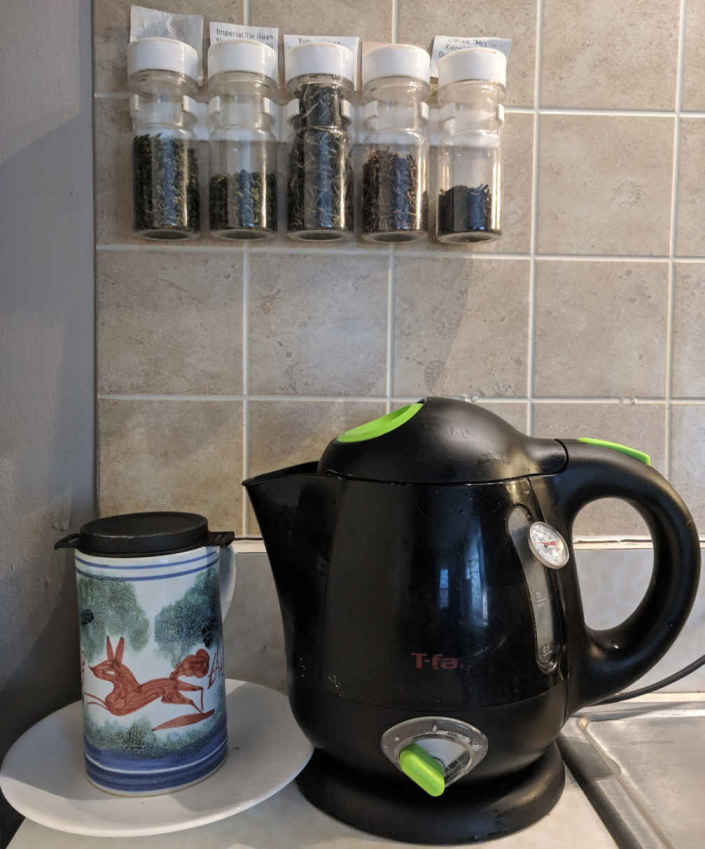
Electric tea kettle, tea mug, and filter
I drink primarily using a Colonial Williamsburg “Beware The Fox” stoneware mug (3-inch diameter), putting the tea in to steep using a Finum medium brewing basket and using ~1.5g of tea for two steeps if possible. The electric tea kettle is a T-fal, with an analogue kitchen/meat thermometer inserted through a hole I drilled for temperature monitoring & control4, as I’ve had bad experiences with the reliability of digitally-controlled electric tea kettles. (My Finum lasted around 5 years before the mesh starts getting clogged enough that it takes an unreasonable time to drain into the cup, especially with the finer green teas; cleaning by soaking in dilute bleach water helps but doesn’t fully restore circulation.)
For travel, I use an insulated thermos mug with built-in brewing basket: “LocknLock Metro Tea Mug Mint 13oz/400ml, Tea and Coffee Mug Cups with Tea Infuser Strainer, Lid and Handle, Double Wall Stainless Steel Vacuum Insulated Travel Tumbler” (~$25). While the brewing basket has too-large holes, it is otherwise a great travel mug—the right size for a single person, not obtrusively branded, and thoughtfully designed with small touches like a rubber non-slip bottom which has saved me more than once from knocking it over or falling off a tiny hotel bedstand.
Origin Story
When I was young, I was a great fan of hot chocolate, but hot chocolate is troublesome to make if you are making real hot chocolate (with milk & everything). I tried coffee once or twice, but it was even more disgusting than beer. My mother would often have over one of her friends and they would drink tea, and, like a kid, I tried to imitate them.
I found herbal teas were drinkable, and I slowly graduated to green tea, with difficulty. Then one day at the grocery store, a my mother bought a Bigelow box set of teas which happened to include an oolong tea.
I instantly fell in love with oolong—not quite as raw and grassy as green tea (which I eventually realized I had been badly oversteeping, in part because herbal teas were immune to oversteeping) but not so bitter & disgusting as black tea, which sometimes makes me nauseous. (Not that green tea is bad; I still liked it, and all my favorite oolongs tend towards the green side of the oolong spectrum. I just prefer oolongs.)
Tea
Oolong
In roughly chronological order:
Tie-Guan-Yin Oolong First Grade (★★★★☆ / ★★★☆☆)
A very nice tieguanyin (which is one of my favorite kinds of oolong). The flavor is straight oolong: in between green and black, with a tiny bit of sweetness. One of the best I’ve had. Handles re-steeping well. (It is largely the same as the second-grade, but the second had a sort of ‘woody’ taste to it that the first doesn’t.)
On the strength of this tasting from 200917ya, I ordered 400g of it in 201214ya to be my standard tea when I ran out of samplers; to my great disappointment, it does not taste as good as I remember it. I don’t know whether my palate has become more demanding or whether the quality has fallen. An online acquaintance happened to order some at the same time, and was very satisfied with it, suggesting the former.
Tindharia Estate Oolong (★★★☆☆)
Nothing memorable.
Bao Jun (★★☆☆☆)
Like the Tindharia, nothing memorable. In fact, this was pretty weak in flavor.
Formosa Heavy-Baked Ti-Guan-Yin (★☆☆☆☆)
Far too bitter and dark and ‘burnt’ tasting!
Formosa Jade Oolong Imperial (★★★★★)
The finest Jade Oolong that we have ever sampled. Those who are looking for the best of what Taiwan can produce will want to try at least the sample size (12 grams).
The first time I ordered a sample, I thought the Imperial was extremely good—one of the, if not the best, oolongs I’ve ever had. But also expensive, so I did not order it again for several years. Again I was struck by the wonderful complex fragrance one inhales as one opens the bag. I wasn’t quite so impressed the second time, having had many more oolongs since then; it is indeed excellent, but I have to stand by my original appraisal that it is too expensive.
Tie-Guan-Yin Oolong Second Grade (★★★☆☆/★★★★☆)
Just slightly woody. Otherwise, a solid good oolong. Downside is that it does not resteep so the price advantage is less than appears.
China Oolong Buddha’s Palm (★★☆☆☆)
Too smoky.
Osmanthus Oolong Se Chung (★★★★☆)
It’s a solid oolong, but the floral taste (I don’t know how to describe the osmanthus flavor) really makes this for me. I like to mix a little of it into some of my other oolongs, though it’s not the best re-steeper I’ve ever had.
This was my default oolong for a long time because 500g was just $18. One of the downsides of buying in such bulk is that the osmanthus fragments exhibited a Brazil nut effect and the last hundred cups were more osmanthus than tea.
Fen Huan Dan Cong (★★☆☆☆)
The description promises a strong flavor, but perhaps I prepared it poorly because the flavor struck me as weak, nor did I particularly notice any peach. I was disappointed; I’d’ve been better off buying some more of the Osmanthus or 1st-grade Imperial.
Season’s Pick Tie-Guan-Yin #132 (★★★☆☆)
A solid oolong somewhere between the Second and First Grade oolongs
Fancy Oolong Imperial (★★★★☆)
Very good; similar to the First Grade Imperial oolong.
Benshan (★★★★☆)
I bought this and the roasted barley tea (see later) from the Rainbow Grocery Cooperative when I was visiting my sister in San Francisco. Benshan is a fairly green oolong and right up my alley, although it struck me as lacking the slight sweetness and floral overtones I expect from the best oolongs. But regardless, it was pretty tasty, and adding a little bit of the barley made the benshan oolong even better.
Iron Buddha from Teavana (★★★☆☆)
Standard oolong; nothing memorable.
Oolong Fine Grade (★★★☆☆); standard oolong
Formosa Amber Oolong (★★☆☆☆); too black-tea-like
Formosa Jade Oolong (★★★☆☆ / ★★★★☆); quite tasty, in the same vein as the First and Second Grade oolongs (although not as good)
China Oolong Se Chung (★★☆☆☆); just as described—too woody for me
Ruan Zhi Thai (★★★☆☆)
I didn’t expect much of a Thai tea, since I’ve never heard of oolongs from Thailand before. To a little surprise, I found it to be a completely normal oolong. Nothing floral to the taste, just a plain ordinary oolong. I would not have suspected you of lying if you had told me it was a Formosan oolong.
Superior Competition Tie-Guan-Yin Oolong (★★★★☆)
Very good oolong. Comparable to the First and Second grade Imperial oolongs, without doubt.
China Oolong Organic Eastern Beauty (★★☆☆☆)
A disappointment; nothing special—the subtle notes are too subtle for me.
Tie-Guan-Yin Special Tribute (★★★☆☆)
Rolled leaf-balls. Similar to the Oolong Fine Grade; but has a somewhat mysterious floral taste I can’t really compare to anything. Doesn’t seem to re-steep very well.
Wuyi Golden Guan Yin (★★☆☆☆)
Loosely rolled long leaves; weak flavor with nothing of interest about it. (I’ll agree with the Upton’s description that it’s not bitter, but calling it ‘sweet’ or having a ‘raisin-like’ flavor is just hyperbole.) Disappointing.
Floral Jinxuan (★★★☆☆)
At first, I thought this was ordinary, but upon resteeping I noticed the promised floral notes—they reminded me strongly of the osmanthus oolong.
Formosa Oolong Spring Dragon (★★★☆☆)
Like the Special Tribute, but weaker in flavor, I think.
“Tea at the Empress” (★★☆☆☆); I picked up this dark blue cylindrical tin of teabags somewhere or other. It doesn’t even specify what kind of tea it is, but apparently it has something to do with a hotel, and claims to be from “The Fairmont Store” (although no item is listed similar to the tin).
It’s not very good oolong. It starts off fairly bitter and doesn’t improve, but at least it doesn’t get too horrible as it resteeps. Regardless, I don’t know where I would get more and I would not get more if I knew.
Empress Guei-Fei Oolong (★★★☆☆)
At 5 minutes of steeping, a pretty ordinary oolong; by 10 minutes, a strong floral taste had developed. Continued steeping made the flavor weaker and bitterer (as one would expect), but no other changes. It reminded me of the osmanthus oolong. During the second tasting, the floral flavor was not as overpowering; I was careful to use the same tsp amount of tea for each of the 9 teas, which suggests that perhaps last time I used too much of the Empress. Not bad at all, I may order it again.
Oolong Choice Grade (★★★★☆)
At 5 minutes, another ordinary oolong, but by 10 minutes, the flavor has not become bitter but rather continued to develop into a very oolong flavor. Little change with re-steepings. In the second tasting, I noted that it was ‘a sharper blacker flavor than Anxi and Empress’. A good oolong, might be a candidate for my ‘standard’ tea (but would need to check prices of the others).
Formosa Oolong Choicest (★★☆☆☆)
The 5 minute steeping tasted both woody and floral, an odd combination which bothered me (I had expected more—it cost twice what the Oolong Choice Grade did). The 10 minute steeping wasn’t much better: it was sweeter tasting, but the stem/wood flavor was even stronger, and it didn’t improve or change very much at any subsequent steeping. It’s possible I prepared it wrong or picked a pinch of stems, but it seems unlikely I will pay the premium for this tea when I am not sure I can even describe it as ‘good’. (In the second tasting, I noted only that it was ‘slightly sour’.)
“Anxi tikwanyin” (★★★☆☆)
Another gift from my sister. This is a mild medium oolong with relatively little floral taste compared to everything else I’ve been testing. As expected from the Anxi county tea region, their Tie-Guan-Yin is perfectly acceptable.
“Momo Oolong Super Grade”, Lupicia Fresh Tea (★★★☆☆ / ★★★★☆)
As the name indicates, this is a peach-flavored oolong. I bought a bag of 10 teabags during Sakura Matsuri 201214ya. I wondered if $18.28$122012 was too much to pay, but the bag seemed oddly heavy and the back said each bag had 2g of tea in them! 2 grams is a lot, and 20g is more reasonable for $18.28$122012—similar to Upton’s samples when S&H is included. (When I checked online, I saw the loose tea was $19.81$132012 for 50g. Oh well. Finder’s fee.)
The bags were the first I’ve seen made with a plastic mesh, and when I brewed the first one, the taste was far too strong. It was without doubt peach-flavored. For the next batches, I cut open the bag and used a fourth of the contents. This made a much more reasonable flavor, which holds up well under resteeping, and the peach-flavor is not as artificial-tasting as the other peach tea I have now. One thing I’ve learned after drinking many mugs is that this tea quickly becomes flavorless—it doesn’t hold up under resteeping; this may be because it was designed for quick release as tea bags—but hopefully the loose tea is unshredded leaves and this would be less of a problem. When I run out of tea, I may order a batch of Lupicia since besides the Momo Oolong, they have some oolongs I haven’t tried before.
Tie-Guan-Yin Oolong Special Grade (★★☆☆☆/★★★☆☆)
Floral, but oddly it also tasted sour. Not recommended, to say the least, but perhaps the first tasting was simply an aberrant cup. On later tastings, I didn’t notice further sourness, and it seemed more acceptable. Dosing is difficult because the large whole leaves are very tightly wrapped but sometimes are just stems, so it is easy to add too few or too many.
I retried a sample of this in November 2019, because I couldn’t believe that a decent-sounding oolong would be so bad. It wasn’t, and was mch better, but was still a bland TGY.
Tie-Guan-Yin Vintage Style, Floral Tie-Guan-Yin Superior (★★★☆☆)
Neither left a strong enough impression to review although the Floral Superior lived up to at least the first part of the name; they were both similar to the Special Grade. At times during this tasting, I wondered if Upton had screwed up & they were the same teas (but they couldn’t’ve been because the tea leaves were visibly different). The Floral Superior does not handle resteeping well, quickly losing flavor.
Super Fancy Oolong (★☆☆☆☆)
Indescribable taste, but whatever it is, makes it bad.
Roasted Oolong (★★★☆☆)
Pretty much as expected: a standard oolong taste with a smoky aftertaste. Smoky oolongs are not my cup of tea, but I had to try. The upside is that it turns out to resteep very well, and the smoky aftertaste slowly changes to a sweeter honey-like aftertaste.
(I’ve found roasted oolongs to pair well with dairy products like milk or cream cheese.)
Magnolia Blossom Oolong (★★★☆☆)
The magnolia flavor is strong with this one. I was surprised to instantly recognize the flavor, because as far as I knew I had never had anything magnolia-flavored before. The flavor itself leaves me mixed—I sort of like but also sort of don’t. This may be one of the teas best consumed only at intervals or mixed in with another. It doesn’t resteep well, almost immediately losing any flavor.
Pre-Chingming Da Hong Pao (★★☆☆☆)
Floral and weak. More green-white than oolong.
Organic Da Hong Pao Oolong (★★☆☆☆)
A stronger Pre-Chingming Da Hong Pao, which then undercuts the improvement by tacking on an aftertaste which is not smoky but burnt. In general, this batch of oolongs was a disappointment: either boring or bad. I may finally have exhausted Upton’s oolong catalog.
Revolution “Dragon Eye Oolong Tea: 16 single cup Infusers” (★★★☆☆)
A Christmas gift, this flavored oolong comes in the nice little plastic mesh bags that non-loose-tea products seem to be moving towards these days. The Se Chung and Shui Xian blend is heavily flavored with safflower, peach, and apricot for a somewhat overwhelmingly floral taste which makes it hard to judge the underlying oolong (it seems OK, but not great). Seems to handle a few resteeps well.
Discover Tea’s “Ti Kuan Yin” (★★★☆☆)
A perfectly ordinary and satisfactory oolong; it handles steeping well and delivers a cup medium between green and black. While I was at their Williamsburg shop, I had a cup of their “Glenburn Moonshine Oolong”; it’s hard to judge from one cup you didn’t make, but while the leaves have a lovely silver fuzz and the brew was pretty good, I didn’t like it sufficiently to justify the 2-3x premium over the tie kuan yin.
Spice & Tea Exchange, Coconut Oolong (★★★☆☆)
Bao Zhong oolong with coconut extract. I am not a fan of coconut flavor and bought it out of curiosity when I wandered into their Williamsburg shop before Christmas 201313ya (I also bought an ounce of their genmai-cha). It was better than I expected: the coconut is a light overlay and not overpowering, and the base Bao Zhong seems to be fine.
Tao of Tea, “Green Dragon Oolong Tea” (★★★★☆)
Solid oolong, much like a tieguanyin with the floral after-taste I love so much in oolongs. Resteeps normally without becoming too bitter.
Tao of Tea, “Black Dragon Oolong Tea” (★★★☆☆)
A black tea in all but name; very similar to the Amali African Queen. Steeps perhaps twice. Didn’t much enjoy, but not as bitter & unpleasant as most black teas.
Tea’s Etc., “Ginseng Loose Leaf Oolong Tea” (★★★☆☆/★★★★☆)
I hadn’t tried a ginseng tea before, and when this one popped up on Amazon, I thought I’d give it a try. While I strongly suspect the health benefits of ginseng have been overblown5, the flavor might still be nice. The tea comes in coated pellets, with some wisps of straw-colored plant matter which I assume are ginseng itself. The ginseng flavor is sweet, mild, fruity & difficult for me to compare to anything (I guess I should just describe it as ginseng-like!). I think I like it, although like the coconut oolong I wouldn’t want to drink too many cups in a row of it.
Daniel Clough, Golden Lily Wulong (★★★☆☆)
1 of 4 oolongs gifted me by Clough after his travels in China. Interesting and not what I expected, since the tea looked more like a tieguanyin. The Golden Lily almost doesn’t taste like an oolong at all: it tastes sweet, perhaps like honey?, and something harder to describe—googling, it seems the usual description is milky, which on further reflection seems like it’s a good analogy.
Clough, Lan Gui Ren ginseng (★★☆☆☆)
A ginseng oolong like the previous Tea’s Etc.; there’s no ‘straw’ in it, and the coated pellets are much smaller, although unlike the other, the pellets do open up into tea leaves. Weakly ginseng, sweeter, and almost completely tasteless after the first steep. This one was a disappointment; I hope the other ginseng turns out to be better.
Clough, unknown ginseng (★★★☆☆)
A normal foil baggy of little ginseng pellets; no straw, small more irregular pellets, green color. Similar to the Tea’s Etc. one.
Clough, unspecified TGY oolong (★★★☆☆/★★★★☆)
A vacuum-sealed small sample (10g?) of Chinese tea; I didn’t recognize any of the names or characters on it (I took a photo just in case it turned out to matter). The first steep is a fairly tasty tieguanyin, but subsequent steeps are absolutely tasteless, which meant I used it up quickly.
Tao of Tea, “Wu Yi Oolong Tea” (★★★☆☆)
Very similar to Tao of Tea’s “Black Dragon Oolong Tea”, which I didn’t much like either, but is better than the usual black.
Summit Tea Company, “Tie Guan Yin Oolong Tea” (★★★☆☆)
Medium oolong, somewhat floral, survives only one steep, not terrible but fairly weak flavor. Tie Guan Yin on a budget: I’m not sure if one can do better for cheaper, but one could easily do better.
Art of Tea, “Iron Goddess of Mercy Oolong Tea” (★★★★☆)
Reasonable Tie Guan Yin, very green, nice floral aftertaste; sensitive to temperature, though, and easily prepared too hot. Probably can do better quality vs price-wise. Container is a bit flimsy and if it falls to the ground, will spill contents all over (as I found out the hard way).
Tao of Tea’s “Royal Phoenix Oolong Tea” (★★★☆☆/★★★★☆)
Toasty texture, fragrant aroma and sweet, high-bounce taste similar to nectarines and peaches. Origin is Guangdong Province, China
No reviews, but I thought the description sounded promising and Tao of Tea has earned a little bit of trust, so I took a gamble with it. The leaves are long stringy black leaves. It resteeps well. My initial impression was that the flavor is indeed somewhat sweet and, grandiose name notwithstanding, it tastes like a middle of the road oolong with no particular additional flavors or aftertaste—just sort of oolong-y. I was disappointed: OK, not good I think I must have prepared it badly the first few times (perhaps too hot or steeped too long) because as I drink the rest of it, I’m enjoying it more and the flavor seems closer to the floral sort of Tie Guan Yin flavor I like most.
Huang Jin Gui Oolong (★★★★☆)
This premium Oolong is produced in Anxi county of Fujian province, with a light oxidation level of less than 20%. The name Huang Jin Gui translates to “golden osmanthus,” referring to the cup’s light gold hue and the osmanthus-like aroma and flavor.
(This and the next 3 are all Chinese teas.) Description is entirely accurate for once. I liked it.
China Tie-Guan-Yin Organic (★★★☆☆/★★★★☆)
This organic selection has a sweet aroma with hints of tropical flowers and a suggestion of toasted coconut. The cup has interesting notes of stone fruit, golden raisins, and walnuts. The finish has a fruity/floral quality, which is balanced by a light mineral note.
Regular TGY. I don’t find the complexities that Upton’s described, but it’s fine.
“Wu Yi” Water Fairy Oolong (★★★☆☆)
While not a true Wu Yi Mountain tea, this Fujian province Oolong is a flavorful and affordable alternative. The dark, chocolate-brown leaves produce a dusky ecru liquor with a harmonious flavor profile, accented with a sweet, lingering finish. Some who have enjoyed this selection have commented about nuances of honeysuckle, citrus and peach.
On the black end of the spectrum; it’s not as bitter as the previous Wu Yi I tried, which I am grateful for and makes it reasonably drinkable, but this one settles it: Wu Yis just aren’t for me. Time to give up on them, and probably time to start avoiding any oolong which is sufficiently oxidized to be described as black or chocolate-colored.
Zhang Ping Shui Hsian Oolong (★☆☆☆☆)
This loosely-rolled Fujian province tea is tightly packed into paper-wrapped “bricks”. Infusing reveals bold, skillfully crafted leaves with a fresh aroma and a hearty cup with a lilac/hyacinth fragrance. The sweet finish has a delicate suggestion of cardamom.
I thought this sounded cute—paper-wrapped bricks of tea, a throwback to the traditional methods of packaging and storing tea in China. And it sounded quite good too, a greener oolong right up my alley. But this one was a serious disappointment! The bricks turn out to be a lot of small bricks, and they are a pain to work with; you cannot simply reach in and get some tea, you have to break off compacted chunks of tea, which are hard to measure right and scatter debris (if you do it outside the bag, it’s a mess to clean up, and if you do it inside, the dust will fall to the bottom). I could put up with this format except to my perplexity, the tea seems almost tasteless, not “hearty”; I tried steeping at a variety of water temperatures (though Upton’s calls for 190°, which is not exotic or unusual), convinced I was simply preparing it wrong, but none of them did the trick. (To avoid death by a thousand cleanups, I wound up crushing all the bricks by hand in a big bowl and then pouring them back in.) Expensive, messy, and tasteless.
Tranquil Tuesday: Phoenix Honey Orchid Oolong (★★★☆☆)
Golden Dragon (?): Tie Guan Yin Oolong Tea—Iron Goddess of Mercy (WuLong) (★★☆☆☆)
Tasteless in much the same way as the Zhang Ping Shui Hsian Oolong was—not a bad taste, but hardly there. Last perhaps one steep and then even the weak flavor is gone. Mine came in a mostly-unlabeled foil bag (so I have no idea where it’s really from), and the reviews for the tins are more positive, suggesting I was sent a lower-quality alternate tea.
The Tao of Tea, Osmanthus Oolong Tea (★★★☆☆)
Doesn’t compare well with Upton’s osmanthus oolong. Same problem as the Tao of Tea genmai-cha: the added flavor (osmanthus) is almost untastable and the base tea is nothing to write home about.
Yamamotoyama, Oolong Tea (★★★☆☆)
Conveniently available in grocery stores, and not as bad as one might expect of bag tea. On the black end of things, without any of the green or floral tastes but more of a robust kukicha-like flavor.
Pre-Chingming “New Style” Fairy Oolong (★★★☆☆)
From Hunan province, this 201511ya special production Pre-Chingming Oolong is notable for its outstanding aroma and cup. The flavor notes are intense, with a pronounced orchid/lilac quality as well as a light mineral hint. The finish lingers pleasantly and sweetly.
A strong aroma whose floral qualities reminds me of the even more intense scent of the Jade Imperial; I find the flavor more akin to jasmine than orchid. Beyond that, the flavor is mild and meek, and green. Overall, I don’t think the floral aroma makes up for the lack of other distinction in its flavor.
Pre-Chingming Fenghuang Dan Cong (★★★☆☆)
From Guangdong province, this venerable-style Oolong tea is made from ancient “single trunk” Camellia sinensis trees. Notable for its peach-like flavor and a pronounced sweet character, this 201511ya harvest is suitable for multiple steepings, as with the Gong-fu method.
Remarkably sweet, this takes oolongs to a place I did not expect them to go. It is even milder than the New Style and there is a definite fruity flavor to it which I can’t pin down beyond citrus-y, although I don’t think “peach-like” captures it. Here too, while distinct, the flavor does not capture my heart.
Select Tie-Guan-Yin Oolong (★★★★☆)
The leaves of this selection display a range of color, with tans, dark olive greens and browns. Rolled in a semi-loose fashion, this tea is processed in the Muzha style (ie. with a finishing light roast). The smooth liquor is sweet, with both fruity and flowery notes. The finish is clean and lightly sweet. Produced in Anxi, Fujian province.
A solid, standard TGY: dark green liquor, resteeps well, and has the virtue of a good TGY in combining the characteristic floral overtones with a robuster main flavor. There are better oolongs but not terribly many.
Jasmine Oolong (★★★★☆)
The base tea of this offering is a quality Tie-Guan-Yin Oolong with light oxidation, expertly scented with jasmine blossoms. Most of the blossoms are removed after scenting, which results in a smoother cup. The liquor is a fine marriage of orchid, jasmine, and other floral notes.
A strong jasmine you smell as soon as you open the package, which overwhelms the oolong without being bitter or grassy. I’m developing a fondness for jasmine, and this hits the spot.
Tie-Guan-Yin Standard Oolong (★★☆☆☆/★★★☆☆)
This Oolong tea has a neat appearance, with evenly rolled leaves ranging in color from dark olive green to a lighter lime green. The clear infusion is light, with a green-yellow hue. The pleasant flavor has notes of almond milk and light floral/citrus hints. Produced in the Fujian province of China.
Thoroughly mediocre. It’s not cheap enough to offset how it’s not much of a TGY and doesn’t resteep. It makes a good TGY cup if you use twice as much as usual but that further destroys the cost advantage.
Formosa GABA Oolong (★★★☆☆/★★★★☆)
Japanese researchers created GABA tea serendipitously in the 1980’s. Wanting effective methods to preserve tea, not fully fermented leaf was exposed to nitrogen. The glutamic acid inherent in tea was transformed to Gamma-Aminobutyric Acid, or GABA for short. This selection is notable for its broad and interesting flavor profile, with notes of mango, peach and guava. The cup has a creamy body with a pronounced, lingering sweetness.
It’s unusual to see a tea with an origin story fit to rival a superhero’s, and GABA itself is an interesting chemical with the potential to augment tea’s theanine as an anxiolytic (although the much greater efficacy of phenibut suggests GABA on its own may be impotent); as soon as I read the description, I knew I had to try it. This one of the two GABA teas Upton’s carries (the other is “Japanese Green GABA (Gabaron)”); I regret not ordering a sample of the other as well, so I could compare them to each other and to other green/oolongs and get an idea of what part of the taste or effect may be attributable to the nitrogen/GABA process and what is part of the underlying tea which happened to get processed that way. (I have noticed that when it comes to additives or different processes like genmai-cha, the base tea determines how much I like it as much as the additives and that they often are of lower quality; so when I dislike something, it may be the additive, or it may be the base tea. So I need to try at least two, or dislike intensely what is clearly the additive, before I can be reasonably certain and ignore that category henceforth.) The flavor itself is as described, with a fruity rather than floral overtone.
Eventually I ordered the Gabaron to compare side by side. The Gabaron tasted like a normal enough green tea, and I couldn’t detect any similarities.
Se Chung Oolong Classic (★★★☆☆)
This is a great everyday Oolong at an attractive price. The neatly rolled leaves yield a golden-yellow liquor with a light floral aroma. The medium-bodied cup has a sweet vegetal quality with woody hints and fruity undertones. A pleasant astringency lingers in the finish.
Regular oolong, not much flavor
Formosa Jade Oolong Supreme (★★★☆☆/★★★★☆)
Those who appreciate the finer grades of Tung-Ting style Oolong will find this one an exceptional value. The flavor is surprisingly more refined than item TT86.
Honey-like, floral.
Oolong Standard Grade/Standard Grade Formosa Oolong (★★★☆☆)
A classic restaurant grade tea, with a smooth character, and classic Formosa Oolong flavors. Priced for everyday use, this selection is an excellent choice for its value and quality.
Woody with some smoke.
Formosa Amber Oolong Select (★★★★☆)
This grade of Amber Oolong (Wu-Long) has more complex flavor and finer leaf style than our TT55. Highly recommended.
Floral, sweet aftertaste, handles long steeping well.
Season’s Pick Oolong Fannings Organic (★★☆☆☆)
Reminiscent of a roasted Tie-Guan-Yin, this fannings grade Oolong infuses in one to two minutes. The smooth cup has an earthy molasses character and a light red apple note, with hints of honey and pecans. The lingering finish has a slight minty note.
(Fannings are very fine, almost dust-like tea.) Steeps almost instantly, dark brown liquor. Bitter with a coffee-like aroma, it tastes exactly like black tea and not at all like an oolong, even one of the darker and smokier ones.
Thurbo Estate FTGFOP1 Darjeeling Oolong (DJ-300) (★★☆☆☆/★★★☆☆)
This tea is an attractive mix of well-twisted, wiry leaves, decorated with downy silver buds. The light amber cup has a pronounced sweet aroma with light fruity notes. A smooth, creamy mouth feel introduces flavor notes of stone fruit and nuts, which some have likened to pecan.
A highly unusual Indian oolong. Medium brown liquor, not particularly black-tasting. Some unidentifiable funky overtone for me that triggers association with mold and wet dogs and puts me off despite the admittedly nice white-tea-esque visual appearance of the leaves.
Belgachi Special Assam Oolong (★★★☆☆)
This is a rare production of Oolong style tea from Assam. The leaves are beautifully made, with a color range of multi-hued browns and some silver and gold tips. The liquor has a light sweet note, which deepens into a complex flavor profile with caramel hints. This tea is produced by hand using old-time methods, including drying over a charcoal fire.
Similar to the Darjeeling in unusual origin, appearance, and liquor color. It lacks the offputting overtone and has a sweeter and pleasant taste.
Tao of Tea: Frozen Summit/Dong Ding (★★★★☆)
Tao of Tea: Oriental Beauty (★★☆☆☆)
China Black Tea Tie-Guan-Yin (★★☆☆☆)
Produced from a cultivar used for Tie-Guan-Yin Oolong, this black tea selection has an interesting, complex aroma and flavor. The large, midnight brown leaves yield an amber cup with an aroma of chestnuts and wood. A refreshing minty suggestion complements the nutty/woody flavor notes. Oolong lovers will delight in this unique offering.
Black leaves yielding a standard bitter and unpleasant black tea, with no discernible connections to normal TGY oolongs, really emphasizing the difference that the processing makes between green/oolong/black.
Pre-Chingming Fairy China Oolong (★★★★☆)
This offering is a 2016 special production Pre-Chingming Oolong from Hunan province. The striking, dark-olive leaf is quite bold and fully intact. Intense orchid/lilac notes are pronounced in both the aroma and the smooth, buttery flavor. Subtle nuances of stone fruit and vegetal hints round out the flavor.
Long green leaves producing equally green liquor reminiscent of gyokuro’s ‘grassy’ overtones but with definite floral aftertaste. Resteeps not too well.
Japanese Oolong Organic (★★★☆☆)
This unusual tea has dry leaves of differing shapes and colors. The end result is an outstanding cup with a complex flavor profile that is unmistakably Oolong in character, with woody hints, delicate floral notes, and a sweet lingering finish.
Like the Standard Grade Formosa Oolong, this is a basic oolong heavy on the woody flavor and somewhat stem-y. A decent cheap accompaniment to a meal but not a great oolong.
Eastern Beauty Oolong (★★★☆☆)
The bold leaves of this limited production ‘Eastern Beauty’ Oolong yield an amber-gold cup with a sweet, rich character. Heady notes of ripe fruit and honey are present in both the aroma and the complex flavor, which finishes with a light suggestion of spice.
Meh. Not nearly as flavorful as other Eastern Beauties.
Clipper Ship Tea Company: Oriental Beauty Oolong (★★★☆☆)
Ginger’s Oolong (★★★☆☆/★★★★☆)
When we added ginger to our peachy and delicious Formosa Oolong, we created Ginger’s Oolong, a fun and flavorful spin on our popular Peaches & Ginger tea. Kosher. Details: This is an old blend done over ten years ago. Our Peaches & Ginger is a popular black tea blend. So we thought, “Formosa Oolong has peach notes, lets add some ginger root.” Thus Ginger’s oolong was born. Dry Leaves: Dark brown leaves. Liquor: The ginger in this tea makes the liquor slightly darker, a medium brown. Aroma: The oolong provides the dark peach notes and the ginger gives spicy aromas. Caffeine Level: Caffeinated Body: The oolong is medium bodied. Flavors: The subtle flavors of peaches and toasted nuts are nicely contrasted by the ginger.
Harney & Sons is an American tea retailer much like Upton’s in being primarily mail-order based in the Northeast founded around the same time, carrying specialty teas, and offering samples for most of their items; it tends to specialize more in offering blended/scented teas and black teas in a British style than Upton’s extreme variety (eg. relatively limited species count in tisanes, and not many whites or pu’erhs or odder teas). I took advantage of a Christmas sale to buy samples of most of their green & oolong teas, and some of the herbals I hadn’t tried like bamboo and chrysanthemum. The samples don’t come with listed amounts, but weighing a few, they mostly come in at 5-7g.
Gingery but not overpoweringly so.
Rou Gui Oolong (★★★☆☆/★★★★☆)
It is a pleasure to offer again Rou Gui Oolong. We love its roasted fruit flavors. It is made in the same area as Da Hong Pao: the Wuyi Mountains of Fujian in China. Dry Leaves: Twisted, dark brown leaves. Liquor: Amber. Aroma: Roasted apricots. Caffeine Level: Caffeinated. Body: Medium. Flavors: Apricots & Peaches.
Pomegranate Oolong (★★★☆☆)
We infuse full leaves of premium Ti Quan Yin Oolong with tangy pomegranate to create this complex full-bodied blend that brews into a sweetly fragrant and silky textured cup of tea. The Ti Quan Yin Oolong we use is named after the Chinese “Goddess of Mercy”. Please note: Pomegranate Oolong in our box of 50 tea bags and our Historic Royal Palaces tin have been discontinued. Please continue to enjoy this tea in our other tea sachet collections, loose tea, or Fresh Brew Iced Tea pouches. Details: We wanted to offer a flavored oolong blend. This would make oolongs more approachable to some tea lovers. So we chose a good oolong and added the pomegranate. Dry Leaves: Rolled green leaves. Liquor: A very light clear green-yellow. Aroma: On top of the floral and citrus flavors of the tea lies the sweet citrus aromas of pomegranates. Caffeine Level: Caffeinated. Body: Medium body. Flavors: A lovely tasting oolong that is light and refreshing with strong flavors of pomegranate.
Fenghuang Shuixian (★★★☆☆)
Fenghuang Shuixian, a delicious and rare oolong tea, is widely regarded for its intense peach and spice flavor. A high point of Mike’s trips to China is visiting the artisans high above the city of Fenghuang. He enjoys seeing how they transform the big leaves into twists of brown oolong, with hints of russet. Even more, he loves drinking it! Details: This is made in one of the most southern tea regions in China. It is the pride of Guangdong Province. Made high in the Fenghuang Mountains above the ancient temple city of Chaozhou, it is this tea that the tiny clay tea pots are used with in the Chaozhou tea brewing style. Dry Leaves: These leaves are dark brown and twisted into long thin pieces. Liquor: Pale orange. Aroma: The stone fruit aroma is of fresh peach nectar. Caffeine level: Caffeinated. Body: This a medium bodied oolong. Flavors: The flavors of the Milan variety of this tea are of fresh peach nectar and it almost fizzes like a Bellini.
Top Ti Quan Yin (★★★☆☆/★★★★☆)
Top Ti Quan Yin is the best tea out of northern Fujian Province. The finest aroma and body is what we aim for, and this year’s version has it. It is an intense mixture of butter and honey, even honeysuckle flowers, reminiscent of great Burgundy white wine. Details: One of the best jobs of the year is to decide upon this tea. Each sample is great, so it is a joy to drink. However which is the best of the best? Dry Leaves: Dark green rolled leaves with bright green flecks. Liquor: This tea brews very light, a green-yellow color that is very clear. Aroma: An intense and complex aroma of toast, almonds, honey and light citrus notes. Caffeine Level: Caffeinated. Body: This Ti Quan Yin has good body that is sustained through several brewings. Flavors: A joy to drink, it is reminiscent of great Mersault wines. The aroma continues with some floral notes, and the “finish” never ends.
Ti Quan Yin Spring Floral (★★★☆☆/★★★★☆)
Ti Quan Yin Spring Floral is delicious—and a great value. We searched through all of Anxi to find a Chinese oolong tea that captures the high floral notes and has nice body, yet isn’t too expensive. Its tiny greenish balls can be re-brewed several times. Details: Ti Quan Yins are some of China’s most famous teas. They are from Southern Fujian Province, and it was in these hills that teas were first rolled into small balls. That allowed the teas to slowly oxidize and slowly develop these great flavors. Each tea leaf goes through complex changes as it gradually dies. Dry Leaves: Light and dark green rolled leaves. Liquor: This tea brews very light, a green-yellow color that is very clear. Aroma: The scent of this tea is of lightly toasted almonds, honey, and butter combined. Caffeine Level: Caffeinated. Body: Ti Quan Yin is medium bodied and may be brewed a few times. Flavors: A lovely oolong with enduring flavors of honey, butter, and almonds.
The Tao of Tea, Baozhong Oolong Tea (★★★☆☆)
A light, low oxidized oolong with several texture levels on the upper palate. Smooth, toasty and buttery brew with a floral aroma and sweetness.
The Tao of Tea, Bamboo Mountain Oolong Tea (★★★☆☆)
A lower oxidation, green oolong from Taiwan’s Zhu Shan “Bamboo Mountain”. Low oxidation and a light roasting contribute to this tea’s bright, floral fragrance and sweet, crisp body.
Sold only in irritatingly large double packs of 114g, I put off trying these two ToT oolongs until running out of other ToTs to sample. While initially favorably impressed, they struck me as blander as time went on and a little bit sour. The Baozhong has a high stem content, and neither Baozhong nor Bamboo Mountain resteeps well. The Green Dragon is better.
For Tea’s Sake: Pretty in Pink Strawberry (15g, $5; ★☆☆☆☆)
For Tea’s Sake Pretty In Pink Loose Leaf Iced Tea Blend. Juicy and delicious strawberries are a traditional summer treat and when blended together with papaya pieces they make a pretty tasty cup of iced tea! Strawberry, 3.5oz/85g Tin. Ingredients: Oolong and green tea, papaya and strawberry pieces, plum and safflower petals, natural flavor.
Disgustingly sweet and overspiced to the point where I dumped out my cup (as well as the rest of the tea).
Teavana: Jasmine Oolong (★★★☆☆)
Well balanced infusion of crisp orchid and sweet jasmine with a clean finish This most precious of green oolong teas is made more delicate with the gentle scenting of fragrantly sweet jasmine. Creating a hint of perfumed wonder, this sublime and aromatic hand-rolled tea is nothing less than a cup of transcendental bliss.
Minimally jasmine, but otherwise an acceptable oolong.
Formosa Oolong Super Fancy (★★★★☆)
This exquisitely crafted Formosa Oolong is very fragrant, with pronounced peach notes in both the aroma and the tawny-gold cup. An abundance of downy, silver tips adorns the large beautiful leaves, yielding a liquor bursting with flavor and a smooth, creamy mouth feel. Notes of dried fruit as well as hints of warm spice and honey lead to a clean finish with a lingering sweetness.
Aromatic and delicious, a fine Formosa oolong which resteeps well. But the price is extravagant at a dollar a gram!
Touch Organic Oolong tea (40 bags, 80g, $3) (★★☆☆☆/★★★☆☆)
Restaurant-grade oolong; not smoky so much as kuki-cha-like. Somewhat better than expected if I use 2 or 3 bags.
Japanese Gabalong (★★★☆☆)
This unique selection is created using nitrogen during the production process. The resulting leaves contain the substance GABA (Gamma-Aminobutyric Acid). The bright green leaves infuse a rich yellow-jade liquor with intense buttery notes and oceanic hints. A truly satisfying cup.
Floral Tie-Guan-Yin Oolong (★★★☆☆/★★★★☆)
An outstanding Tie-Guan-Yin Oolong selection, with an appealing floral intensity. The attractive, olive-green leaves produce a fragrant, pale gold infusion with a buttery smooth mouth feel. Orchid/lilac notes are prominent in both the flavor and aroma, as well as a hint of honey sweetness.
Tanzania Usambara Oolong Tea (★★★☆☆)
The bold dark leaves, laced with silvery tips, are fragrant with the scent of sweet cocoa. A warm toasty note complements a hint of almond in the aroma. A silky smooth mouth feel lingers long into the finish, which echoes with a light suggestion of flowers.
While an odd country to source oolong from, the result is a sweetly dark oolong-black tea which exceeds my expectations.
New Zealand Oolong Tea (★★★☆☆ / ★★★★☆)
The beautiful, handmade leaves of this unique Oolong tea are created under the guidance of tea masters from Taiwan. The pale golden liquor is fragrant with a light floral aroma. The silky smooth cup is light and flavorful with a pronounced floral character. A lingering whisper of spice completes an outstanding tea experience.
An intriguingly spicy somewhat TGY-like oolong. (Unfortunately expensive.)
Glenwood Reserve Green Oolong (★★★☆☆)
Large, well-twisted leaves produce a pale golden liquor with a savory aroma, hinting of flowers. The savory quality may also be found in the flavor where it joins intense buttery notes and a light vegetal nuance.
Feel too inclined towards black tea-like flavoring without the promised flower hints and vegetal nuance.
Milk Oolong (★★☆☆☆/★★★☆☆)
From Fujian province, this unique Oolong is composed of loosely rolled leaves with a rich buttery fragrance. The sparkling pale yellow cup has a silky smooth mouth feel with a round, complex flavor profile. A tropical fruit sweetness complements notes of coconut cream and a light floral suggestion. This tea is a perfect choice for multiple infusions.
Milk oolongs continue to strike me as the ‘milk’ taste being an offputting sweet aftertaste; I think I may simply not like milk oolongs.
Fujian Oolong Supreme (★★★☆☆)
From its honeyed aroma to its smooth, fruity flavor, this Oolong selection from Fujian province offers many fine qualities. A pronounced honey sweetness complements hints of pear and apple in the light amber cup. Toasty/woody nuances lead to a clean finish.
Initially disappointingly woody and bitter, the flavor improves after a few minutes of steeping, revealing the honey sweetness and complex flavors I expect of a good oolong. The end result still doesn’t impress me.
Yunnan Sourcing (YS): Bittermelon Stuffed With Roasted Tie Guan Yin Oolong Tea (★★★☆☆)
Ever wondered what would happen if you took bittermelon, took out the insides and left the thick rind and then stuffed it with Tie Guan Yin and roasted it? Well now you can try this lovely tea. Strangely enough it’s not bitter at all, the bittermelon rind after roasting commingles with the Tie Guan Yin forming a lovely balanced sweet dark oolong goodness! This is available in whole sections or in cut cross sections individually packed! You choose! Spring 2017 Tie Guan Yin oolong tea was used in batch! If you order the whole sections in the plastic canister we cannot guarantee the canister will arrive in perfect cosmetic condition. Its purpose to protect the bittermelon sections during shipping. Individual packets contain a cross section of the bittermelon, weight varies from 7 grams to 11 grams, if you order 100 grams of individual packets you get no less than 100 grams of tea, but the number of packets may vary 9–12 packets.
I’d never wondered until I saw this listing, and then I did. I was too much of a coward to order a whole section, and went with 50g of individal packets of which I got ~6. Each foil packet contains a single slice of gourd with TGY stuffed into it. Apparently one simply brews the whole thing? A single slice is a hefty helping of tea and can be steeped multiple times. The flavor is distinct from reglar TGYs—the roast bittermelon adds a kind of smoky black tea flavor to it while indeed remaining slightly sweet in a balanced combination. It’s different, yes, but the total effect is that of the darker or roasted oolongs.
YS: Huang Mei Gui Wu Yi Rock Oolong Tea (Spring 2016) (★★★☆☆/★★★★☆)
Huang Mei Gui (黄玫瑰) aka Yellow Rose Oolong tea is a Wu Yi Mountain grown tea varietal that is a cross between Huang Jin Gui (黄金桂) and Huang Dan (黄旦). Unlike an Anxi Oolong, the tea was grown and processed entirely in the Wu Yi tradition. Roasted 4 times with “rest” periods of up to two months in-between roastings, it was not offered for sale until 5 months after harvest (first week of May). The taste is smooth with a floral notes that creep in as a kind of floral sweet hui gan. Thick and sweet with a pungent feeling in the mouth, but with basically no astringency makes this tea very interesting to drink. Goes many rounds without losing energy. Harvest time: May 2016. Processing Period: 5 months.
YS: Tie Luo Han “Iron Arhat” Premium Wu Yi Shan Rock Oolong tea 2016 ($8.50, 25g; ★★★☆☆/★★★★☆)
Tie Luo Han (铁罗汉) or Iron Arhat is a rare varietal of Wu Yi Mountain Rock tea. It’s one of the 4 “Si Da Ming Cong” or most well known Wu Yi rock teas which also include Da Hong Pao, Shui Jin Gui and Bai Ji Guan. Tie Luo Han is lightly processed… the leaves are green with some brown and the tea brews up a bright golden tea soup. The taste is floral and sweet with ineffable nectar-like complexity! A highly rare and unique tea that surely won’t disappoint! May 2016 harvest, final roast done in August 2016.
YS: Classic “Mi Lan Xiang” Dan Cong Oolong Tea Spring 2017 (★★★★☆)
Mi Lan Xiang (aka Honey Orchid Aroma) Dan Cong is the most well-known Dan Cong style. Bai Ye varietal is used and was expertly processed over a period of four months to give it a special thick, sweet and floral (orchid) aroma. The leaves are larger and broader than may other varietals and the finished dry leaf is a deep brown color. The brewed leaves are also more brown (and less green) than most other Dan Cong oolongs. This higher degree of oxidation due to roasting brings out the delicious honey and orchid taste. When you experience the wonderful taste keep in mind it’s all due to the skill of the master who lovingly processed this tea into something so special and delicious! Our Classic “Mi Lan Xiang” is a medium level of roast, with a robust taste of fruit and honey, and a lingering Orchid taste/aroma. It’s grown naturally at an altitude of 550 meters in the Wu Dong Mountains. This is a medium level of roast, classic style of processing. April 2017 picking. Zhongshan Village, Wu Dong Mountains, Guangdong Province of China
YS: Anxi Hairy Crab Mao Xie Fujian Oolong Tea (Autumn 2017) ($5, 50g; ★★★☆☆/★★★★☆)
Mao Xie aka “Hairy Crab” is a type of Anxi oolong tea that grows in many places in Anxi county of Fujian. Mao Xie means literally “Hair of the Crab” and refers to the hairs on the tea leaves that break off when brewed and float on the top of your cup. Mao Xie has got a thicker and sweeter taste than its more floral counterpart Tie Guan Yin. Our Mao Xie Oolong is the highest grade normally available. Autumn Harvest 2017. Gan De Village in Anxi County.
YS: Honey Orchid “Mi Lan Xiang” Dan Cong Oolong Tea (Spring 2018) (★★★★☆)
Mi Lan Xiang (aka Honey Orchid Aroma) Dan Cong is the most well-known Dan Cong style. Bai Ye varietal is used and was expertly processed over a period of a month to give it a special thick, sweet and floral (orchid) aroma. The leaves are larger and broader than may other varietals and the finished dry leaf is a deep brown color. The brewed leaves are also more brown (and less green) than most other Dan Cong oolongs. This higher degree of oxidation due to roasting brings out the delicious honey and orchid taste. When you experience the wonderful taste keep in mind it’s all due to the skill of the master who lovingly processed this tea into something so special and delicious! Our Honey Orchid Dan Cong for sale here is a high grade version, harvested from 20 to 80 year old trees and bushes growing in Middle Mountain (中山) part of the Wu Dong Mountains. It is creamy and complex, with high aroma (of Orchid) and long-lasting feeling in the mouth. April 2018 picking. Zhongshan Village, Wu Dong Mountains, Guangdong Province of China
YS: Imperial Tie Guan Yin of Anxi Oolong Tea of Fujian (Autumn 2017) (★★★★☆)
This is the highest grade of Tie Guan Yin normally available. Picked in a small window of just 2 days during the spring and autumn harvest and hand-processed in small batches to achieve a high level of aroma and full Guan Yin taste! Also known as AAA Grade! We recommend you order other grades first before ordering this one… taste this side by side with Premium and Fancy grades we offer and you will taste the difference. The tea is composed of uniformly small, tightly hand-rolled emerald green nuggets! The brewed tea liquor is a lovely emerald green with floral hints and a lingering taste in the mouth and throat! Upgrade your Tie Guan Yin experience!
YS: High Mountain “Lao Cong Mi Lan Xiang” Dan Cong Oolong Tea (Spring 2017) (★★★☆☆/★★★★☆)
Mi Lan Xiang (aka Honey Orchid Aroma) Dan Cong is the most well-known Dan Cong style. This is a high mountain pluck from older trees (Lao Cong) growing at an altitude of 1250 meters. This is a very lightly processed Dan Cong with a perfectly balanced roast to green ratio. This is achieved through several stages of low temperature charcoal roasting. The tea has a creamy natural milk taste that is countered by a bouquet of flowers and honey-like sweetness. This is an ultra-premium Dan Cong that will not disappoint even the pickiest Dan Cong aficionados! April 2017 picking. Wu Dong Mountains, Guangdong Province of China.
YS: Wu Yi Shan “Zi Hong Pao” Purple Da Hong Pao Oolong Tea (Spring 2016) ($14, 50g; ★★★☆☆/★★★★☆)
“Zi Hong Pao” is a purple varietal that’s a naturally mutated offshoot from the classic “Da Hong Pao” varietal. It’s also called “Jiu Long Pao” (lit. 9 Dragon Robe) or Wu Yi varietal #303. It’s “medium-leaf” class of tea, not purely Assamica or Sinensis. The leaves are thick and dense with a purple/red/green color when fresh. Zi Hong Pao is a very rare tea with only about 10 mu of land in total producing this tea. The buds and leaf shoots are slow to grow and the harvest is the last of the spring harvests. Perhaps the most special aspect of “Zi Hong Pao” is the lovely delicious, thick and pungent tea that it brews. I recommend drinking the rinse. With just a 10 second rinse you are greeted with a vibrant and viscous tea soup. The second through the fifth infusions are really full and exciting to drink. The 6th through 8th infusion is still quite strong and pungent but needs to be pushed a little bit. Truly a remarkable tea in pedigree, taste and experience. May 2016 harvest. Area: Wu Yi Mountains, Xing Zhen, Cao Dun Village.
Arrestingly sweet.
YS: 2014 Spring Wu Dong Shan Dan Cong Premium Oolong tea ($8, 50g; ★★★☆☆)
A premium grade Dan Cong from Wu Dong Mountain in Guangdong. The tea is expertly processed from first flush of spring 201412ya tea leaves. Light oxidization processing has preserved this tea’s high quality tea leaves while bring out their natural “Mi Lan Xiang” (lit. Honey and Orchid) aroma and taste. Can be infused 10 or more times without going flat!
YS: Light Roast Premium AA Grade Ben Shan Oolong of Anxi (Autumn 2017) ($6, 50g; ★★★☆☆/★★★★☆)
This lightly roasted tea is made from Premium “AA” Grade Ben Shan oolong of Anxi county, Fujian. The tea was roasted for about 6 hours at a low temperature of about 55C. This light roasting gives the Tie Guan Yin a softer almost sweet taste to it. There is a slight milk aroma (nai xiang) that is present when brewed. This roasted tea is made from Premium “AA” Grade Ben Shan oolong of Anxi county, Fujian. The tea was roasted for about 6 hours at a temperature of about 48C. This roasting gives the Ben Shan a nutty and sweet taste. There is a slight milk aroma (nai xiang) that is present when brewed. Pre-packed as 50 grams per pack.
YS: Premium Anxi “Huang Jin Gui” Oolong Tea of Fujian (Autumn 2017) ($5.50, 50g; ★★★☆☆/★★★★☆)
Huang Jin Gui (Golden Turtle) is another varietal of Anxi Oolong tea. Lacking the slight sour-bitterness of Tie Guan Yin, it is characterized by a smooth sweet flavor with a rich slightly nutty after-taste. Our Premium grade is the highest grade of Huang Jin Gui that is normally available! Autumn 2017 Harvest. Gan De Village in Anxi County.
YS: Wu Dong Chou Shi Dan Cong Oolong tea (Spring 2018) ($7.50, 25g; ★★★☆☆)
This is a new style of processing Dan Cong that shares some similarity to Anxi Tie Guan Yin. The tea is picked, and before it can wilt it is fried to start kill-green process in motion, the tea is then rolled briefly by hand and then put in a special dehydrator to stop the wilting process entirely. The result is a very green and very aromatic dan cong. The tea also has a very sweet taste, with some vegetal almost Tie Guan Yin like feeling. High quality, hand-picked Spring 2018 leaves were used! Area: Wu Dong mountain of Guangdong province
YS: Premium Tie Guan Yin of Anxi Oolong Tea of Fujian (Autumn 2017) ($9.50, 50g; ★★★★☆)
Premium Grade Tie Guan Yin is made from a genuine varietal of Tie Guan Yin from Gande village in Anxi County of Fujian province. The tea is full of flavor and aroma, smooth but with a bitter-sweet aftertaste. The first infusion should be used to prepare the leaves and warm the drinking cups. This grade is also referred to as “Grade AA” Tie Guan Yin. Premium Grade Tie Guan Yin is quite different from our Fancy Grade Tie Guan! A much higher grade with careful processing. Tea leaves are more whole and robust, more infusable. More importantly, Premium grade TGY has a higher aromatic quality, fuller and thicker taste, and bright emerald tea liquor! All our Anxi oolongs come vacuum packed to ensure freshness!
YS: Premium Grade Anxi Ben Shan Oolong tea (Autumn 2017) ($6, 50g; ★★★☆☆/★★★★☆)
We have been searching for a high grade Anxi Ben Shan oolong that would satisfy even the most discriminating aficionados of Jade oolongs (very lightly oxidized), like Tie Guan Yin and Huang Jin Gui. A unique aroma and taste accompany this delicate Ben Shan… there are elements of fresh grass and fruit… a cooling sensation in the mouth and throat. Autumn 2017 tea from Gan De village in Anxi county (Fujian).
YS: Competition Grade Tie Guan Yin Oolong tea of Gande Village (Autumn 2017) ($5.50, 7g; ★★★★★)
This is the highest grade of Tie Guan Yin we have ever come across. It’s unique to Gan De village and cannot be beat in terms of taste and aroma. It can be infused many many times each time yielding a distinctive thick “Guan Yin” aroma and taste. Expansive in the mouth and throat. Grown naturally and hand-processed at every stage makes this tea best of the best! Limited to just 19 kilograms in total. Comes pre-packed in 7 gram individual packs. Each pack has two layers two seal the tea in and ensure freshness. We recommend you store in your freezer sealed in plastic until the time of brewing. Autumn 2017 Harvest.
One of the best TGYs I’ve tried. I’m not sure if it’s the best because it is so expensive I only dared order the 7g sampler, which went quickly. (For comparison, the Spring 2019 is $299.81$2352019 for 500g.)
YS: Light Roast Premium Tie Guan Yin Anxi Oolong Tea (Autumn 2017) (★★★★☆)
This lightly roasted tea is made from our Premium Grade Anxi Tie Guan Yin from Gan De village. The tea was roasted for about 6 hours at a low temperature of about 50C. This light roasting gives the Tie Guan Yin a softer almost sweet taste to it. There is a slight milk aroma (nai xiang) that is present when brewed. Pre-packed as 50 grams per bag!
YS: Winter 2017 “Snowflake Duck Shit Aroma” Dan Cong Oolong Tea ($6, 25g; ★★★★☆)
“Da Wu Ye” known as Big Black Leaf grows almost exclusively in Phoenix Village in the Wu Dong Mountains of Guangdong. Da Wu Ye is a medium leaf varietal and natural hybrid of local “Ya Shi Xiang” bushes and “Shui Xian” varietal. It is also called “Snowflake Dan Cong” and has the lowest harvest quantity per bush of any Dan Cong. Winter Harvested “Duck Shit Aroma” is the best candidate for super light oxidation, giving it a very green leaf with a fruity and floral aroma/taste and a creamy mouth-feel. Winter 2017 harvest.
YS “Zheng Yan 105” Wu Yi Rock Oolong Tea (Spring 2016) (★★★☆☆)
Varietal 105 is grown in the “Zheng Yan” area of Wu Yi. Zheng Yan (正岩) refers to the innermost protected area of the Wu Yi Heritage site. It’s a protected area separate from the scenic area and outsiders are not allowed inside. The “Zheng Yan Growing Area” refers to these tea gardens: tiānxīn yán/天心岩, mǎ tóu yán/马头岩, huìyuàn/慧苑, zhú kē/竹窠, bì shí/碧石, yànzi kē/燕子窠, jiǔlóng kē/九龙窠, yù cháyuán/御茶园, yù huā dòng/玉花洞, shuǐ lián dòng/水帘洞, fo guó/佛国, táohuā dòng/桃花洞, guìlín/桂林, sān yǎng fēng děng děng/三仰峰等等. Varietal 105 is an unique Anxi varietal that’s a hybrid of Huang Jin Gui and Jin Guan Yin (Jin Guang Yin itself is a cross between Huang Jing Gui and Tie Guan Yin). As such, 105 could be considered 3 parts Huang Jin Gui and 1 part Tie Guan Yin. Due to the unique soil and growing conditions within the Zheng Yan growing area, and the unique Wu Yi processing, the resulting 105 tea is very much a Wu Yi tea despite its unique Anxi origins. It should be noted that varietal 105 was created by a Wu Yi local and is entirely unique to the Wu Yi Shan area.
An odd duck. As with other Wu Yis, they shade into the black territory.
YS: Ping Keng Tou “Almond Aroma” Dan Cong Oolong Tea (Spring 2018) (★★★☆☆/★★★★☆)
Our Xing Ren Xiang 杏仁香 Dan Cong Oolong is grown in Ping Keng Tou 平坑头 Village at an altitude of 870 Meters. It comes from trees and bushes growing naturally aged 20-40 years of age. No pesticides or artificial fertilizers were used. Xing Ren Xiang “Almond Aroma” is one of the many varietals of Dan Cong that has been around for centuries. It is called “almond aroma” because during the roasting process the tea smells much like roasted almonds! The taste is crisp, bitter-sweet, with notes of honey and cream.
YS: Wu Dong Mountain “Cao Lan” Dan Cong Oolong from Jiao Di Village (Spring 2016) (★★★☆☆)
Cao Lan is a special varietal grown only in Jiao Di Village in the Wu Dong mountainous area of Guangdong, and as such the entirety (worldwide) of Cao Lan Dan Cong tea is produced by less than 20 families with an output of less than 300 kilograms per harvest. Cao Lan (草兰) varietal is medium-large leaf size with obvious ridges, the leaves are sturdy and thick and require extra rolling and breaking during processing. The word “Cao Lan / 草兰” is a type orchid-like flower called Cymbidium elegans. Our Cao Lan Dan Cong has something akin to this aroma and flower taste. It also has a very vibrant honey sweetness to counter the subtle floral vegetal bitterness. Again very difficult to describe this tea, it just makes an impression that is very memorable and dream-like. The world of Dan Cong is truly “博大精深”! May 2016 harvest. Cao Lan Varietal. Altitude: 1200 meters. Area: Jiao Di Village, Wu Dong Shan, Guangdong.
YS: Fancy Tie Guan Yin of Anxi Oolong Tea of Fujian (Autumn 2017) (★★★☆☆/★★★★☆)
Fancy Grade Tie Guan Yin is made from a genuine varietal of Tie Guan Yin from Gande village in Anxi County of Fujian province. The tea is full of flavor and aroma, smooth but with a bitter-sweet aftertaste. The first infusion should be used to prepare the leaves and warm the drinking cups. This grade is also referred to as “Grade A” Tie Guan Yin. An incredible Tie Guan Yin in this price range!
YS: Phoenix Village “Mi Xiang” Shui Xian Oolong tea (Spring 2017) ($6, 50g; ★★★☆☆)
A lovely spring Shui Xian from Phoenix Village in Wu Yi mountainous area. Shui Xian varietal is an older varietal that has become less popular since it’s got a stronger taste than Da Hong Pao, Rou Gui and Tie Luo Han. Our Shui Xian is grown by village elders who stubbornly keep their gardens entirely the Shui Xian varietal. The tea bushes are around 60 years old and grow naturally. This Spring 2017 Shui Xian we offer is a medium oxidation version with a “Honey Aroma” taste (pinyin: Mi Xiang) and mouthfeel. There is a hint of brown sugar, lots of honey and hay in there with a thick mineral base that delivers many infusions of lovely thick tea soup!
YS: Premium Jin Xuan Milk Oolong Tai Hua Gao Shan Oolong Tea (Flavored) (★★★☆☆)
Spring 2017 harvest Jin Xuan tea grown on Tai Hua Mountain in Anxi county of Fujian. Taiwanese Jin Xuan varietal tea growing at an altitude of 1100 meters is expertly hand-picked and processed in the traditional method. The tea is lightly roasted to bring out it’s milk fragrance (nai xiang) and then steamed in milk to enhance the milk flavor further! Very aromatic tea with a subtle but lasting taste. Fujian grown Taiwan varietal! Spring 2017 Harvest. Not Vegan! This tea may contain milk products. If you are lactose intolerant or have allergies to dairy or cow’s milk please do not buy this product!
Mem Tea: Baked GABA (★★★☆☆)
Caffeinated; Tasting Notes: rye bread - raisin - apricot; Origin: Taiwan. Specially processed, stress-reducing oolong with balanced flavors of raisins, rye bread, and a bright, sweet apricot finish.
Mem Tea: Bai Hao: Silver Tip (★★★☆☆)
Caffeinated; Tasting Notes: cinnamon - golden raisin - gardenia; Origin: Taiwan. This autumn picked Taiwanese tea endures a special fermentation due to being snacked on by leafhoppers. The result is rich sweet flavors of cinnamon and golden raisins with a lingering floral finish.
Mem Tea: Golden Buds Milk Oolong: Jin Xuan (★★★☆☆)
Caffeinated. Tasting Notes: macadamia - honeydew - butter. Origin: Taiwan. Sourced from Taiwan, and produced from the famous Jin Xuan cultivar, this oolong is naturally sweet and rich, with flavors and scents that are reminiscent of melon and toasted nuts - most notable though, is its luxuriously creamy mouthfeel, which is where it gets its name.
Mem Tea: Fern Stream Amber Oolong (★★★★☆)
Caffeinated; Tasting Notes: pear - mango - brown butter; Origin: Pinglin, Taiwan. A specially produced oolong from Northern Taiwan, this tea is rich and juicy with a roasted buttery liquor, notes of tropical fruit and a pleasant minerality.
Mem Tea: Bei Dou (★★★☆☆/★★★★☆)
Caffeinated; Tasting Notes: burnt sugar - caramel - stewed plum; Origin: Fujian, China. This dark twisted oolong frpm the Wuyi mountains yields a heavy liquor with a burnt sugar aroma, caramel flavor, and a sweet stewed plum finish.
Mem Tea: Jade: Nantou (★★★☆☆/★★★★☆)
Caffeinated; Tasting Notes: lilac - magnolia - candied lemon; Origin: Nantou, Taiwan. This lightly oxidized oolong has a luminescent liquor with a distinct flowery bouquet and bright flavors of candied citrus.
Mem Tea: Ali Shan (★★★☆☆/★★★★☆)
Caffeinated; Tasting Notes: hyacinth - pear - brazil nut; Origin: Nantou, Taiwan. This famous Taiwanese oolong is sweet and floral. The creamy golden liquor yields flavors of hyacinth and asian pears with a mild nutty finish.
Floral Huang Jin Gui (★★★☆☆/★★★★☆)
With a light oxidation level of less than 20%, this premium Oolong is produced in Anxi county of Fujian province. The name Huang Jin Gui translates to golden osmanthus, referring to the cup’s light gold hue and osmanthus-like aroma and flavor.
Upton: Season’s Pick Vietnam Eastern Beauty Oolong (★★★☆☆/★★★★☆)
A profusion of silver tips enhances the bold, handcrafted leaves of this unique Oolong selection from Vietnam. Fragrant notes of apricot, peach and honey introduce the smooth, rich cup, which fills your mouth with its buttery mouth feel. An ambrosia-like sweetness lingers long into the finish.
Upton: Roasted Tie-Guan-Yin Oolong (★★★☆☆)
Processed in the traditional roasted style, this classic Tie-Guan-Yin Oolong produces a light amber-gold cup with a smooth, toasty character. Notes of honey and chestnut pair nicely with light toasty notes in both the aroma and flavor. A subtle floral undertone whispers in the lingering finish.
Upton: Season’s Pick Fujian Oolong (★★★☆☆)
Upton: Organic China Oolong (★★★☆☆)
Teatulia (“organic single garden teas”): “Oolong Tea” (★★★☆☆)
Ingredients: Oolong Tea • Dry Leaves: Large black and grey spotted leaves. • Aroma: Sweet butterscotch with spicy and floral notes. • Color: Goldenrod. • Flavor: A stunning, full-bodied cup with hints of fresh pie crust, lemon and sake.
Purchased at Harris Teeter along with their generic decaf green tea as an experiment (not good). Unusually, this is a Bangladeshi oolong tea, which is not something I expect to run into at a grocery store.
While expensive (unsurprisingly), this is a good oolong in the medium-oxidation range.
Chafolio, “Yuzu Oolong” ($30, 120g)
[Official description is meaningless AI slop and omitted.]
Yuzu is an obscure but trending Chinese-Japanese citrus fruit. I expect this combo to work similarly to Mandarin orange oolong. The yuzu strikes me as being like a lemon-y orange, and there is perhaps too much—I will have to drink it more to see if it grows on me or become exhausting.
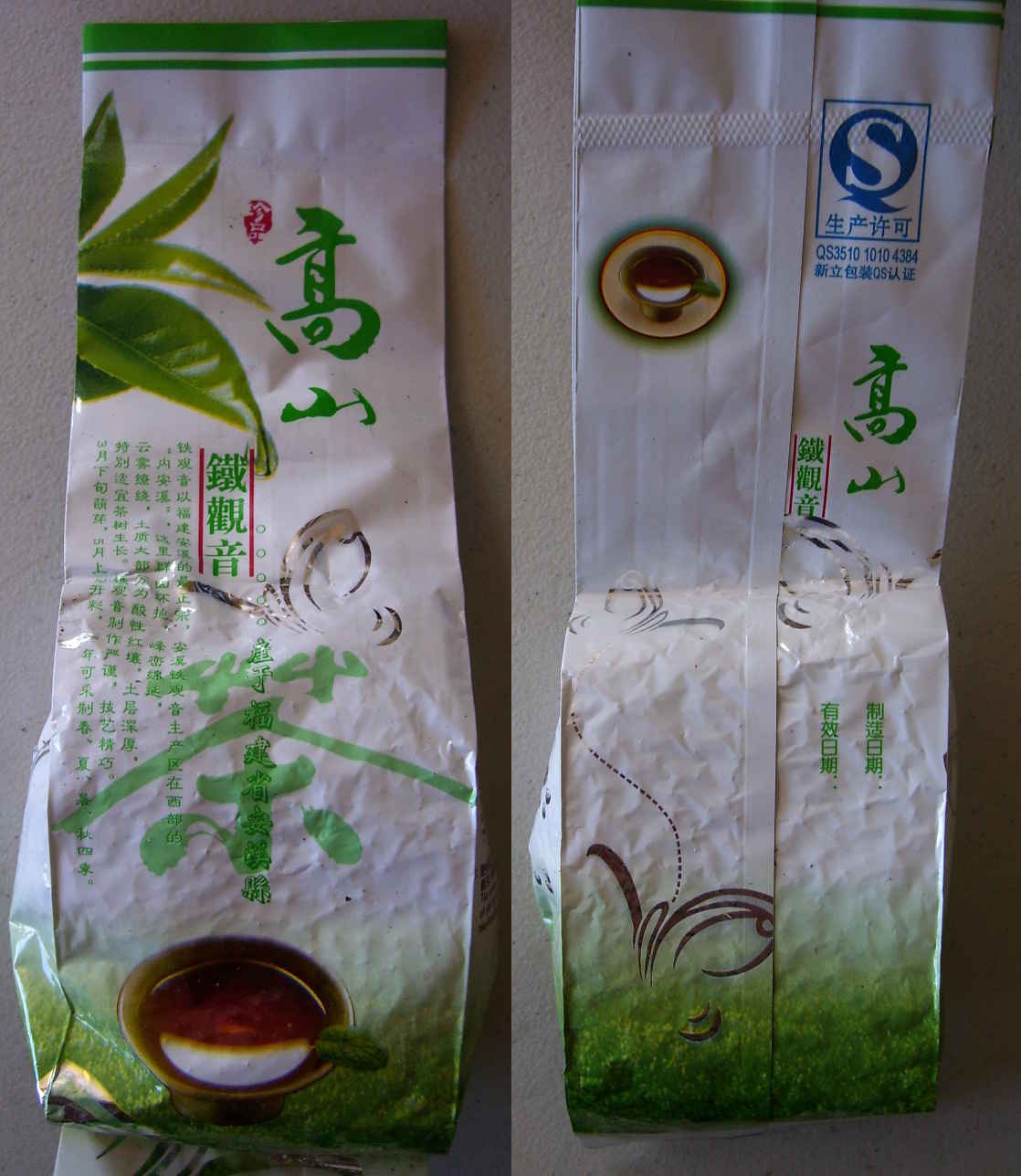
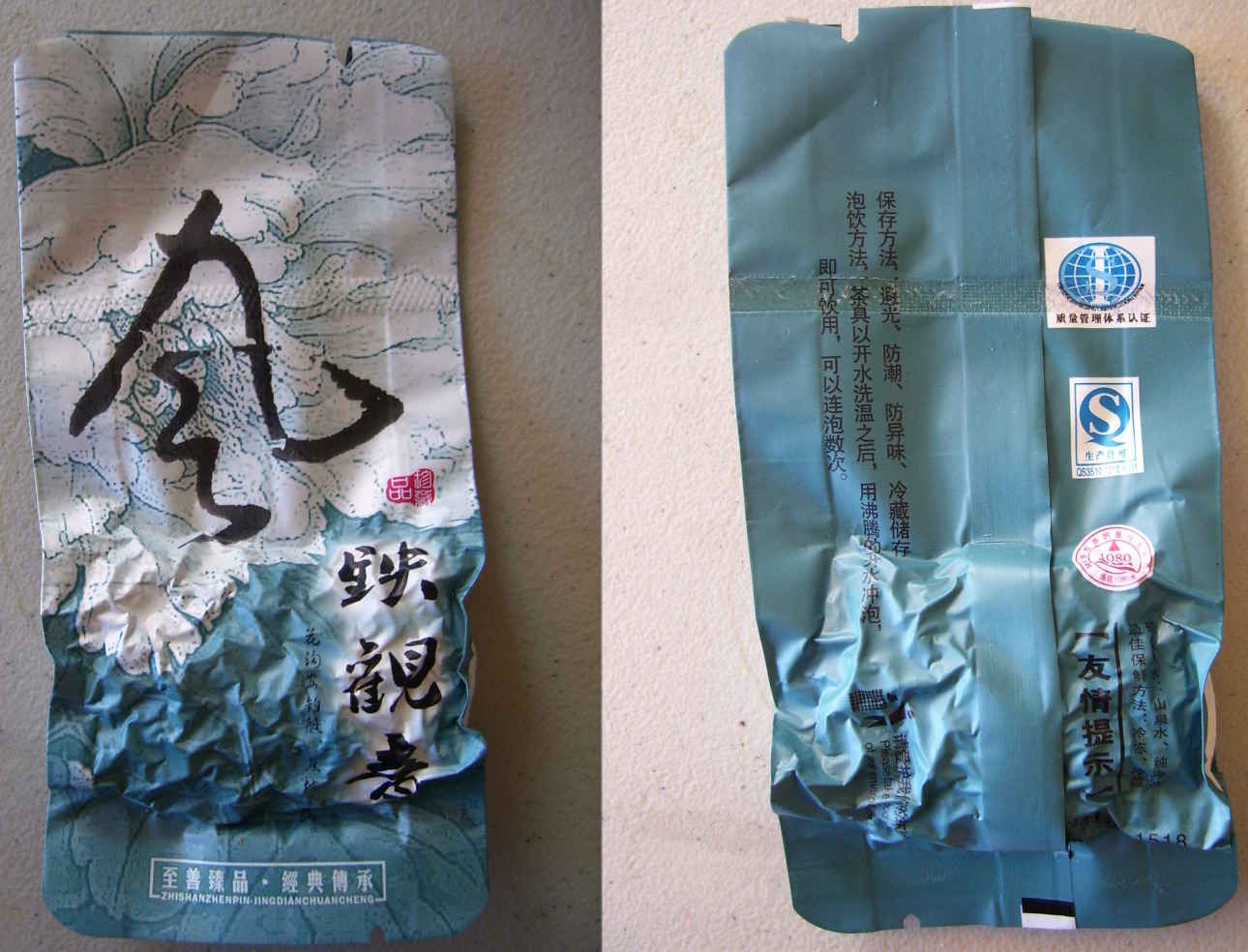
Green
Williamsburg pinhead gunpowder (★★☆☆☆)
Pinhead Gunpowder is a green Chinese tea. Pale straw colored, the brew is light and refreshing in flavor. Each leaf is hand-rolled into a pellet-shaped ball. Because the tightly rolled shape helps the tea retain its freshness, it was one of the first teas to be exported from China. 1/4 lb. Loose Tea, No.42316
I originally bought a packet on a trip to Colonial Williamsburg around 200521ya or so. It struck me as rather grassy and the tightly-rolled leaves seemed to easily oversteep and become bitter. Having received another batch in Christmas 201313ya and preparing it with more respect for being a green tea (sub-boiling water, much shorter steep time), I find it more palatable and so I think my early impressions may have been more my fault than the tea’s fault.
Xian Shan Pouchong (★★★☆☆)
Rolled green tea; strongly reminiscent of oolongs and definitely on the border. Fairly good considered as a green/oolong cross, but nothing memorable about the flavor—similar to Oolong Fine Grade.
“Green Tea Pomegranate”, English Tea Shop (★☆☆☆☆)
Satori Tea Company’s Sencha Klaus (★★☆☆☆)
Gift from sister; a tin of variegated green (long thin leaves, stems, broken leaves) mixed with flakes of thin orange peel or skin. As the name indicates, it’s a Christmas-style tea which makes it taste like potpourri. The flavor is interesting; after the first few minutes, it struck me as a sweeter kind of green but I can’t figure out the flavor—minty? Floral? Some sort of citrus orange? After another 5 minutes, it’s much stronger and I feel confident identifying it as an orange flavor. It’s strong enough that I don’t think I want to drink it on its own, but perhaps I could mix in the Dae-Jak. (Satori’s description identifies the contents: “almond bits, cinnamon bits, natural flavor and orange blossoms”. Makes sense.) I ultimately wound up picking out all the orange peel to make it more palatable.
TeaAndAbsinthe’s “sun dew apricot mango” mix (★★★☆☆)
Purchased at a SF convention; after losing the bidding war for the tea item in a charity auction, I resolved to go find the original vendor in the dealers’ room, which I succeeded in doing. To my surprise, they were primarily a steampunk clothing vendor who happened to have one shelf-unit of tea mixes. Mostly blacks and rooibos, but there was one green that smelled nice and I was piqued that I had lost the bidding war Saturday for the awesome original convention artwork and then the bidding war Sunday for the 3 teas, and it was just $3 an ounce. I had a nice chat with the guy, and bought an ounce of the mango green tea.
It has a pleasant green flavor with no real negatives, and the mango/apricot is not overwhelming. It degrades gracefully under resteeping. Overall, it’s quite good: better than most floral flavorings, above the peach tea (but below osmanthus oolong) in my estimation. Unfortunately, when I checked their website, they seem to offer no online shopping or long-distance ordering capability, so I dropped further consideration.
Stash Premium, “Mangosteen Green Tea” (★☆☆☆☆)
A disappointment. Not a good green, and the mangosteen just tasted too sweet. I didn’t bother with a second steep.
Davids Tea, “Daydreamer” (★★★☆☆)
Small sample packet—a sencha green with mango & mangosteen. Much better than the Stash Premium. It started off well, and handled resteeping admirably. Competitive with TeaAndAbsinthe’s “sun dew apricot mango” mix, although a simpler overall flavor.
Korean greens:
Dae-Jak (★★☆☆☆)
After 5 minutes, struck me as rather grassy, akin to gyokuro, but with a weaker flavor. By 10 minutes, it was still grassy but a certain unpleasant edge had crept in, which was still there after the resteep. Not impressed. During the second-tasting, the unpleasant edge was weaker than I remembered, but otherwise both the Dae-Jak and Jung-Jak tasted the same.
Jung-Jak (★★☆☆☆)
Very similar to the Dae-Jak, but less sweet (when tasting them side by side); the sweetness passed Dae-Jak at 10 minutes, and at 15 minutes, I wasn’t noticing the unpleasant edge. Better than the Dae-Jak, but I still doubt I’ll be ordering it again.
Gyokuro Kenjyo (★★★☆☆)
At 1 minute, it’s a sharp tasting green which reminds me of a previous green tea I’ve had, but maddeningly, I can’t seem to place the specific aftertaste. At 5 minutes, the taste is stronger (but not more bitter or worse).
Pre-Chingming Snow Dragon (★☆☆☆☆)
At 1 and 5 minutes, this is almost tasteless. I’d liken it to a white tea, which it may well be better classified as. I’d call it bad, but that implied there was any real flavor to dislike.
Kagoshima Kabuse Sencha (★★★☆☆)
A ordinary sencha, the only thing I’d note is the slight floral note. Handles resteeping well.
Yamamotoyama’s “Genmai-cha Green Tea with Roasted Brown Rice” 16-pack (★★★☆☆)
Picked up at my grocery store for $2 out of curiosity. As the instructions warn you, this green doesn’t handle resteeping very well and turns bitter after a few minutes. The roasted brown rice flavor is very strong and one can smell it upon opening a teabag packet. The green tea itself is acceptable. The combination is not bad, but I think the rice is over-toasted and comes off as a bit too burnt. The lesson here may be to find my own source of more lightly toasted brown rice.
Spice & Tea Exchange, Genmaicha (★★★☆☆)
This improves on the Yamamotoyama. The rice is toasted much more lightly. I liked it, especially for drinking in the morning, although it doesn’t handle resteeps well and tastes a bit burned. I think genmai-cha can probably be even better, though.
Tao of Tea, “Genmaicha Green Tea And Toasted Rice” (★★☆☆☆)
Devoid of the toasted-rice flavor—there’s grains of rice, yes, but it’s hard to believe they were ever toasted. It doesn’t taste nearly as good as the other two genmai-chas, and was a waste of money since it’s not that good a green tea on its own.
Organic China Gen-mai Cha (★★★★☆)
A traditional combination of organic green tea with toasted brown rice produces a mild and smooth cup with nutty nuance and sweet, lingering aftertaste.
A sweet and mild green, with an equally mild toasted-rice flavor. Definitely a good gen-mai cha.
Gen-mai Cha (Japan) (★★★☆☆)
Literally, Gen-mai Cha means brown rice tea. Toasted and partially puffed rice is blended with large-leaf Sencha.
Not as mild as the China gen-mai, with more of a green edge. The toasted-rice taste isn’t there, though.
Koto Genmaicha (★★★★☆)
Genmaicha is a blend of Japanese green tea and roasted rice. Our Koto Genmaicha is a custom blend of Uji green tea and premium roasted Niigata brown rice. Enjoy its deep aroma and complex nutty flavor. Yields a vibrant yellow green tea. This tea is grown exclusively in the Uji region of Japan. The rice is grown exclusively in the Niigata, Japan.
Gyokuro (★★★★☆/★★★★★)
The finest Japanese green tea, only shade-grown tips are used for Gyokuro. Prized for its delicate flavor and natural sweetness.
Delicious. It’s described as sweet, and it really is! The taste is entirely different from your more usual green teas; and oddly, while I describe black tea as making me feel worse than it tastes, gyokuro makes me feel better than it tastes. It’s a pity it’s so much more expensive (3x $/g).
The Tao of Tea, Handrolled Jasmine Pearls Green Tea (★★★★☆)
Marking a distinct departure from their gen-mai cha, which was seriously weak tea, here the jasmine is, if anything, too strong, overwhelming the green to the point where I’m not sure what it is. Since I like jasmine, this is good, and it resteeps well. (The only downside is that I was unable to drink the whole thing since about halfway through, I discovered a corner of the tin had become enveloped in a fuzzy mold; I keep my teas next to my sink & dish-drying rack, which might’ve caused that, but on the other hand, I can’t recall any of my other teas ever developing a fuzzy mold.)
The Tao of Tea, Pearl Green Tea (★★★☆☆/★★★★☆)
A solid green tea, a bit sharp & oversteeps easily. Like a gunpowder.
Japanese Supersencha Kamakura (★★★☆☆)
Produced for the Japanese domestic market, this special Sencha has beautiful, evenly shaped, deep-green leaves with yellow highlights. The vegetal aroma is layered with lively nutty tones. The cup has medium body and well-balanced flavor. Certified organic.
Like the other senchas. A pretty yellow-green liquor and even flavor (not heavy on the vegetable nor sweet nor bitter). Doesn’t impress me as much as the Sencha Fukamushi or Tamaryokucha, and bitter on resteeps.
Organic Fukamushi Cha/Organic Sencha Fukamushi (★★★★☆)
This offering is grown on the Nishi farm in the Kagoshima prefecture using the Yabukita cultivar, the most popular variety in Japan. Both the leaf and cup have a deep, dark green color and heady, rich aroma. The exquisite liquor has sweet, vegetal notes, a brothy mouth feel and pleasing, light astringency. The leaves are typical of the Fukamushi style, with both larger and small leaf pieces.
Powdery dark-green; the Upton description is dead on: a sweet vegetal taste with just the right amount of astringency. (No idea what is meant by ‘brothy’.)
Organic Tamaryokucha (★★★★☆)
Tamaryokucha, (“coiled tea”) is a superb, handcrafted green tea that has a full, complex flavor. Vegetal notes and a pleasing pungency are accentuated by hints of dark berries and a sweet aftertaste. Produced in Takachiho, Miyazaki from the Yabukita cultivar.
Tastes much like the gyokuro: the vegetal notes leavened by a sweet distinctive aftertaste. But much cheaper.
Japanese Ho-ji Cha (★★★★☆)
Bancha green tea is roasted evenly until it is brown, imparting an unique flavor. The liquor is golden brown; the taste is mellow.
A followup from Japanese Ku-Ki Ho-Ji Cha: since I liked the ku-ki when it was roasted, how would I like green tea similarly roasted? The answer is: quite well. It tastes much like the Ku-Ki Ho-Ji Cha, with perhaps a fuller flavor and a bit less bitter. I think I like it better as far as the roasted flavor goes (there’s no point in comparing with the Ku-Ki Cha Green Kamakura; that’s a green ku-ki, and this is roasted green) but I will probably order some of both later to directly compare.
Huang Ya Imperial Yellow Tea (★★★☆☆)
The leaves are long, twisted and threaded with fawn-colored tip. The aroma has nuances of pear and light citrus. The delicate liquor is smooth, with sweet notes of peach and steamed vegetables.
I had never heard of “yellow tea” before this. WP and various tea sellers make it sound like it’s most akin to green. Mild, inoffensive, entirely unremarkable flavor like a weak black, perhaps.
88th Night Shincha (★★★★☆)
This Shincha (first flush) tea is harvested on the 88th day of spring, and is manufactured using the traditional “lightly-steamed process”. The tea is made from the unique “Okumidori” varietal, known for yielding a very sweet and aromatic cup. The liquor has a mild aroma, with pleasant floral notes, accented by a delicate hint of freshly cut hay.
A very pleasant green tea in the same vein as the Tamaryokucha & Fukamushi.
Tamaryokucha Koga (★★★★☆)
Tamaryokucha is a Japanese green tea that is processed uniquely to achieve its coiled shape. Our Tamaryokucha Koga is a custom blend of high Sencha grade Japanese tea. Enjoy its subtle sweetness with a strong floral fragrance and flavor. Yields a bright yellow green tea. This tea is grown exclusively in the Ureshino region of Saga, Japan.
Uji Shibano Tea (★★★★☆)
Uji tea is a high grade Japanese tea grown exclusively in the Uji region of Japan. Our Uji Shibano tea is custom blended for the high quality. Enjoy a slightly sweet and gentle flavor and vibrant aroma. Yields a deep yellow green tea. This tea is grown exclusively in the Uji region of Japan
Similar to the Sencha Fukamushi.
Chun Mee (Moon Palace) (★★★☆☆/★★★★☆)
Literally translated, Chun Mee means ‘precious eyebrows’. One of our most popular organic China green teas. Steep about 2 minutes.
Cheap but astringent green. Oversteeps at the drop of a hat and you can only use it once. Treated carefully, it is barely adequate. (The 2021 vintage, on the other hand, seems better.)
Sencha Special Grade Yamato (★★★☆☆/★★★★☆)
A superior grade of Sencha, with a brighter flavor and smoother finish than basic Sencha. Highly recommended.
Difficult for me to distinguish this sencha from the 88th Night Shincha/Tamaryokucha/Fukamushi, but I think it is somewhat milder, and I am not as impressed.
“Pi Lo Chun Imperial” (★☆☆☆☆)
Also known as Green Snail Spring, this exemplary China tea has a sweet, delicate aroma with mineral/seagrass notes. The flavor is very smooth with a buttery mouth feel. A light vegetal nuance and hint of melon complement a clean finish.
Tasteless.
Bancha First Grade Organic (★★★☆☆)
First grade Bancha, produced during peak season, is a tea with herbaceous aroma, smooth character, and pale jade liquor. This is a tea with a full mouth feel, bright cup, and clean finish.
Foucha Imperial Organic (★★★☆☆)
This outstanding selection is also known as “Buddha’s Tea”, a reference to its former cultivation at Buddhist monasteries. The sweet cup has a sublimely rich flavor, with a buttery mouth feel and pleasing finish. A connoisseur’s selection.
Both the Bancha and Foucha were better than the disappointment of the Pi Lo Chun Imperial, but neither lived up to the advertising.
Pan Long Yin Hao (★★★☆☆)
Originally produced in the early 1980s, Pan Long Yin Hao (Curled Dragon Silver Tips) has won numerous awards in competitions held by China’s Ministry of Agriculture. This fine plucking is processed into a tighter roll than is typical for this style of tea. The cup is smooth and flavorful with predominantly sweet vegetal notes. The liquor has a round, brothy quality and pleasant finish.
China Green Gyokuro Organic (★★★☆☆/★★★★☆)
A fine, Japanese style green tea, produced with traditional shade-grown techniques. The liquor is delicate and possesses a natural sweetness.
An attempt to clone the Japanese gyokuro plants & processing; it sort of succeeds in that you can tell from more than just the coloring/leaf-shape that it’s intended to be gyokuro, but the flavor shows there’s still work to be done.
Japanese Sencha (★★★☆☆)
Delicate but brisk, this splendid green tea has a clean vegetal flavor. Rapidly gaining the recognition it deserves, this tea refreshes the palate with a hint of sweetness.
Delicate here again turns out to mean neutral and not particularly strongly flavored.
Fujian Green Needle (★★★☆☆)
This tea is produced from a fine plucking, with the leaf sets expertly crafted so that the first and second leaf envelop the downy white bud. The mild liquor has an enticing aroma, with a light sweetness and refined character. A very gentle pungency refreshes the palate.
Classified as a green by Upton’s, I would call it a white; the softness and fuzziness of the blades are common among whites. The description is accurate enough, but being a white, I don’t like it.
Japanese Green GABA (Gabaron) (★★★☆☆)
This unique selection is created using nitrogen during the production process. The resulting leaf is rich in the substance GABA (Gamma-Aminobutyric Acid), which some purport to have salubrious properties. We like this tea because it has a rich taste with intense buttery notes in the aroma and flavor, and oceanic hints in the liquor. A truly satisfying cup.
The GABA effects aside, this was unremarkable green tea.
Gunpowder Green Peppermint (★★★☆☆)
Gunpowder green tea from China, scented with peppermint oil. (Formerly item TF45)
Peppermint oil is not overwhelmingly strong, but it does mask most of the green tea flavor. I would rather just drink the spearmint.
Kyo Bancha Organic (★★★☆☆)
This small production, Uji region Bancha tea is entirely handmade, from plucking to roasting. The bold leaves are produced from larger, older leaves and naturally contain much less caffeine than an average green tea. The liquor has a full yet smooth character with a pleasant toasty note in the flavor. This offering is a fairly rare treat for the Japanese tea enthusiast.
Unusually for Upton’s, the largest quantity carried is 30g. The leaves themselves are even more unusual: they are large, on par in size with cooking bay leaves but dark and almost shiny, reminding me of oak & maple leaves which have decomposed over a long winter. The Upton’s description mentions roasting the bancha, so this is a ho-ji cha. The other ho-ji chas left more of an impression.
Lung-Ching (Long-Jing) Dragon Well Imperial (★★★★☆)
Crafted from carefully selected leaves, this tea has a distinctively sweet, light-toasty flavor with hints of chestnut, and a pleasing vegetal finish. Highly recommended.
Like gyokuro without the bite.
Yunnan Green Mao Feng (★★★☆☆)
The production of this classic tea begins with a fine plucking of select buds. The superb cup has a pale liquor with a light vegetal quality and a buttery mouth feel. The initial flavor notes, with hints of peach, are followed by a delicate menthol nuance. The finish is clean and refreshing.
Brothy sweet undertone, with definite peach.
Jiu Hua Mao Feng “Nine Glorious Mountains” (★★★☆☆)
This tea is produced on Jiu Hua Mountain, one of the four sacred Buddhist peaks in China. Crafted from a classic “two leaves and a bud” fine plucking, this leaf produces a delightful cup with a surprisingly full mouth feel and sweet floral nuances. The finish has a light, cleansing astringency. 3/4
Lung Jing Te Ji/China Green Tea Top Lung Ching (★★★☆☆/★★★★☆)
This Dragon Well is made from a fine plucking, which is then processed in a traditional manner and fired in charcoal pans for finishing. The infusion has a light jade-yellow color. The aroma of the liquor is delightful, and portends the sweet corn nuances and chestnut hints teased from the cup.
Season’s Pick Young Hyson (★★★☆☆)
The aroma of this selection is lightly floral. The mild cup has sweet tones of honey and a light smoky undertone. The finish has a cranberry note and gentle tartness.
Bonus sample; thick chunky leaves. Gunpowder green-like, bit floral, slight bitter, oversteeps quickly. Might still be worth it since 800g is only $26.
China Green Tea Mao Jian Wu Lu (★★★★☆)
The cup has an aroma of sweet peas and sea grass, with delicate floral notes. The first sip reveals a mild, sweet, and buttery smooth flavor. Light vegetal notes of sweet peas and corn silk are complemented by a savory undertone in the clean finish.
Wiry; sweet and gyokuro-like. I could see myself drinking this as a cheaper green. (Not as cheap as the Young Hyson though—800g costs $51.)
China Special Green Tea Dao Ren (★★★☆☆)
A quality selection with a bright and full-flavored cup, accented by sweet nuances and subtle nutty overtones. The aroma and liquor have a fruity aspect which follows in the finish.
Wiry; similar to the Mao Jian Wu Lu in being semi-gyokuro like but much less so.
China Jasmine Chung-Hao Organic (★★★☆☆)
An organic silver-tip green tea was scented with fresh, organic jasmine blossoms, creating this delightful tea. The cup aroma is candy sweet and redolent with the sublime scent of jasmine. The liquor is smooth and well balanced, with a pleasing level of jasmine flavor that lingers into the finish.
Heavily jasmined, hard to distinguish anything beyond that; oversteeps fairly quickly.
Sencha Yabukita Organic #2 (★★★★☆)
This selection from Kirishima, in Kagoshima prefecture, is crafted from the Yabukita cultivar and usually reserved for the domestic market. The mouth feel has a decidedly brothy character, and the flavor has a classic “umami” aspect. A superb specimen of this style and grade.
Japanese Select Competition Temomicha (★★★☆☆)
This selection was created using time-honored, hand-processing techniques that go back centuries. The cup has a soft and buttery complexion with a range of complex flavor notes. The liquor is extremely well-balanced and finishes on a clean, sweet note. The twenty-gram packets are factory packed and nitrogen flushed. Samples are repackaged at our facility. Produced in Shizuoka prefecture from the Saemidori cultivar.
Very fine sticky slices of dark green which cling to plastic surfaces (static electricity?) and expand surprisingly much when steeped. Simultaneously sweet and savory with a strange seafood-like aftertaste.
Pre-Chingming Green Gu Zhang Mao Jian (★★☆☆☆/★★★☆☆)
This 2016 Pre-Chingming offering has wiry, well-twisted leaves with a profusion of delicate, downy buds. The pale jade liquor is fragrant with light floral hints. The sweet cup is smooth and buttery, with a brothy mouth feel and clean finish.
Pre-Chingming Green Lung Ching (★★★☆☆)
The flat, spring green leaves of this 2016 Pre-Chingming selection produce a yellow jade liquor with a fresh vegetal aroma. The light cup is smooth and savory with hints of melon and chestnut. A crisp tang lingers in the finish.
China Pre-Chingming E-Mei Xiang (★★★☆☆)
The dark green leaf of this 201511ya offering is twisted and curled. The cup has a vegetal aroma with hints of mint and sweet flowers. The liquor has a light vegetal flavor with a buttery mouth feel and hints of spice.
Pre-Chingming Hunan Hairpoint (★★☆☆☆/★★★☆☆)
The attractive, dark green leaves are well-twisted and interspersed with many silvery-white tips. The dry leaf aroma has a smooth, fresh hay quality, with a hint of what some have likened to “raw dough.” The infused leaf has vegetal notes with a very subtle smoky suggestion. The light liquor has multiple layers of flavor. This 201511ya selection is from Hunan province.
Capital Teas, Gyokuro (★★★☆☆/★★★★☆)
Japan’s finest green tea, made from single buds picked only in April or May; full-flavored with umami characteristics.
For gyokuro, this is excellently priced, and while I did not have any of Upton’s more expensive regular gyokuro at hand to compare side by side, I think the quality was only somewhat less. Sadly, hardly halfway through the tin, I realized I had made a major mistake in not transferring the bulk of it into a sealed container & using a smaller amount in a small container to protect against the extremely humid section of my kitchen where I store my teas, as I noticed that a mold had started to grow in one corner and the bottom half had compacted into a single mass & discolored. (This is similar to what happened with my Tao of Tea Handrolled Jasmine Pearls Green Tea balls.) I had to throw out the rest. I immediately transferred the Capital Tea Himalayan Golden Monkey, which was in a similar tin, into separate containers with some desiccant bags—but tragically it was too late for the gyokuro.
Clipper Ship Tea Company: Imperial Green (★★★☆☆)
Pi Lo Chun (★★☆☆☆/★★★☆☆)
This Pi Lo Chun selection has beautifully crafted leaves with silver downy buds. The pale gold infusion has a light floral fragrance. The satisfying cup is sweet and smooth with fruity notes and gentle floral hints.
smoky aftertaste?
China Green Sencha (★★★☆☆)
A good green tea for everyday consumption. In the style of Japanese Sencha, this China tea represents an affordable alternative to the more costly Japanese varieties.
Organic Green Ceylon OP (★★☆☆☆)
This green tea offering has large, well-twisted leaves that produce a light golden liquor with a delicate floral aroma. The smooth cup is well-balanced with a full, buttery mouth feel and gentle pungency. The flavor has sweet tropical fruit notes and light citrus hints. A suggestion of spice may be found in the clean, lingering finish. bleh
Organic Gyokuro (★★★★☆/★★★★★)
Limited lots of organic Gyokuro tea are produced each year. This lot has smooth umami notes, a rich cup and a clean, sweet finish. It was grown in Miyazaki prefecture using the Yabukita cultivar. We are happy to offer this tea while our current supply lasts.
Tastes as good as the other gyokuro.
Formosa Pouchong (★★★☆☆/★★★★☆)
The large, twisted leaves of this Pouchong selection yield a pale golden cup with a light floral essence in both the aroma and the flavor. A sweet honey note enhances the mild vegetal quality of the liquor. The finish is clean and refreshing.
Pre-Chingming Pi Lo Chun (★★★☆☆)
One of China’s most well-known green teas, Pi Lo Chun, or Green Snail Spring, is named for its unique appearance. This 2016 Pre-Chingming selection has a mix of olive green leaves and silver tips rolled into the classic spiral shapes. The pale yellow-jade infusion is smooth and buttery with a vegetal aroma, hinting of fresh corn. Some have noted a hint of spice, suggestive of anise, in the gently pungent finish.
Vietnam Green Mao Feng Organic (★★☆☆☆/★★★★☆)
Reminiscent of a Yunnan green tea, this organic offering from Vietnam has bold, olive-green leaves with a crepe-y appearance. A fruity note is present in both the aroma and the cup. The bright golden liquor has a note of sweet uncured tobacco with peach hints in the finish.
(I would describe the “sweet uncured tobacco” as more of a smoky-puerh-like flavor.)
Pre-Chingming Nan Ding Mao Jian (★★★☆☆)
This 2016 Pre-Chingming offering is composed of bright-green, well-twisted leaves with a sprinkling of downy silver tips. A lovely floral note is present in both the aroma and the velvety smooth cup. The light jade liquor is flavorful and sweet with a full, buttery mouth feel and clean aftertaste.
Korea Green Tea Sejak Organic (★★★☆☆/★★★★☆)
The dark emerald green leaves of this offering produce a light jade liquor with a lively, vegetal aroma and a clean, savory quality. The cup has a slightly brothy mouth feel with sweet, buttery hints and a crisp finish. This tea has been expertly handcrafted using time honored methods and is good for multiple infusions.
Remarkably sencha-like.
The Tao of Tea, Sencha Green Tea, Loose Leaf (★★★★☆)
The Tao of Tea, Dragonwell Green Tea, Loose Leaf (★★★☆☆)
The Tao of Tea, Tea Forest Green Tea, Loose Leaf (★★★☆☆)
Weishan Mao Feng (★★★☆☆)
During our most recent trip to China, we journeyed to the Weishan area. There, in back of the Buddhist temple, is an organic garden where we found a spring tea. It turned out to be a delightful discovery. Light in the cup, Weishan Mao Feng features just the right roast flavors. Details: Weishan is well known inside Hunan Province for its Buddhist temple honoring Guan Yin, and like many such centers there was tea made around the temple. Originally, it was probably monks that made the tea and then passed their knowledge down the local peasants. Most of the teas are very rustic with much use of charcoal firing that makes for a very smoky (and unpleasant for most Westerners) flavor. In fact they make a blend of tough leaves and dried vegetables that is made into a soup for the hard working local peasants. Although this region is not well known outside of Hunan, we like this example of the lighter, more elegant teas that are starting to be made. Dry Leaves: “Mao Feng” means “downy tip” in Chinese, meaning the bud is young and covered with white “down” like a bird. These are the tricomes or small outgrowths that protect the very young tea tip (also called a bud) from insects and hostile weather conditions. As the leaves matures, the tricomes disappear. So when one sees the “downy” tricomes it is a sign of a very young tip with all the desired qualities of sweetness and elevated levels of antioxidants. These leaves are definitely small with a silvery tips. Liquor: The color of the this tea is very light green with a slight khaki tinge that comes from the final firing over charcoal. Aroma: Light with vegetal roasts. This is the result of a light firing over charcoal in the traditional manner. Caffeine Level: Caffeinated Body: As mentioned, the leaves are very small and there are many tips, so the body is very light. Flavors: The mixture of light vegetal flavors of steamed green beans or artichokes is accented by the definite roast flavors from the final charcoal firing.
Ichiban Sencha (★★★☆☆/★★★★☆)
Ichiban Sencha is the first production from the all-important Kakegawa area within Shizuoka, Japan’s most important tea growing prefecture. This bracing, lemony tea is an assertive example of the popular style of deep steamed (Fukumushi) Sencha. Details: The Otsuka family has been making tea in the coastal region of Kakegawa for almost 150 years. This Ichiban is their pride, made from the tea fields that surround their factory. The area is so dominated by tea that one hill has a tea bush topiary trimmed to the shape of the Japanese character for “tea.” Ichiban is harvested on the first days of production in late April. It is made at an old, traditional factory and then finished at their plant. Compared with the polished and almost pastoral quality of Matsuda’s Sencha, this Ichiban has the punch and intensity of Tokyo’s rush hour. Dry Leaves A fine mix of leaf filaments that are light green and powdery. This is due to the deep steam (Fukumushi) method of fixing the teas green. The leaves are subjected to an extra thirty seconds of high pressure steam that totally breaks up the tea leaf. Liquor: This tea is a light green, and it is a little clouded from from the fine leaf particles that are dissolved in the liquor. Aroma: Ichiban has a citrusy top note of lemon juice and is balanced by the dark vegetal aromas of spinach and nori seaweed. Caffeine level: Caffeinated. Body: As a very early season tea, it is loaded with amino acids. So this tea has more body than most green teas. Flavors: The style of this Sencha is bracing and lemony at the start with the mellowness of cooked spinach at the finish. It is among the most assertive of Senchas that we offer. The guttiness and astringency come from the deep-steamed production method.
Resteeps well.
Gyokuro (★★★★☆)
Produced in the most famous area in Japan, we present Uji’s most famous tea—Gyokuro. Japanese aristocrats have been sipping this highly regarded shade-grown emerald green tea for centuries. Details: Most Gyokuro is grown in Uji, half an hour south the former Imperial capital of Kyoto. To service the demands of the Emperor and other members of the aristocracy, there were large tea fields and many tea factories built around Kyoto. It was in the twilight of the Edo era that shade grown teas were commercialized. Dry Leaves: These leaves are shiny emerald green spindles. The dark green comes from the fact that tea is grown in increasing shade. The plant compensates by making extra chlorophyll. They are shiny spindles because they are processed in hot machines that straighten out the leaves, then the heat buffs the leaves. Liquor: A lovely pale green, caused by the extra chlorophyll. Aroma: Very spinachy and seaweedy, dark and decidedly vegetal, with none of the lemon sheen of Sencha. Caffeine level: caffeinated. Body: Overall it is medium bodied, however it is much fuller (coats your mouth) than other green teas. This is because in the final weeks of growing the plants are covered in shade, which increases the amino acids that create body. Flavors: The lush green flavor of the freshest steamed spinach, the cooked flavor of lightly toasted walnuts and a very slight note of sulfur. Filling and sustaining.
Jeju Sejak (★★☆☆☆/★★★☆☆)
The island of Jeju (Cheju-do) is located south of mainland South Korea. Largely tourist, there is a great volcano and National Park located at its center. As the hills sweep up to meet the peak, vast and beautiful fields of green tea can be found at 4 different gardens. This style of Korean tea is similar to a Japanese Sencha in that it is lightly shaded and steamed during processing. Altogether, this tea lends itself a beautiful, curly leaf, an aromatic bouquet and a smooth cup. We are proud to offer our very first South Korean tea. Dry Leaves: Curly, forest green leaves. Liquor: Bright Lima bean green. Aroma: Sauteed spinach. Caffeine level: Caffeinated. Body: Light. Flavors: Mild notes of spinach & bok choy.
Lung Ching (★★★☆☆/★★★★☆)
Lung Chings are famous worldwide as some of the best Chinese green teas. Our Lung Ching is made by a respected producer two hours beyond the traditional area. The small green leaves make for a brew that has a mild and sweet—almost nut-like—flavor. Since Lung Ching teas remain in consistently high demand, the price is dictated by the market. Details: This is an ancient tea that has come back to life. Dry Leaves: The flat, narrow leaf is stiff and smooth with a spear-like shape, about an inch long. Though it looks like a single flat needle, the unit actually comprises two leaves and a bud joined at a stem. Liquor: Pale yellow. Aroma: Steamed baby bok choy and lightly toasted walnuts. Caffeine Level: Caffeinated. Body: Medium light. Flavors: The delicious meatiness of roasted eggplant with similar steamed bok choy and toasted walnut flavors.
Matsuda’s Sencha (★★★☆☆)
It has been an honor to be the sole source for the great Japanese Sencha. The life’s work of a great tea man and his family, this Sencha has great body and flavor. Details: Mike has visited Matsuda and his family several times. Their house is located halfway up a hill that is covered with tea bushes, and looking out over the valley, that is all one sees. The family’s abode has been all business for generations. They have a space to make the tea in the back, with steamers to fix the green tea and rollers. This tradition and dedication serves us well, because it is an unique Sencha with a distinctive aroma, great body, and flavors that are hard to forget. Dry Leaves: The slender spears are a vivid, forest green which comes from constant attention through out the year. Liquor: In the cup, the tea is an intense yellow green. This is a sign that Matsuda has not taken the shortcut of covering his tea bushes like some of his neighbors. Aroma: Many senchas have similar aromas, however Matsuda’s teas smell wonderfully vibrant. There are fresh lemon notes backed by a nice spinachy aroma and the roasted hints of nori seaweed. Caffeine Level: Caffeinated. Body: A medium bodied tea that is still mouth-filling and brothy. This comes from the high levels of amino acids. Flavors: If you like the vegetal flavors of Japanese green teas, you are in for a treat! It opens with vegetal flavors that seem like sautéed chard and finish with roasted Nori. The tea’s pale sweetness is balanced by a slight bitterness on the back of the tongue. The sweetness endures and evolves long after you’ve sipped the tea.
Kagoshima (★★★☆☆)
One of the best Senchas from the Kagoshima area in southern Japan, this brew is light in the cup with a good balance of sweet and bitter flavors. Details: Kagoshima is the southern port of the southern Japanese island of Kyushu. Spring springs earlier in Kagoshima than in the northern tea regions. The first fresh teas are from this area. The tea fields have been flattened and straightened, so that large tractors may be used to harvest the tea. Sometimes quantity is more important than quality in teas from Kyushu. Our friend Tsuyoshi looks for the best teas from the region. Included in the blend is Asatsuyu, which is called a natural gyokuro because of its mellow sweetness. Dry Leaves: This a blend of of silky, semi glossy deep-steamed (fukamushi) filaments and stiff forest green needles (futsumushi.) Liquor: The blend of teas in Kagoshima make for a pale green. Aroma: This is a blend of the several senchas from Kagoshima. They give the tea the high notes of fresh lemons and bell peppers with the mellowness of cooked spinach. Caffeine Level: Caffeinated. Body: This is an early season tea, so it has high levels of amino acids, giving it good body for a Sencha. Flavors: Assertive notes of green bell peppers and lemons. There are hints of the flavor of roasted walnuts.
Moroccan Mint (★★★☆☆)
Moroccan Mint, our contemporary interpretation of the traditional Arabian beverage, features Gunpowder Green tea blended with exceptional peppermint leaves from Oregon. This combination imparts an uniquely brisk and aromatic green tea experience. Kosher. Caffeinated. Dry Leaves: The leaves of this gunpowder are very dark and tightly balled, made from tougher leaves. Liquor: The mint flavor in this tea and the oxidation process darken the liquor to a light brown. Aroma: A slight charred or burnt aroma due to the drying process, as well as a strong mint aroma. Caffeine Level: Caffeinated. Body: This tea has a lighter body and a little less caffeine. Flavors: This tea has slightly vegetal flavors with strong tones of mint.
A pleasantly minty combination, but as always with gunpowder greens, it’s hard to steep them right without going into unpleasant bitterness.
I wondered why I see Morocco as the country of origin of so many mint teas, when Morocco seems like a small obscure dry desert country and an improbable place to grow globally competitive amounts of what I know first-hand to be a water-loving herb. Apparently the answer is that (see Cornwell 2018 for a detailed history) north Morocco is good for agriculture when irrigated properly, like California, and is a major exporter in general; and there is tradition of massive domestic consumption dating back centuries blending mint with gunpowder green tea.
Meijia Wu Lung Ching (★★☆☆☆)
Lung Ching is to Chinese green teas what French Champagne is to sparkling wines: the standard against which all others are measured. With almost no tips, it has the classic Chinese green tea qualities of steamed bok choy and roasted nuts. Details: Lung Ching means “Dragon Well”, which refers to an old well halfway up a hill outside of Hangzhou in Zhejiang province, where the tea was originally grown. This tea comes from a village the other side of the hill, called. For the last few years, Mr. Zhao has made our Lung Ching. His house and tea factory is up the hill, with hills of tea plants just outside. We like to get our Lung Ching from tea just after the start of the season. The first teas are very, very expensive and often the tea does not match the price. This year we choose a tea that had great body and lovely sweetness, indicative of great levels of amino acids. Dry Leaves: The flat, narrow leaf is stiff and smooth with a spear-like shape about an inch long. Though it looks like a single flat needle, the unit actually comprises two leaves and a bud joined at the stem. Liquor: Pale yellow. Aroma: Steamed bok choy and toasted walnuts, with top notes of sweet spring grass. Caffeine Level: Caffeinated. Body: Medium light. The tea is loaded with amino acids that give sweetness and body. Flavors: The delicious meatiness of roasted eggplant with similar steamed bok choy and toasted walnut flavors.
Totally tasteless, even brewed in large quantities.
Pan Asia (★★★☆☆)
Pan Asia tea is our delightful blend of Chinese Bancha green tea and big chrysanthemum flowers that creates a light, clean tasting beverage. Kosher. Dry Leaves: Our Pan Asia is a wonderful blend of dark green Chinese Bancha leaves and beautiful chrysanthemum flowers. Liquor: The flowers in this tea make the liquor slightly more brown than our basic green teas. Aroma: The chrysanthemums in this tea give it subtle floral notes while the aroma remains a little grassy. Caffeine Level: Caffeinated. Body: A light body. Flavors: This tea has a light, clean taste of our Chinese Bancha and a trace of chrysanthemum.
A decent bancha; I didn’t notice much from the chrysanthemum flower additions.
Junshan Yellow (★★☆☆☆/★★★☆☆)
This is one of China’s most famous teas. Only tiny amounts are made on Junshan Island in northern Hunan Province. It is made of just the buds, which have been yellowed in a secret process. The liquor is more mellow than green teas, yet it is still slightly sweet. A delight to drink! Details: Please brew them in a tall glass by pouring the hot water first, then add the tea and admire how the buds slowly sink to the bottom. Dry Leaves: Long needles of white buds with tinges of darker yellow. Liquor: Pale yellow. Aroma: Subtle fruit aromas. Caffeine Level: Caffeinated. Body: Light in body. Flavors: Light and sweet with subtle fruit flavors.
Mostly tasteless.
Bangkok (Green Tea with Coconut, Ginger & Vanilla) (★★★☆☆)
The rich flavors of Bangkok, Thailand are the inspiration for this tasty blend that combines green tea, lemongrass, vanilla, coconut and ginger. Also known as Green Tea with Coconut, Ginger & Vanilla. Kosher. Details: Many of the blends used in our flavored green teas are what might be considered sweet, as in a dessert. So, Mike wanted to do a tea that was more ‘savory.’ Being a big fan of Thailand, he decided to lean on the flavors found in many Thai dishes (at least in the States), and that is what we have blended into the green tea: ginger for spice, lemongrass for some citrus flavors, and coconut for creaminess. It all comes together into a lovely tea. With our importation of coconut water, we get over to Bangkok at least once a year, and it is an amazing city. This confirms our opinion of choosing to honor the city and the cuisine of Thailand. Dry Leaves: Lighter colored lemongrass is visible amongst the green tea leaves of our Bangkok Tea. Liquor: Bright yellow with slightly brown hues. Aroma: The aroma of this tea is a tropical mélange, including ginger and vanilla. Caffeine Level: Caffeinated. Body: This flavored green tea has a moderate to light body. Flavors: Bangkok has a mixture of coconut, lemongrass, ginger, and vanilla flavors.
A pleasant combination, the vanilla and coconut are almost ‘toasty’. I imagine that coconut flavoring might pair well with a genmai-cha.
Hunan Mao Jian (★★★☆☆)
We’re pleased to offer Hunan Mao Jian, a nice organic green tea from China, as a good value that is possible to enjoy often. Details: While looking for the best teas in Changsha, we found this organic green tea. Not every occasion demands the best tea; this is a nice one to drink more often. Dry Leaves: Big curls of dark green tea. Liquor: Medium yellow. Aroma: A light squash like nose. Caffeine Level: Caffeinated. Body: Light bodied. Flavors: Good vegetal flavors like zucchini.
Bi Lo Chun (★★★☆☆)
Bi Lo Chun, a green tea from Jiangsu Province in China, offers pronounced roasted vegetal flavors of grilled endive, with a somewhat bitter bite. You’ll enjoy its charming floral and citrus flavors. Details: This is a light green tea that has a wonderful mixture of sweetness, vegetal flavors, and a bit of smoke. Bi Lo Chun comes from the tiny Dongting island in Jiangsu Province. It the most northerly grown tea in China. Dry Leaves: A mixture of dark green, almost bluish gray, spiraled wiry filaments coated in fuzzy yellow down. Liquor: Pale green, slightly cloudy from the down. Aroma: Light and sweet, with the roasted sweetness of brown sugar and a vegetal base note. The top layer has hints of smoke. Caffeine Level: Caffeinated. Body: Light and slightly brisk. The briskness dries the mouth slightly. Flavors: The faintest hint of flowers is nearly matched by the roasted vegetal flavor.
Powerfully vegetal aftertaste.
Blueberry Green (★★☆☆☆/★★★☆☆)
For Blueberry Green, we’ve artfully blended Chinese green tea with lemongrass, blueberry, and vanilla to create a brew that’s sure to hit all the right notes. Delicious hot or iced. Details: Growing up around here, one of our favorite times was picking blueberries on the slopes of the high hills of Mt. Riga. We were able to capture that delight in this tea. Dry Leaves: Green leaves. Liquor: Pale yellow. Aroma: The smell of summer and ripe blueberries. Caffeine Level: Caffeinated. Body: This green is light in body. Flavors: Lovely ripe blueberries, just like up on our hills.
Thin-tasting and a bit sour. The lemongrass doesn’t help—lemon and blueberry‽
Citron Green (★★★☆☆)
We often suggest Citron Green, a lightly flavored green tea, to our tasting room customers interested in trying green tea for the first time. The delicate citrus flavor and beautiful orange flavors provide a gentle introduction to the world of green tea. Loose tea, sample.
Tong Lu Green (★★★☆☆)
On our annual trip to China, we were shown a new area in southern Zhejiang Province. There, veteran tea growers have created a new tea garden using the famous Anji tea plants. They have used these plants to make great tasting green & black teas. It was wonderful to see innovation at work. Dry Leaves: A mixture of bright and dark green twisted leaves. Liquor: Lima bean green. Aroma: Fresh cucumbers. Caffeine Level: Caffeinated. Body: Mild. Flavors: Cucumbers and zucchinis.
Bancha (★★★☆☆/★★★★☆)
Bancha is summertime green tea from Japan, notable for its grassy flavor and no smokiness. Details: It is amazing what a few weeks make. Banchas are made of large, tougher leaves. As the season wears on, the chemical composition of the leaves change. By the time the Bancha harvest begins, the smoother-tasting polyphenols in the leaves have been replaced by harsher ones, and the leaves have lost amino acids that create sweetness and body. Bancha yields a grassier, lighter-bodied tea. Dry Leaves: Bancha consists of wide leaves mixed with stalk, ranging in color from sage green to khaki. Liquor: Bright Yellow. Aroma: Bancha is a summer grown tea, so it is lively and grassy. It is as if someone had turned up the volume on a Sencha. Caffeine Level: Caffeinated. Body: With its big leaves an occasional stems, this Bancha’s body is light. Flavors: Japanese Bancha has lighter vegetal flavors of grass, celery, and wet wood, yet it is very assertive.
Decaf Sencha (★★★☆☆)
Are you looking for a plain green tea that has flavor and some body, yet without the caffeine? We propose our Decaf Sencha as your clear choice; Harney & Sons offers simply the best! Details: People who choose to drink decaf teas often get a bad deal. Their teas simply taste bad. We wanted to offer them something better. We work with tea suppliers and decaffeination factories to make good tasting green teas. We supplied the good teas and they removed the caffeine using carbon dioxide [CO2]. Dry Leaves: This Decaf Sencha is based on a Chinese green tea and consists of wide leaves mixed with stalk, ranging in color from sage green to khaki. Liquor: Bright yellow. Aroma: Our Decaf Sencha comes from summer grown tea, so it is a lively, grassy tea. When the caffeine is removed, so is some of the flavor. Caffeine Level: Decaffeinated. Body: When the caffeine is removed, so are some of the compounds that create body in tea. So it is lighter in body. Flavors: Lighter vegetal flavors of grass.
Odd sencha—the flavor feels almost cut in half and towards oolong. I was hoping for a decaf tea which I could drink late at night without being troubled by the caffeine keeping me awake, but this is unacceptable; it would be better to drop tea entirely at night.
This is not a kind of defective flavor I have noticed anywhere else, and I immediately wondered if the CO2 decaffeination process was responsible. I have since ordered several decaf teas to compare, and most of them were highly unsatisfactory. As of 2019, Upton now warns you “Please note that even the best decaffeinated teas lose some of the flavor and complexity of their unprocessed counterparts.” The only exception was a flavored black tea (Upton’s “Decaffeinated Apricot with Flowers”), but black teas have such a strong flavor on their own, much less when flavored, that I suspect that the ‘hollowness’ is being covered up; which is not necessarily a bad thing but doesn’t vindicate the CO2 process. The two main decaffeination processes are apparently CO2 liquid at high temperature/pressure, and hot water at even higher temperature, neither of which sounds like they are ultra-selective for caffeine and I am suspicious that the sencha tastes half like it should because it is in fact only half what it was. An Economist article claims “it [CO2/hot-water decaffeination] can cause collateral damage to some of the fragile compounds that give tea its benefits. And, as with decaf coffee, which is treated in similar ways, many people argue that it also spoils the flavour.” Which does match my experience. If this is the case, it’s hard to see how decaf tea could be improved: CO2 is not going to change, after all. So the current options are to either use overwhelming tea which can survive the process without too much damage, inherently low-caffeine drinks (kukicha or tea flowers, tisanes/herbals in general; the caffeine levels of white/green/oolong/black teas vary too widely from batch to batch/year to year/farm to farm to be of much help), or go with out. One future option would be to stop tea plants from synthesizing caffeine in the first place—there are some wild tea plants which don’t produce caffeine (eg. Jin et al 2018’s “Hongyacha” tea), so caffeine (which is usually believed to be synthesized as an insecticide, like nicotine) is not necessary for a tea plant; this implies that the caffeine-free tea bushes, whether wild or cultivated, could be found and selected for, giving high-quality tea sans caffeine sans decaffeination. (Another option, given that destroying functionality is much easier for genetic engineering than adding or changing functions, would be to knockout caffeine production using a technique like CRISPR; Chinese geneticists particularly specialize in agricultural applications of CRISPR, and it’d probably be straightforward.)
Lemony Gunpowder (★★★☆☆)
Lemony Gunpowder, a popular flavored green tea, is based on traditional Gunpowder with a hint of lemon added to brighten the flavor. Kosher. Dry Leaves: The dark, balled leaves of this flavored gunpowder are blended with lemon. Liquor: The liquor of this tea is a light yellow. Aroma: A slightly charred aroma, combined with lemon. Caffeine Level: Caffeinated. Body: A medium body. Flavors: Charred and very slightly vegetal with a strong lemon accent.
Wild Mountain Green (★★★☆☆/★★★★☆)
A very rare, light and sweet green tea made from wild tea plants growing in China’s Jiangxi Province. Details: An unexpected but delightful part of our recent trip to China was the excursion to Yangjiaping village high in the mountains of Jiangxi Province. As we rolled up the mountain and into a small village, we were told that we were the first western tea buyers to visit this tiny village that is devoted to tea. They certainly did treat us like royalty. We took a walk up to the top of the mountain to see the tea gardens. On the way down, our friends pointed out some wild tea bushes. After a great meal made by the boss’s family, we were shown some the teas made from wild tea bushes. We were very pleased with them and now you can be pleased with them too! Dry Leaves: Long twisted dull green leaves w/ silver tips. Liquor: Light olive. Aroma: Light vegetables. Caffeine Level: Caffeinated. Body: Light body. Flavors: Light vegetables like sweet Lima beans.
Japanese Sencha (★★★★☆)
We call this tea Japanese Sencha because not all Sencha on the market is from Japan. Our Sencha is a very fine one from the central Shizuoka province, and can be found in many homes in Tokyo. It is a pleasant and approachable green tea—a fine choice for everyday, in the way our founder John Harney always began his mornings with this cup. Kosher. Details: The Kaburagi family has sold to Americans for over 110 years. They are well known in Tokyo and throughout Japan as a pre-eminent supplier of tea. They supply this pleasant Sencha from central Shizuoka. To keep the price somewhat reasonable, we choose teas from the middle of the season. John Harney drank this tea everyday for over 10 years. He valued the pleasant flavor and the antioxidants. Dry Leaves: The leaves from this tea are a medium lime green color. Since this is a traditional sencha (futsumushi) the leaves are more identifiable than in the deep steamed (fukamushi). Liquor: The liquor is a medium green, not as intense as the Ichiban. The green is a truer green than the Bancha, which tends more towards yellow. Aroma: Our Japanese Sencha has pleasant spinachy notes, with slight roast flavors that are similar to toasted bread. Caffeine Level: Caffeinated. Body: As a mid-season Sencha, this green tea has good levels of amino acids and more body than most green teas. Flavors: This is a very pleasant green tea. The mild vegetal flavors with light accents of citrus and toast make this a tea that can handle all your moods—every day.
Sencha Scent of Mountains (★★★☆☆ / ★★★★☆)
This Japanese green tea is a hit! Sencha Scent of Mountains remains one of the most popular teas at our SoHo flagship store. People love the delicious light vegetal taste and distinctive aromas of this unique tea, grown in the highest region of Shizuoka. You will too! Details: The Otsuka family, who supply several of the Japanese green teas, did a great job with this Sencha. Scent of the Mountain comes from Kawane, which is the highest tea region in the massive Shizuoka tea region. Although not as high as Darjeeling or Uva, it is high for Japanese tea gardens. The cooler air helps make for the lovely aroma. Dry Leaves: The leaves are medium in size, maybe a quarter of an inch with some even smaller. The tea is forest green with some lighter stalks included. The tea is between a regular steamed tea and a deep steamed tea, and this accounts for the size of the leaves. Liquor: The liquor is light and clear. Aroma: They do not call it Scent of the Mountain for no reason. This tea has a lovely, beguiling vegetal aroma. Few can resist. Caffeine Level: Caffeinated. Body: The body is light. This come from the Shizouka region, and is not deep steamed, so the body is lighter than other Senchas. Flavors: Like the aroma, the flavors are enticing. The vegetal spinachy flavor comes through clearly and strongly.
Yanagi Premium Green (★★★☆☆ / ★★★★☆)
Japanese teas are popular because people like the aromas, flavors, and even the elevated levels of antioxidants. We offer Yanagi as a value-based alternative to some of the more costly greens, so you may enjoy Sencha flavors more often. Details: Our supplier from Uji, in Japan recommended that we try this tea. It is made at the same time as high quality Sencha, however it is not considered acceptable as a Sencha. It represents a good value. Dry Leaves: These are large green leaves, mostly medium green but with some lighter colored stalks. This tea looks like Sencha, but larger. That is because it is the ‘rejects’ from the Sencha made in May. Liquor: The liquor is a pale light green, similar to most Senchas but light. The big leaves account for the lighter color. Aroma: Yanagi’s aroma is a lighter version of most Sencha: spinach and nori seaweed with the backnotes of toast. This is contrast to a tea it might be confused with: Bancha. However Yanagi has none of the grassy aromas found in Bancha. This is because it is made in the Spring like senchas. Bancha is made later. Caffeine Level: Caffeinated. Body: This a medium bodied green tea. Flavors: Steamed leaf vegetables like spinach or tatsoi with some roasted flavors.
Genmaicha (★★★☆☆ / ★★★★☆)
Genmaicha is a different kind of Japanese green tea that many people find intriguing. Brown rice kernels (“genmai”) are added while the green Bancha leaves (“cha”) are being dried, so the kernels get crispy and some burst open. Genmaicha has an unique appearance and a pleasant roasted flavor. Kosher. Details: Bancha is a summer tea made after the Sencha season. Because there is so much of this inexpensive tea, an innovative Kyoto tea merchant thought to combine the two staples of the Japanese diet, bringing Genmaicha into existence. Once considered a cheap peasant beverage, Genmaicha has recently come into vogue among the Japanese urban elite. Dry Leaves: Broad yellow-green Bancha tea leaves are mixed with toasted brown rice. Liquor: The liquor is vibrant light green tinged slightly khaki brown from the rice. Aroma: The predominant aroma is the roasted brown rice with light vegetal undernotes and hints of citrus from the Bancha. Caffeine Level: Caffeinated. Body: Genmaicha is a light-bodied green tea. Flavors: Above a baseline vegetal flavor of spring grass, there is the strong roasted flavor from the toasted rice. It is evocative of popcorn.
Organic Sencha (★★★☆☆ / ★★★★☆)
In the past, we have avoided “Organic Sencha.” Our feeling was maybe it was organic, and maybe it was a Japanese Sencha, but the tea did not meet our taste expectations. However, Mike met our current supplier a few years ago and was quite impressed by this Sencha. This one is certified organic—and it is certainly from Japan—and most importantly, it tastes like a good Sencha. Details: The Organic Sencha is the “real deal.” We were happy to find a nice tasting green tea that was truly Organic and truly a Sencha. We are big fans of Matsuda and his Sencha. When we learned that this tea was the from the same valley: Watsuka, we were very excited. Organic teas are very important to some, however, sometimes it is hard to find these teas made in Japan. The tea makers often feel that they can not make good tea without the addition of Nitrogen. This element is found in every amino acid (even those in your body) and amino acids give Sencha there body or umami, also they add sweetness to the brew. However this teamaker gets by with natural fertilizers. Yes, the tea is a bit weaker than other Senchas, but is still very nice. Dry Leaves: The leaves are medium green, and shorter in length than other Senchas. This tea comes from the same valley as Matsuda’s Sencha, so the microclimate (or terroir) and the traditions make it possible to make good Sencha. Liquor: The liquor is a light, clear green because the tea is regular steamed (in contrast to deep-steamed.) Aroma: This tea has an aroma of lightly steamed vegetables like spinach. Since it is organic, the aromas will be lighter. In comparison to conventional tea, there are less amino acids.Caffeine Level: Caffeinated. Body: The body is lighter than most Senchas. Flavors: Organic Sencha has agreeable vegetal flavors, but the volume is turned down. It comes from a great area, so the tea does have some amino acids and antioxidants to make an agreeable tea, just less of them.
Organic Green with Citrus & Ginkgo (★★★☆☆)
Based on a hand-picked organic green tea from Southern India, our refreshing Organic Green with Citrus & Ginkgo blend delivers the benefits associated with green tea and ginkgo. It features a dash of lemongrass and the bright taste of natural citrus. This tea uses Fair Trade teas. Details: This was one of our first certified Organic teas. We decided to give the green tea blend a bit of “functionality” and added some Ginkgo. However we can not remember the reason! Dry Leaves: This Indian Green Tea is certified organic and blended with cut lemongrass and citrus peels. Liquor: The liquor of this tea is a very light green-brown. Aroma: This tea has a citrus aroma with a trace of ginkgo that gives an earthy twang. Caffeine Level: Caffeinated. Body: A light body. Flavors: A mixture of vegetal and citrus flavors with an unique ginkgo taste.
Chun Mee (★★☆☆☆ / ★★★☆☆)
Chun Mee is a traditional green summer tea from China, with a lightly roasted vegetal taste. When John Harney started in the tea trade over 30 years ago, Chun Mee was one of only two green tea offerings from China, along with Gunpowder. Our offerings have greatly expanded since then, yet many people still enjoy Chun Mee’s familiar taste. Details: This is the green tea that many of us and our parents grew up with; many of us crave its roasted and assertive flavors. It is made from the tougher leaves that are fixed green, and then fired for an extended period in a hot rotating oven. Dry Leaves: Grayish green leaves rolled into a semi-circle. It is easy to see where the name “Chun Mee,” comes from; it means “eyebrows.” Liquor: Bright yellow. Aroma: Definitely charred vegetal aromas. Caffeine Level: Caffeinated. Body: Medium bodied from heavy roasting. Flavors: The flavor of leeks that have been left on the grill for a very long time.
Chinese Flower (★★☆☆☆ / ★★★☆☆)
Our Chinese Flower tea is a joy for the eyes and the palate. A beautiful and aromatic blend of Chun Mee and three types of flower petals, you’ll notice accents of citrus flavors. Kosher. Dry Leaves: A blend of Chun Mee and various flower petals and orange peel. Liquor: The flowers in this flavored green tea make the liquor a yellowish-brown, similar to a gunpowder tea. Aroma: A light aroma of flowers and Chun Mee. Caffeine Level: Caffeinated. Body: This tea has a light body due to the flowers blended into it. Flavors: The orange peel gives this tea a light citrus flavor while the flower petals give it a floral taste as well.
The Chun Mee is not improved by an attempt to turn it into patchouli..
Jane’s Garden Tea (★★☆☆☆ / ★★★☆☆)
Gardens inspire by showing continual growth, renewal, and vitality; it also takes love, tenderness, and care to nurture a garden. It is in Jane’s memory, a lifelong friend and gardener, that Jane’s Garden Tea was blended to show support during her battle against breast cancer. We are pleased to offer Jane’s Garden Blend two ways: as loose tea in our traditional black tin, and also in a beautiful pink and green tin with 20 tea sachets. Kosher. One dollar ($1) of the proceeds from the sale of Jane’s Garden tins will be shared by the Jane Lloyd Fund and the National Breast Cancer Foundation. The Jane Lloyd Fund helps patients in Salisbury, CT with their day-to-day expenses while battling cancer. The National Breast Cancer Foundation provides mammograms, education and research about breast cancer nationwide. Dry Leaves: Dark green leaves with bright rose petals. Liquor: Jane’s Garden Tea has a light yellow liquor. Aroma: This tea has a light floral aroma. Caffeine Level: Caffeinated. Body: A light body due to the rose petals and floral flavors. Flavors: A delicate floral flavor is brought out in this tea by the rose petals blended with the green tea leaves.
Dragon Pearl Jasmine (★★★☆☆/ ★★★★☆)
Delight in Dragon Pearl Jasmine tea—a masterpiece from Fuan, China—comprised of little hand rolled tea ‘pearls’ gently infused with floral essences from jasmine flowers. The tea is a beautiful to look at, and the light colored brew is full of floral and sweet aromas. Kosher. Details: There was a time, and it was not too long ago, that there was no Dragon Pearl Jasmine. Now the world is a better place. These are hand rolled by ladies in Fuan in northern Fujian Province. When Mike met the lady that originated this lovely tea, he thanked her on behalf of all tea drinkers. Dry Leaves: Small rolled “pearls” of faded green and white leaves. They are very pretty. Liquor: A light and clear liquor that is tinged a pale yellow. Aroma: There is no question here: Jasmine and more jasmine! Caffeine Level: Caffeinated. Body: This is a medium bodied tea. Flavors: What a wonderful tea! We looked long and hard to find a tea that is both sweet and very floral. Please enjoy it as is, there is no need to alter it all.
Jasmine (★★★☆☆)
Flavoring teas with Jasmine flowers is an ancient Chinese tradition. The base of our Jasmine is a Pouchong tea, which is slightly browner than green tea. We add fresh jasmine flowers to create a delicate and fragrant brew. Kosher. Caffeinated. Details: The Chinese love to mix Jasmine flowers with various teas. We offer four options: Jasmine, Yin Hao Jasmine, Silver Needle Jasmine, and Dragon Pearl Jasmine. This is our most basic Jasmine, however it is much better than those served in many Chinese restaurants. Dry Leaves: Medium sized pale green leaves with dried jasmine flowers. Liquor: Yellowish green. Aroma: Over the vegetal base, there is a strong Jasmine flower aroma. Caffeine Level: Caffeinated. Body: This is a medium bodied tea. Flavors: The floral flavors of Jasmine are very present.
Season’s Pick Green Fannings Organic (★★☆☆☆ / ★★★☆☆)
This is a perfect tea for getting your daily dose of “greens.” This fannings grade produces a smooth and flavorful cup within a minute. Value-priced for everyday consumption and chosen for its pleasing character, this tea is an excellent choice for the green tea enthusiast on a budget.
Cheap indeed, oversteeps almost immediately, and yields a somewhat bitter ordinary green. It may cost next to nothing but demonstrates it’s worth paying a little more for real greens.
China Green Decaffeinated Tea (★★☆☆☆/★★★☆☆)
Surprisingly flavorful, this [CO2] decaffeinated green tea has a pleasant vegetal quality. A bolder version of our ZG09, Decaffeinated China Green Tea.
Another CO2 decaffeination test along with the Sweet Orange Black, but where the black is so masked by the sweet orange that I can’t evaluate it, one sip of the green and I instantly recognize the “hollow” flavor, something deeply wrong with the taste, I remembered from Harney’s decaf green tea. Indeed, so similar are they that I immediately wondered if I had bought the same tea, but closely comparing the photos and descriptions, while I can’t rule it out, it seems like they are different teas. In any case, this was a disappointment because it implies that the advertising of the CO2 decaffeination as preserving the flavor is optimistic at best, and cannot provide high quality decaf teas.
Hunan Bai Hao Mao Feng (★★★☆☆/ ★★★★☆)
Bold, well-twisted leaves are interspersed with silver downy buds, creating an attractive appearance. The rose-gold liquor has an initial sweetness, which is tempered by a vegetal hint and a brothy/buttery mouth feel. This offering is produced with time-honored techniques and finished with a charcoal basket firing, which lends a light toasty hint to the cup.
Satisfying brothy.
Ko-kei Cha (★★★☆☆)
Sometimes called spaghetti tea, this by-product of the manufacture of Matcha is extruded like tiny pasta. An exquisite green tea at an affordable price!
Simplistic sencha-like, oversteeps easily. Interesting appearance, though.
Green Tea Tamacha (★★★☆☆)
Literally translated as “round tea”, this tea is produced using the same unshaded leaf type as Sencha. Instead of the classic needle shape, the leaf is rolled into a small ball shape. The tea has a flavor profile much like a quality Sencha.
Similar to Ko-kei Cha: unusual chunky/flake-like appearance, sort of sencha flavor but not a standout.
Teavana: Sencha Jade Reserve (★★★☆☆/ ★★★★☆)
Fresh, sweet, vegetal infusion. This extra fine Japanese cultivar is gently steamed to release the light and complex green tea sweetness. Most popular as an everyday delight, but elevated by the discerning selection of artful cylindrical leaves which infuse the fresh green taste of an early Spring harvest in each and every cup.
Teavana: Gyokuro Genmaicha (★★★☆☆/ ★★★★☆)
Light smooth vegetal green tea taste with sweet nutty undertones. The exceptional top tier Gyokuro Imperial is intuitively paired with toasted brown “genmaicha” rice resulting in a highly aromatic medium bodied green tea blend.
The idea is great but Teavana’s implementation is only good: too much under-toasted rice and the gyokuro tastes low-grade and not particularly rich or complex. I will keep an eye out for others.
Meng Ding Huang Ya (★★★☆☆)
This Sichuan province classic has a noble and venerable pedigree, being used long ago as a tribute tea. It is composed mainly of downy buds, with a small complement of young leaf. The complex flavor has a pleasant sweetness. The mouth feel has a brothy character and the aftertaste is smooth and light.
White tea-like, somewhat sweet.
Gu Zhang Mao Jian (★★★☆☆)
Gu Zhang Mao Jian, or “Sky Between the Branches” is a relatively rare tea, traditionally only harvested for a short time in the spring. The cup is quite satisfying, with interesting notes of nuts, as well as a sweet herbaceous quality.
Special Grade Temple of Heaven Gunpowder Green (★★☆☆☆/★★★☆☆)
Finest pinhead gunpowder tea with a naturally sweet flavor. A finer grade than ordinary Temple of Heaven.
Nevertheless, bitter and oversteeped quickly
China Jasmine (★★☆☆☆/★★★☆☆)
Green tea roasted with jasmine flowers, producing a fragrant, delicate tea. Sometimes classified as an Oolong tea, Jasmine teas are technically of the scented Pouchong family of teas.
Bitter like a gunpowder.
Chung-Hao Special Grade Jasmine (★★★☆☆)
Chung-Hao Jasmine belongs to the same series of China Jasmine tea as Yin- Hao, but is less expensive. The leaf style is comparable. Exceptional quality and flavor.
Moroccan Green Mint (★★★☆☆/ ★★★★☆)
Gunpowder green tea blended with a generous amount of peppermint. Ingredients: green tea, peppermint leaves. Origin: Germany
A pleasant and winning combination that balances the mint against an acceptable gunpowder.
Inspired by the traditional mint tea of Morocco, this delightful blend of Gunpowder green tea and peppermint produces an invigorating, well-balanced cup. Prominent notes of mint lend a cool, refreshing character to the smooth, full-bodied green tea base. Tastes great, hot or iced.
Years later, when I ran out of the Moroccan mint, specifically the spearmint, I vaguely recalled it was from Morocco and simply bought the “Moroccan Green Mint” as a replacement for my bedtime tea. When it arrived, I didn’t even look at it before refilling my mint tea canister—after all, it was exactly the same thing as before.
Slowly over that year, I became gradually convinced that the mint herbal tea was damaging my sleep. This was odd because mint isn’t associated with stimulation or sleep disturbance; in fact, I had had the vague impression that it was helpful for sleep. I couldn’t find any research indicating that mint had harms, even after having the LLMs do ‘deep research’ reports, and puzzled, I just stopped drinking it at night.
About a year later, while packing up, I happened to look at the full bag to check what it said, and thought to myself, “wait, why is it titled ‘Moroccan Green Mint’? Is there any kind of mint which isn’t ‘green’…?” And then I noticed the ingredient list was longer than one item, and looked at it. That is when I realized to my horror that there was an obvious explanation, in plain sight, why my mint tea might be damaging my sleep (and also why it looked a bit chunky and lumpy and came in a different shaped bag than the old one and…).
Organic Anhui Mountain Tea (★★★☆☆)
The beautifully handcrafted leaves of this organic green tea yield a pale jade green infusion with a fresh aroma, hinting of sweet corn and spring flowers. The delicate cup is smooth and buttery with nutty notes and a sweetness reminiscent of almond paste. Fruity nuances lead to a crisp, clean finish.
Fujian Green Snow Buds (★★☆☆☆/★★★☆☆)
From Fujian province, this special, handcrafted selection is composed of downy silver tea buds. The champagne-gold liquor has a savory aroma with earthy, vegetal hints. The brothy cup has a buttery mouth feel with melon notes and hints of honey and sweet tobacco. Supplies are limited.
Pre-Chingming Green Sword (★★★☆☆)
A profusion of fuzzy, cream-colored buds provide a beautiful contrast to dark olive leaves in this handcrafted offering from the 2017 Pre-Chingming season. The pale gold liquor is sweet and delicate with a buttery mouth feel and floral notes. Supply of this superlative selection is limited.
Pre-Chingming Golden Needles (★★★☆☆/ ★★★★☆)
Handcrafted using time-honored traditional methods, this attractive tea is comprised of predominantly golden buds, covered in fine silky hairs. The ruby-copper cup is robust and earthy with a pronounced cocoa aroma and flavor. A light toastiness leads to a smooth, lingering finish hinting of spice.
Richly oolong-like.
Pre-Chingming Pi Lo Chun (★★★☆☆)
One of China’s most well-known green teas, Pi Lo Chun, or Green Snail Spring, is named for its unique appearance. This 2017 Pre-Chingming selection has a profusion of silver tips mixed with olive green leaves, which are rolled into curly spiral shapes. The pale golden infusion is smooth with a sweet delicate aroma and fresh herbaceous flavor.
Young Hyson Imperial Organic (★★★☆☆)
This organic tea has the bold flavor of a high-fired tea, yet it has a pleasing smoothness with delicate sweetness. The thin, well-twisted leaves produce a liquor with a pale green color. This is a very popular style of China green tea with a bolder leaf.
China Green Silver Spiral (★★★☆☆/ ★★★★☆)
The silver-tipped leaves have an appearance that has been likened to that of sea snails. The aroma is fragrant with a pronounced nutty note. The cup has a complex flavor profile and a savory, brothy character. The smooth, clean finish has a pleasant hint of sweetness.
Misty Mountain Mao Feng (★★★☆☆)
Sprinkled with silvery buds, the long olive-green leaves have been carefully plucked and handcrafted to produce this high-quality green tea selection. The cup aroma is sweet and delicate with buttery vegetal notes. The pale yellow-jade infusion is light yet flavorful, with a slightly brothy, savory quality. Floral hints lead to a smooth, clean finish.
Hubei Golden Tips Imperial (★★★☆☆/ ★★★★☆)
The beautiful, uninfused leaves have a wonderful aroma, with a sweet essence that has a faint evergreen note. The overall appearance is stunning, with plentiful golden buds, yielding a smooth liquor with medium body and subtle berry notes.
Season’s Pick China Sencha Organic (★★★☆☆)
Processed in the style of a Japanese Sencha tea, this selection is an excellent value for an everyday green tea. The golden cup is aromatic with floral hints and a sweet, buttery mouth feel.
A little unpleasantly reminiscent of the ‘hollow’ taste of the decaf…
Pre-Chingming Downy Golden Spiral (★★★☆☆/ ★★★★☆)
In this 2017 Pre-Chingming selection from Yunnan province, a profusion of downy golden tips are rolled into spiral shapes with a soft, silky feel. Rich cocoa notes predominate in both the aroma and the deep amber liquor. The creamy smooth cup hints of raisins as well as malt and spice in the finish.
Upton: Pre-Chingming Yunnan Black Snail (“12g $3”) (★★★☆☆/ ★★★★☆)
A fine plucking of leaves and downy golden buds are loosely rolled into interesting “snail” shapes in this 2017 Pre-Chingming selection. The deep amber cup has a complex aroma with notes of cocoa and dark honey. The full-bodied liquor is silky smooth with notes of sweet cocoa and malt. The finish lingers with warm spicy hints.
Japanese Premium Sencha Fukamushi (★★★☆☆)
Fukamushi (‘Deep-Steam’) manufacture requires special processing and a longer steaming time than traditional Sencha, resulting in a sweet, rich taste and thick cup. The tea takes on a broken appearance, with a mixture of fine particles and larger leaf. Fukamushi Sencha is prized for its superior taste, rather than the visual appearance of its leaf. Certified organic, this tea was grown in Kagoshima prefecture using a Yabukita cultivar.
Gen-mai Cha Kamakura Organic (★★★☆☆/ ★★★★☆)
An organic version of this very popular tea. The liquor is aromatic and has the classic toasty, nutty flavor of this unique tea.
China Jasmine White Monkey (★★★☆☆)
Dark-olive leaves, decorated with silver tea buds, have been scented with jasmine flowers in this superlative offering from Fujian province. The light golden infusion is redolent with the fragrance of a fresh bouquet of jasmine and lilac blossoms. The full-bodied cup is smooth and refreshing, with very sweet jasmine notes that complement the high-quality green tea base.
China Green Tea Jasmine Pearls/Guangdong Province Jasmine Pearls (★★★☆☆)
Tightly rolled leaf bud sets scented with an alluring fruity nuance. This is a more affordable alternative to our extremely popular Dragon Phoenix Pearl.
China Green Tea/Guangdong Province Jasmine Dragon Phoenix Pearl (★★★☆☆)
Select fine pluckings (two leaves and a bud), scented with the finest jasmine flowers and tightly rolled into pearl-sized spheres. A rare treat for Jasmine tea lovers.
China Organic Jasmine Dragon Phoenix Pearl (★★★☆☆)
This rare offering is produced from carefully selected leaf sets, consisting of buds and tender first-leaf sets. It is then scented with the highest quality jasmine blossoms, which are later painstakingly removed to ensure that the quality of the leaf is represented in the cup.
A disappointing set of jasmine teas—they all tasted about the same to me.
Sweet Almond Green Tea (★★★☆☆)
China Sencha is flavored and blended with a sweet, pleasing mix of slivered almonds, cinnamon and decorative lime flowers. The cinnamon creates a finish of gentle spicy notes. This product contains tree nuts(almonds). Ingredients: green tea, almonds, cinnamon, lime flowers, artificial flavor. Origin: Germany
Goji-Açai Green Tea (★★☆☆☆)
A green sencha with the flavor of goji and açai berries. Ingredients: green tea, hibiscus, rosehip peels, apple bits, goji berries, raspberry bits, açai fruit powder (açai, maltodextrin [corn-derived]), artificial flavor. Origin: Germany.
Gin-Zen Green Tea (★★☆☆☆/★★★☆☆)
China Sencha green tea, ginger, pineapple and ginseng make a great combination in this refreshing blend, delicious hot or iced. Ingredients: China Sencha green tea, ginseng root, ginger pieces, pineapple pieces (pineapple, sugar), artificial flavoring. Origin: Germany.
Si Feng Lung Ching (Long Jing) Organic (★★★☆☆/ ★★★★☆)
Flat, lustrous leaves, in shades of spring green, produce a pale yellow jade cup with a smooth, full mouth feel. Classic notes of chestnut are prominent in both the aroma and the flavor, as well as fresh vegetal notes, which are enveloped by a rich toastiness. The finish lingers to allow your further enjoyment of this outstanding selection.
Pre-Chingming Dragon Silk (★★★☆☆)
Delicate, white tips thread through beautiful, handcrafted leaves in this very special 2017 Pre-Chingming selection. The pale jade cup has a fresh vegetal aroma with a whisper of flowers. A silky smooth mouth feel introduces a hint of honey, which lingers into the finish.
Jun Chiyabari Pine/Jun Chiyabari Green HP1 (★★★☆☆)
Nepal. In variegated tones of olive green and downy silver, the dry leaves of this selection produce a tea with flavor notes similar to the finest Yunnan green teas. The light, buttery smooth mouth feel and clean, sweet taste are balanced with a pleasing pungency. A quality selection sure to please the most discerning green tea enthusiast.
Season’s Pick Green Snail (★★☆☆☆/★★★☆☆)
From Fujian province, the olive-green leaves have been loosely rolled into pearls, showing some visible downy tips. The dark golden liquor has a light earthy aroma with a faint suggestion of tobacco. A smooth, savory flavor with hints of melon adds a pleasing complexity to the cup. The finish lingers with a buttery mouth feel and light fruity nuances.
An Hui Green Huangshan Mao Feng (★★★☆☆ / ★★★★☆)
Produced in An Hui province, this classic green tea yields a smooth, complex cup. The flavor profile has a note of steamed peas, with hints of popped corn. This tea is one of China’s “Ten Famous Teas”, a traditional list containing what was purported to be the best teas produced in China long ago.
Upton: Green Lu’An Melon Seed (ZG69; 6g, $2.00) (★★★☆☆ / ★★★★☆)
Jasmine Yin Zhen (★★★☆☆ / ★★★★☆)
Silver downy tea buds have been expertly scented with jasmine, lending a sweet perfumed essence to this distinctive selection from Fujian province. The white tea base adds a light savory body to the pale straw-colored infusion. Gentle floral notes in the cup complement the herbaceous melon notes of the white tea. Hints of honey lead to a delicate, lingering finish.
Yin-Hao Special Grade Jasmine (★★★☆☆)
The choicest of the standard grades of Jasmine tea. Delicate flavor with a natural sweetness that is enhanced by the sublime aroma of the finest jasmine flowers.
Chung-Hao Jasmine Imperial (★★★☆☆)
This fine Jasmine selection produces an amber gold cup with a rich, full mouth feel. The flavor showcases a perfect balance between the base tea and its meticulous jasmine scenting. Light floral notes are highlighted by a hint of sweetness that lingers into the finish.
China Green Tea Blueberry (★★★☆☆)
Dried blueberries and natural flavoring complement the smooth China green tea base, yielding a pale gold liquor with refreshing blueberry notes and a crisp, clean finish. This well-balanced blend tastes delicious hot or iced!
Organic China Yunnan Green Tea ★★★★☆
Silvery tips mix with bold, olive green leaves in this classic green tea from Yunnan province. The rosy gold liquor has a toasty, herbaceous aroma and velvety smooth mouth feel. Sweet floral hints join notes of stone fruit in the cup, ending with a smooth finish.
Melon green hints in a sweet mildmannered green.
Mist Forest Naturally Flavored Colombian Green Tea (★★★☆☆ / ★★★★☆)
This naturally flavored green tea selection from Colombia produces a golden yellow liquor with the luscious fragrance of tropical fruit. Pieces of pear guava, a natural hybrid of pear and guava, and soursop, a fruit with a citrus flavor, complement the green tea base in a harmonious balance of flavors.
Colombian Wiry Green Tea Organic (★★★☆☆)
The dark olive leaves of this green tea offering from Colombia are long and wiry, yielding a golden jade liquor with an herbaceous aroma. The cup has a smooth, buttery mouth feel with a hint of honey and suggestion of cocoa. With its crisp, clean finish, this tea is a great choice for those looking for a green tea without a vegetal quality.
Tsuen Tea, unknown Uji sencha: (★★★☆☆)
A gift from my sister when she visited Tsuen Tea on a trip to Japan; the Tsuen Tea teahouse, remarkably, has operated for almost a millennium. Despite its elegant paper envelope packaging, the sencha doesn’t live up to the pedigree, and is a normal enough sencha (no resteeping).
Walmart, “Great Value Decaffeinated Green Tea” ($1.98 for 1.9oz/54g in 40 paper-bag tea bags) (★★☆☆☆/★★★☆☆)
While waiting for my Yunnan Sourcing order, I ran out of tea and was forced to buy some locally. I saw the decaf and thought I would give it a try. The packaging does not specify what process is used to decaffeinate it, so it was probably the CO2 process. The green tea is… not nearly as bad as one would expect? The main defect is that the amount of tea in each packet is far too small, leading to a weak flavor, and I wound up using 3 teabags per mug. However, the decaffeination doesn’t make it taste “hollow”, or at least, if it does have that problem, I couldn’t notice against the overall low level. I wouldn’t buy it again but it worked better than I expected and shows that decaffeination is possible to a degree.
The Tao of Tea, Sencha Shinrikyu Green Tea (★★★★☆)
An early season Sencha. Lightly steamed, fine leaves with classic oceanic aroma, distinctive of Sencha’s from Shizuoka prefecture.
One of Tao of Tea’s most expensive green teas, this is also one of their finest I’ve tried: a true sencha, which resteeps like a champ.
YS: Yunnan “Pine Needles” Green Tea from Mengku (Spring 2018) ($4.50, 50g; ★★★☆☆/★★★★☆)
This lovely tea is grown in Mengku County of Lincang in a village called “Dofu Zhai” (aka Tofu Village). It’s a local varietal, a hybrid of pure Assamica and Change Ye Bai Hao. The tea was picked and processed between March 4th and 7th. The tea is fried by and in a wok, rolled, wilted very very briefly and then dried by hand in a wok again. At this final stage the tea is pressed flat again to make is straight and pointy. The finished product is a silver and green needled tea that locals call “Song Zhen” (Pine Needles). In addition to its beautiful appearance, the tea brews up a lovely bright green-yellow tea soup with hints of raw chestnut and umami. The tea is thick and lubricating to the mouth and throat (never drying or harsh). A fine Yunnan green tea that complex, delicate and satisfying to experience! March 2018 Harvest and processing.
YS: Tai Ping Hou Kui Green Tea from Anhui (Spring 2018) ($7.75, 25g; ★★★★☆)
Our Tai Ping Hou Kui is grown in Hou Gang village near Huangshan Mountain in Anhui. It was harvested in mid-April (first flush) from a decades old tea garden at about 300 meters. The tea is hand-fried in a wok for several minutes (kill-green) and the roasted in a four drawer system at progressively lower temperatures. This roasting is achieved in about an hour, after which the tea leaves are laid out by hand on a smooth piece of paper or fabric and then pressed between the paper and using wooden blocks. Finally the tea is low temperature roasted one more time to further reduce moisture content so that it can be stored sealed to maintain freshness. Our Tai Ping Hou Kui is a medium-high grade that delivers an incredible price to value ratio and is sure not to disappoint even seasoned drinkers of Tai Ping Hou Kui. The taste is fresh and sweet and delivers 3 to 5 infusions.
YS: Ai Lao Mountain Jade Needle White Tea (Spring 2018) ($7.50, 50g; ★★★☆☆)
A unique varietal of white tea grown in the high altitude mountains of Ai Lao range in the eastern part of Jing Dong County (Simao Prefecture). The tea processing is something in-between white and green tea. It has a strong thick aroma and hints of sugarcane and wheatgrass. The leaves are extremely fine and due to expert processing the small hairs on the leaf have been preserved. Spring 2018 harvest.
Upton: Japanese Cherry Green Tea (★★☆☆☆)
Japanese green tea provides the premium tea base for this naturally flavored selection. Notes of sweet cherry are pronounced in both the aroma and the cup, lingering long into the finish. A whisper of vanilla complements the cherry flavor. Great hot or iced. Ingredients: loose leaf green tea, rose petals, blue cornflowers and natural cherry flavor
What could be more Japanese than green tea and cherry blossoms? If it had stuck to cherry blossoms, perhaps this would have worked, but like the Harney & Sons flavored teas, this one goes overboard and winds up sickeningly sick.
Upton: Kagoshima Saemidori Sencha Organic (★★★☆☆/★★★★☆)
This organic Sencha offering comes from Kagoshima prefecture in southern Japan. Crafted from the Saemidori cultivar, the emerald green leaves produce a pale yellow-jade liquor with a clean aroma and rich buttery quality. With a fresh savory flavor reminiscent of steamed spring greens, the cup feels soft and silky on the palate. A smooth, lingering finish completes an outstanding tea experience.
Tasty sencha, but on the expensive side.
Upton: Silver Sprout Green Tea, Pre-Chingming (★★★☆☆)
From Sichuan province, this 2018 Pre-Chingming green tea produces a fresh, vibrant cup. A toasty aroma hints of sweet corn, introducing a bright golden liquor with a smooth, full mouth feel. A rich fruitiness leads to a pleasant, lingering finish.
Free sample. I was a little offput by the odd aftertaste. Perhaps the notes of ‘sweet corn’ mentioned, which is not a flavor I associate with my green teas.
Upton: Season’s Pick Japanese Sencha Organic (★★★☆☆/★★★★☆)
A sweet, delicate fragrance introduces this organic Japanese Sencha tea. The yellow-jade cup has a light vegetal character with savory hints of umami. A gentle sweetness complements the clean finish. A great value.
As described. A good sencha at a good price.
Upton: Season’s Pick Korean Woojeon Green Tea (★★★☆☆/★★★★☆)
Grown on the volcanic island of Jeju in South Korea, this first flush green tea produces a sparkling yellow-jade liquor with a sweet vegetal aroma. Woojeon translates to “before the rains,” referring to its early spring harvest before the monsoon rains. A pronounced umami flavor is balanced by a lovely sweetness that lingers into the finish.
Harris Teeter: “HT Traders Decaffeinated Green Tea” (★★☆☆☆)
No information beyond “decaffeinated green tea”. I speculate it’s a hot-water process, not CO2-based, because it tastes like a (very) weak green tea (even doubling or tripling the nominally-1.9g bags) rather than tasting full-strength but ‘hollow’.
Dollar General: generic green tea ($2; ?g) (★★☆☆☆)
Severely underweight & weak, even tripling the bags scarcely gives a genuine green tea.
Maruyama Seicha: Peach Hibiscus tea
via Sakuraco
Ito En: Organic Decaf Genmaicha Green Tea ($18⧸51g; Amazon; ★★★☆☆)
The best decaf tea I have ever had, which is to say, I will drink it all and will buy it again. I don’t know what Ito En does differently (the packaging doesn’t even specify which decaf process it uses), so its secret may simply be starting with a decent sencha and then the toasted rice covers up for the flavor loss.
Matcha
Sato Matcha Genmaicha (★★★☆☆)
Matcha Genmaicha is a blend of Japanese green tea and roasted rice coated with Matcha powder. Our Sato Matcha Genmaicha is a custom blend of Uji green tea and premium roasted Niigata brown rice coated with our Uji Matcha. Enjoy its complex aroma and deep nutty and leafy flavor. Yields a deep green colored tea. This tea is grown exclusively in the Uji region of Japan. The rice is grown exclusively in the Niigata of Japan.
I’m not sure what the point of the matcha powder is, aside from coloring. It doesn’t taste much different from other genmaicha.
Kakegawa Matcha Organic (★★★☆☆)
A quality Matcha produced near Kakegawa city in Shizuoka prefecture. Packed in a silver matte tin.
This is the first tea I’ve ever bought where it came canned with a pull-tab. I suppose they are serious about preservation. The matcha is a bright green powder so fine and so consistent I briefly had the conviction that it was makeup or some industrial powder. The powder is so fine, in fact, that I immediately gave up the idea of using my usual Finum brewing basket, as the matcha would clearly clog the mesh and take forever to drain; instead, following descriptions of the tea ceremony and “whipping” up a dense liquid, I put spoonfuls directly into my tea mug with the water, and stirred vigorously. The water immediately takes on a totally opaque and somewhat-disturbing bright green appearance.
The taste is strong and consistent and somewhat gyokuro-like, with almost no complexity or change in flavor over time that I noticed. (The phrase “vegetable smoothie” comes to mind.) It is certainly a matcha tea. Varying how much I put in did not seem to make much of a difference. 1g a mug (so 30 servings) works fine.
Overall, while I’m impressed by the vividness of the green and the consistency of the powder and flavor, the flavor itself does not impress me enough to justify the price.
Japanese Matcha Gen-mai Cha Premium Organic (★★★★☆)
This extraordinary grade of Matcha Gen-mai Cha is seldom seen outside of Japan. The components are of an exceptional quality, and produce a harmonious, well-balanced infusion that is eminently smooth. Toasted rice adds a soothing and mellow quality to the complex vegetal flavor. Highly recommended. JAS certified organic.
This one was odd: it didn’t taste much like the regular matcha did. What it tasted exactly like was the Organic China Gen-mai Cha (but more expensive). I’ll be sticking with the other gen-mai chas.
Matcha iri Genmaicha (★★★☆☆/★★★★☆)
Matcha is a much beloved green tea in Japan, yet it can seem intense to the uninitiated Westerner. As an alternative, we suggest Matcha iri Genmaicha, the best of both worlds. The bancha (“cha”) leaves and brown rice (“genmai”) that comprise Genmaicha are coated with Matcha green tea powder, and the result is fantastic! Details: Mike’s son Emeric popularized this tea for the Harneys years ago. He used to take some of the Matcha Jobetsugi and dust our Genmaicha with it. It became a big hit at our Millerton shop. So we rolled it out, and people have enjoyed it ever since. Dry Leaves: Genmaicha is coated with matcha. This tea is a blend of large bancha leaves and the brown toasted rice with occasional popped rice dusted with brilliant green tea powder. Liquor: The liquor is greener than most teas, except our matchas. Aroma: The predominant aroma is that of the roasted brown rice with vegetal undernotes and hints of citrus. Caffeine Level: Caffeinated. Body: Matcha iri Genmaicha is a medium bodied green tea. The matcha gives it body, but the rice makes it a lighter brew, so it ends up in the middle. Flavors: This has become a popular tea. People have love the flavor of roasted vegetable for time immemorial. When the wonderful vegetal flavors (spinach and artichoke) are added, it becomes irresistible.
Tencha (★★★☆☆)
We are pleased to bring you this special offering, as Tencha is rare to find for sale, even inside Japan. Tencha is the base green tea for making powdered matcha. Dark in color yet light in the cup, this tea has a lot of body (or umami) and no roast flavors. Details: Why offer what no one else offers? Well, the question answers itself; we like being different. Also, Tencha looks stunning and delivers a lovely cup of tea. Finally, we like the educational value of comparing and contrasting this tea with other teas, especially Matcha. It is amazing that the vivid green flecks that make a clear liquor become a duller green and opaque when ground between two rotating stones. Dry Leaves: These tea leaves look like no other: small, dark green, round, and ragged flecks. This is because Tencha is a grown in the shade, like Gyokuro. We get our Tencha from the source of the best Matcha: Uji. After plucking by hand, the leaves are cut and dried by warm air. Liquor: Although the leaves are a very dark green, the tea brews up a light yellow green, very different from Matcha. Aroma: There is a light vegetal aroma of lightly cooked spinach, with the slight sweetness of steamed white rice. Since this tea is dried by air, without any direct contact with intense heat, there are no roasty toasty aromas. This is unlike any other Japanese green tea. Caffeine Level: Caffeinated. Body: Given the light liquor, the body is surprisingly full. This is because the amount of amino acids that give body and create umami is higher in shade-grown plants. Flavors: A cup of this tea delivers on the aromas, light spinach backed by the rounded sweetness of steamed rice. And there are none of the roasted nuts or toasty flavors found in other Japanese teas.
Difficult to drink loose without a strainer because of the extreme flakiness and the leaves not settling after steeping. The flavor profile is flat and somewhat like mulberry or bamboo.
Costco, Kirkland Signature Green Tea, Sencha & Matcha Blend (100 bags, $12.89) (★★★☆☆)
In 2017, I bought a Costco membership in order to use their audiology services & buy a new pair of hearing aids. (For a simple replacement, Costco hearing aids can be thousands of dollars cheaper than buying through a regular audiologist.) While there, because it is so far away, I killed two birds with one stone doing my grocery shopping.
A sample lady was making their Ito En green tea nylon bags, and what is a Costco trip without having some samples? I was impressed enough to buy a box.
You need to use 2 bags at a time because each bag holds a too-small amount (a common sin), but the quality is still decent (especially for a ‘grocery store tea’) and is an acceptable substitute should one run out of higher-end tea.
Organic Aichi Matcha (★★★★☆)
The more I drank gyokuro, the more I felt I should retry matcha.
On reflecting, I thought I had been using too-hot water and that matcha, being a delicate green tea which is already ground up, probably needs as low a temperature as possible and to avoid steeping; even 160F was far too high, and I should mix in some cold water to bring it down to more like 140F. So no wonder it struck me as bitter.
Further, it occurred to me that one way to prepare matcha without a whisk or ceremony but still get mixing & foam would be to pour in hot water from a height—put my mug with matcha powder in the sink, and then lift the kettle to head height and pour in a little bit at a time. This yields nice foam, and while one can’t fill the entire mug because the contents start to splash out, I found that that wasn’t a good idea to begin with; half a mug is the right quantity. (Matcha is highly stimulating, supposedly due to the shade-growing, and I find even half a mug is too much to drink after 6PM.)
I liked the matcha much more on retrying it this way, but there was still an obstacle: price.
Culinary grade matcha (★★★☆☆/★★★★☆)
This organic selection was made specifically for use as an ingredient in smoothies, ice cream, baked goods, lattes, or anything else one’s creativity can conjure up. Produced in the Uji prefecture of Japan and NOP certified. Packet design may vary.
At a dollar a gram or worse, matcha is a pricey tea to drink! Fortunately, matcha (like oolong before it) seems to have become something of a fad, and there are a surprising number of products in grocery stores which are matcha-flavored or matcha-colored, and demand for matcha has resulted in the availability of lower-end matcha powders not intended for ceremonial or connoisseur use, but ‘culinary’ use. Being neither, I thought I’d try it out.
Upton offers a culinary-grade matcha at a quarter the price (which comes in an flat envelope-like bag), and so I ordered it as well as the regular tinned matcha to compare side by side. (If it was bad, I could try making ‘matcha sous-vide chicken’ or something; I once had an excellent ‘oolong salmon’ in a restaurant in Las Vegas, so tea-meat pairings can work.) Perhaps my ghetto preparation method is at fault or perhaps it is my unculturedness, but the culinary matcha was good—yes, the regular matcha was noticeably better, but not that much better. At a quarter the price and almost the same quality, I am happy to drink the ‘culinary’ matcha. (I wish well anyone who feels they must spend 4× for the matcha without the ‘culinary’ label slapped onto it, and thank them for subsidizing my cheap matcha.)
Travel matcha sticks/singles/packets:
Once or twice a year, I travel to conferences.
With regular travel, tea is not such a problem: it’s true that any coffee or tea shops will charge you a fortune for a cup of tea (a Starbucks somewhere like NYC will happily charge you $9 total for a big mug of Teavana tea, where the same mug at home would cost <$0.10), but there is usually6 a kettle in the hotel room or house. So one can easily make tea with any available cup and a filter, and bring some ordinary tea with one, and have some tea on the regular returns to one’s room, and leave the cup & filter & tea there.
With conferences, however, one is spending as little time as possible in one’s room. (Assuming one has a room which might have a kettle—not a given at my conferences!) The organizers will typically ensure hot water is available in big hot water tanks (not kettles) and sometimes provide tea as well; but the water is usually not that hot and rapidly cooling down (in and outside the tank) to the point where some loose teas do not steep (bag teas, using finely-ground tea leaves, will steep much faster and may make it in the temperature window), and the provided tea will usually be decaf, herbal, or black tea, with little green.7 So even if you bring your own tea, you may be drinking lukewarm weak tea.
And suppose you settle for that? You have to bring the tea from your lodgings: if you’re not carrying a purse or backpack or something like that already, where do you put the tea or the tea filter? The tea could be put into a ziplock baggy which could go into a pocket, but my Finum filter is a hard rigid rectangular plastic object which wouldn’t fit anywhere. (This also makes it annoying in luggage.)
Let’s say you’ve brought them somehow, and you have sat around with the cup for 5–10 minutes waiting for it to slowly steep, and finally ‘enjoyed’ your weak tea. Now what? Well, you empty the filter into the nearby garbage and… stick the wet dirty filter into your pockets? Put it down, where the staff will dispose it as used garbage? (This happened to one of my filters.) You can just carry it around until you go back to your room, but now you’re the guy who has holding an empty mug for the past 5 hours—uncomfortable, cumbersome, and weird.
So what’s the solution? Well, we can discard the awkward tea container by putting it in a ziplock, fine. But we still need the filter for most teas because we don’t want to oversteep, and we need some way to dispose of the tea grounds. One candidate would be a white tea: it is hard to oversteep and the leaves can be left in the disposable cup. White teas also need lower water temperatures, so are more likely to work with caterers’ hot water tanks. But I don’t particularly like white teas. Is there anything better? Some sort of “instant tea”?
Well, one thing came to mind: there is another kind of tea which steeps almost instantly, steeps at very low water temperatures, where you not only don’t need to but you can’t use a filter, which is more strongly flavored than any white tea, and which is faddishly popular and so is likely available in small foil packets8 easily carried in a pocket—matcha! While griping to myself in previous years, I had ignored matcha entirely and had been thinking only about bag tea, but after getting matcha right and seeing how cheap ‘culinary’ matcha can be, it struck me after one trip that matcha might be the solution to my tea travel woes.
And indeed, searching Amazon afterwards, I found that there are not one but many competing matcha tea single-serving packet providers of ‘matcha sticks’ or ‘matcha singles’. They are advertised not for travel purposes but for sheer convenience; however, their foil packets are perfect for my travel purposes, and satisfy all the criteria I can think of. Their only drawbacks are that (1) you have to like matcha, and (2) they are fairly expensive (~$1/1g or serving).
I ordered two similarly-priced/packaged brands to compare: Chinese brand TeeLux Matcha Sticks ($10; 25 sticks, 2g each), and Peet’s Coffee’s Mighty Leaf Organic Matcha Singles ($11; 12 pouches, 1.5g each).
The packets are robust sealed foil packets, and the doses are more than adequate for a good mug of tea. The matcha quality is similar but slightly worse than the Upton culinary matcha. Size-wise, they are flat and stiff enough to fit conveniently into a pocket, even one with a wallet or smartphone. Use-wise, the Mighty Leaf packets are too robust, and lack a notch for tearing, so one has to tear them down the middle, which is a bit fiddly—I worry a bit about tearing it wrong because sometimes with foil packets like these, if you mess up the initial tear, you have to either use scissors or your teeth (which would be embarrassingly uncouth to do in the middle of a conference).
On my next trip, I put some in a ziplock bag for storage in my luggage, and then used one at a time. They worked as I hoped. (I had worried that, even if it worked mechanically, that I might get bored of drinking exclusively matcha on a trip; but it turned out that between the novelty & stress of travel, and often many hours passing between being able to make tea, boredom was never an issue.)
Ku-Ki
An obscure niche of tea is kukicha/ku-ki/kuki-cha/kuki hojicha/twig/stick tea: a de-mono tea made from, as it sounds, the byproduct stems of the tea leaves proper. Despite having few or no tea leaves, this near-oxymoron turns out to yield a tasty tea. (And since leaves secrete caffeine as an insecticide while tougher stems don’t need as much protection, ku-ki will usually be low in caffeine.) They seem to usually be considered a kind of green tea but that might be due to the connection to sencha/gyokuro/matcha manufacturing since some come roasted and overall ku-is reminds me more of oolongs than greens. I discovered ku-kis entirely serendipitously, which is too bad; their obscurity means many people who might like them will probably never hear of or give them a try.
Choice Organic Tea’s Twig Ku-ki cha (★★★☆☆ / ★★★★☆)
This was a random try of a tea bag, and I was a little dubious—“twig kukicha” doesn’t sound very promising, and “twiggy” is usually a bad adjective coming from me. But the first steep turned out to be fairly good, as did the second steep. The Wikipedia description of it as “mildly nutty” and slightly “sweet” turns out to be on the money; it also reminded me of genmai-cha. There was only one tea bag, so my first impression will remain limited, but I think I will try some kukichas in the future. (Upton’s stocks 3 Japanese kukichas and 1 Chinese.)
Organic China Ku-ki Cha (★★★★☆)
To my sorrow, this was the only ku-ki tea Upton’s had in stock when I ordered this batch, and not the one I was most interested in (the roasted ku-ki cha). This may be a continuing effect from the Fukushima incident which cut off many rarer Japanese teas.
Regardless, I like it. It has a sort of hybrid green-oolong taste, but with a nutty or roasted-barley overtone. (The only downside was that I drink my teas without a strainer or tea ball, and the stems & twigs all float!) This suggests that the one packet I tried before was not an aberration; if Upton’s doesn’t have any more when next I order, I’ll probably look for another retailer which does have some.
Japanese Ku-Ki Ho-Ji Cha (Roasted Ku-Ki Cha) (★★★☆☆ / ★★★★☆)
This carefully roasted Ku-Ki Cha (twig tea) produces a golden brown cup with a sweet vegetal flavor. A mild tea that is naturally low in caffeine. The distinct toasty notes linger pleasingly on the palate. Not to be confused with regular Ho-Ji Cha.
Fortunately, they did have two available when I ordered in June 201511ya (the two Japanese ones, but not the Chinese). The roasted ku-ki cha is all-twig and dark brown; it tastes strong and like heavily-toasted genmai-cha, nutty and bordering on smoky. (Reminds me of the Choice Organic Tea one.) An interesting flavor worth trying.
Organic Ku-Ki Cha Green Kamakura (★★★★☆)
This is an organic green tea, produced from Camellia sinensis twigs. The mellow cup has delicate, fresh hay flavor notes. Naturally low in caffeine.
Not pure (unroasted green) twigs, but perhaps one-thirds green-tea leaves. A sweet grassy flavor combined with the twiggy flavor which I liked.
Eden Organic Kukicha Twig Tea (★★★☆☆)
Browsing Whole Foods for the first time in years aside from noting that the clientele is surprisingly tall compared to at Walmart and that many New Age fads like homeopathy and probiotics have yet to run their course, I lamented that their selections remained entirely teabag-oriented (with the honorable exception of some surprisingly reasonably priced matcha powder) when I spotted a most unexpected box of kukicha teabags. Having exhausted Upton’s selection, I was curious, and it’s always good to support the more obscurer kinds when they show up in a mainstream retailer so I gave it a try.
Eden takes a similar tack as Choice Organic Tea’s teabags: it’s a mild flavor, neither bitter nor sweet, with a sort of nutty or coffee vibe. Nothing special but a good my-first-kukicha..
Hojicha Kurenai (★★★☆☆ / ★★★★☆)
Our Hojicha Kurenai is exclusively made from tea leaf stems. The stems provide a longer lasting flavor and more infusions. Enjoy a mild roasted flavor with a deep and pleasant aroma. Yields a deep red colored tea. This tea is grown exclusively in Kyoto, Japan.
In early November 2015, the exchange rate for Bitcoin suddenly increased steadily to the point where it had gained 50% and would ultimately almost double; I hold more bitcoins than I want to at this point due to laziness about cashing out (I haven’t sold too much in part because I’m worried about going past some threshold and then having a headache of taxes to deal with), and I couldn’t see any good reason for the exchange rate to increase so much, so I decided to cash out some in the form of consumption. I prepaid some hosting costs, donated $540 to GiveDirectly, another $50 to the Brain Preservation Foundation, experimented with buying some household goods I needed off Amazon via Purse.io (which worked more smoothly than I had expected aside from their website not working in my Iceweasel web browser), and finally thought—“I wonder if anyone sells good loose tea for bitcoins?” Turned out at least 4 did: Tealet, New Mexico Tea Company, Beautiful Taiwan Tea, & Teanobi. Tealet struck me as extremely expensive (1g/$!) and I didn’t like the focus on blacker teas since that end of the spectrum has not worked out well for me in the past even when darker teas have been advertised as oolongs; New Mexico Tea Company looked OK, and I was thinking of trying the plum & orange blossom oolongs but I didn’t see anything else that grabbed me and I try to order at least 3 teas at a time to amortize S&H; Beautiful Taiwan Tea struck me as sketchy, somehow, so I moved on; finally, at Teanobi, which has an interesting emphasis on green teas as cooking ingredients & coffee blends, I found some of my old favorites and some new ones to try, so though fairly expensive (5g/$) I ordered 5 from them at $194.68₿0.2082015 (a hojicha, 2 genmai-chas, a Uji Shibano, and a Tamaryokucha Koga), then $95, and a week later (after the teas had arrived), worth $70 (so by quickly buying, I got in effect a 25% discount). They all turned out to be good, although tasting so similar to the previous Upton’s that I find myself wondering if Teanobi & Upton’s are sourcing to the same tea farms (presumably there aren’t that many hojicha tea makers in Japan). I also wish all 5 had come in resealable foil packets; 2 did, but the other 3 are not resealable which is always a nuisance.
The Hojicha is, well, similar to the Upton’s Japanese Ku-Ki Ho-Ji Cha. The only difference is that it tastes somewhat sharper and more coffee-like.
Hojicha (★★★☆☆ / ★★★★☆)
Hojicha, a Japanese specialty, contains roasted twigs from some of the best tea gardens in Uji. One of the joys of Japanese food stores is the smell of fresh roasted Hojicha. It is reminiscent of coffee, but sweeter, and has very reduced levels of caffeine. Details: The Japanese are a thrifty lot. Hojicha is another creative use of tea by-products. Hojicha was commercialized when mechanical harvesters were used in Japan (there is a labor shortage there). The tea plant was shorn of everything, and the mess was separated later. The best leaves became Sencha, the larger leaves became Yanagi, and the stems Hojicha. Tea terms in Japan have several meanings, and Hojicha can mean several types of tea. For us, it is roasted twigs. Dry Leaves: No leaves at all, just small, light brown wooden stalks. Caffeine is concentrated in the tender leaves and decreases in the tough stems, so there are low levels of caffeine in the brew. Liquor: Unlike other green teas, the liquor is caramel brown. Aroma: Gently reminiscent of roasted coffee, with more sweet caramel coffee notes (at least that is our memory from when we drank coffee). Caffeine Level: Caffeinated. Body: Overall it is medium bodied, however much less than coffee. Flavors: The lush green flavor of the freshest steamed spinach, the cooked flavor of lightly toasted walnuts and a very slight note of sulfur. Filling and sustaining.
Harney’s kuki-cha and hoji-cha both strike me as near identical to the Upton’s.
Heirloom Tea Flowers Organic (★★★☆☆ / ★★★★☆)
An unusual tisane made solely from organic Camellia sinensis flowers, which are carefully plucked from heirloom tea bushes in full bloom, and then sun-dried. Tests show the flowers to contain similar amounts of catechins and polyphenols as regular leaf tea, but with a significantly lower caffeine content. The flavor is surprisingly full, with notes of honey, caramel and citrus. This is a new lot of this very unique offering.
Visually resembles cut-up dry honeycomb. The use of the flowers is as strange as kukicha’s use of twigs & stems, and I had to try such an uncategorizable. The caffeine-free aspect is also welcome for expanding the minimal ranks of tea products without caffeine. Even more surprising is the flavor: it tastes like osmanthus oolong! I had expected it to taste like nothing at all, or perhaps a white tea. But no, it tastes good. The downside is that it is expensive: eg. 200g for $48, compared with the osmanthus oolong’s 250g for $15 (so the tea flowers are 1/4th the g/$).
Organic China Green Sencha (★★★☆☆)
In the style of Japanese Sencha, this China tea represents an affordable alternative to the more costly Japanese varieties. The pleasing cup is sweet and vegetal with a citrus-like brightness. This offering is an excellent choice for everyday consumption.
Another mediocre Chinese clone. Stick with the Japanese senchas.
Food Lion: Nature’s Place Organic 100% Green Tea (★★☆☆☆)
Commercial tea bag; apparently Food Lion’s generic in-store brand. Steep quickly and easily oversteep, but despite being careful, still not decent tea at all. And it’s disquieting when a tea makes a boast like “100%”.
Uncle Lee’s Tea: green tea (★★☆☆☆/★★★☆☆)
A better tea bag in comparison to the Food Lion. For a tea bag, maybe not that bad?
Harney: Kukicha (★★★★☆)
Kukicha is made from stalks of Japanese tea plants, a resourceful use of harvested materials that are often discarded in other regions. Kukicha is similar to Hojicha, yet not roasted, and yields a slightly vegetal brew with a light green color. This tea has gained an ardent following in Japan; they enjoy its mellow flavor and low levels of caffeine. It is also used in macrobiotic diets. Details: Being a frugal people, the Japanese let nothing go to waste while making green tea. The tea stalks which might be discarded in other tea regions have been harnessed to make a pleasant tea. Since it is made from the stems and twigs of the tea plant there is less caffeine, amino acids, and antioxidants to give flavor and add benefits to the brew. Dry Leaves: This is a mixture of green stems and yellow twigs from tea plants in Japan. Liquor: This is a very light green. Aroma: Because the green stems are from good tea bushes, there are hints of Sencha with woody undertones. Although the stems are similar to Hojicha, these twigs are not roasted. Caffeine Level: Caffeinated. Body: The body of Kukicha can only be described as light. Flavors: Kukicha has a light vegetal flavors from the remaining stems and some woody notes from the twigs.
Sakura Scented Kukicha (★★★★☆)
Tiny, pink cherry blossoms peek out from bright green twigs in this unique offering from Japan. The golden yellow liquor is redolent with fragrant floral notes. A light vegetal undertone complements a buttery sweetness in the smooth, refreshing cup.
This takes my favorite green kukicha and improves it by adding just enough floral scenting to make it oolong-like. Very pleased.
Everlasting Tea: “Wood Dragon” Nantou twig tea special order (200g, $16.50) (★★★★☆)
While visiting the Google Manhattan offices, we stopped for tea in their tea nook on an upper floor and picked an intriguing-looking oolong/kukicha hybrid. It was tasty in a both woody and nutty oolong sort of way and struck me as a successful combination. I forgot to take a photo and misremembered the name so had a dickens of a time finding it afterwards, finding several other Wood Dragons but by sellers whose names didn’t sound right or whose photos were of clearly different Wood Dragons; eventually after doublechecking with my host, it turned out that I wasn’t finding it because Everlasting Tea had run out! A disappointment but I emailed to ask whether and when it would be in stock again, and ET was kind enough to offer some left from his personal stock, and I of course accepted.
It turned out to be as tasty as I recalled. I would put rate up there with the Sakura & Kamakura kukichas. On more tasting, I think it combines several of the good features of both: it’s low caffeine & resteeps well thanks to the kukicha half, but the flavor is not so woody/nutty or plain thanks to the oolong. I also ordered from the other sellers to compare, and it’s clear ET’s is different (he did mention he had his Wood Dragon specially prepared), and, I would, say, noticeably better thanks to the additional oolong—the others are almost pure twig, making them almost entirely a standard kukicha.
Upton: Kagoshima Hoji Kuki Gen-mai Cha Organic (★★★★☆)
Toasted brown rice combines with roasted tea twigs to create a harmonious blend of toasty aroma and flavor. The medium-amber cup is smooth and mellow with a honey sweetness that envelops notes reminiscent of semi-sweet cocoa. A great tea for any time of day. This special blend was designed by and crafted exclusively for Upton Tea Imports. Ingredients: roasted tea twigs, toasted brown rice.
I’ve thought to myself that kuki-cha and genmai-cha are similar in being more of a ‘hearty’ tea than your grassy green tea or your floral oolong tea, and might be two great flavors that go great together (somewhat like the Wood Dragon combination of kuki twigs and oolong leaves). This is good, but I am not sure this quite nails it—I think some tea leaves would be a good addition, perhaps a darker or roasted oolong, or just using a regular genmai-cha. I may play around with this mixture more in future orders, and try combining my roasted barley, a genmai-cha, kuki-cha, and oolongs.
White
My general take on white tea is that they seem to be rather fragile and I generally prefer stronger flavors from green/oolongs. (Subtle flavors can be good, but for white teas, it seems that their subtlety usually comes across as weak or tasteless.) It’s possible I’ve either not had really good white tea or I’ve ruined the ones I had.
Special Grade Shou Mei (★★☆☆☆)
Fairly twiggy (little in the way of leaves proper). Very white—tasted like a weak green with a certain floral overtone. In its favor, it handled re-steeping very well, not becoming bitter even slightly & tasting the same over multiple cups.
Organic Pai Mu Tan (★★★☆☆)
The Pai Mu Tan tasted like the Shou Mei or Yin Zhen Bai Hao, but much more so, and so gets more approval from me; probably won’t buy it again, though. (I don’t actually dislike the general white tea flavor, it’s just usually far too weak to be worth drinking.)
China Yin Zhen Bai Hao Downy White Pekoe (★★☆☆☆)
As promised, the pekoe is indeed ‘downy’—the leaves & branches are downright fuzzy. However, it tastes almost identical to the Shou Mei.
Peach Momotaro (★★☆☆☆)
A gift from the littler sister. I was amused at the clever title—an allusion to the Japanese folktale Momotarō (literally “Peach Tarō” or “Peach Boy”). I didn’t have much hope for this flowering tea, but it improved on my expectations: the bloomed tea ball was a lovely white stalk on a grassy green base, and the peach flavor was respectable and comparable to the other peach tea I have. Flavor-wise, the tea was pretty weak (I was under the impression it was either a green or oolong tea) and overpowered by the peach, but at least it had a flavor and so was better than the previous flowering teas. It improved a little bit by the 10 minute mark, having sweetened a little. The weak tea flavor was explained when I learned it was a white tea; such a flavor is pretty par for the course for whites.
Tranquil Tuesday: White Peony White Tea (★★★☆☆)
Pre-Chingming Ya Bao Special (★★★☆☆)
“Ya Bao” is a special production Yunnan tea made from tender young buds that are hand plucked from ancient tea trees. The liquor has an unique flavor, with floral notes and hints of sweet corn and light honey. The aftertaste has a wonderful, light evergreen note, which lingers on the palate. A 201511ya production.
Not your usual white tea, this comes in the strikingly different-looking form of large slightly-moist greenish-white corn/pine-cone-shaped buds. There is a sweet aroma with a mysterious edge to it, which is even stronger when brewed. To my regret, the flavor did not entirely agree with me; it is interesting but not tasty to me. Perhaps it might work for white tea fans?
Clipper Ship Tea Company: White Peony/Pai Mu Tan (★★☆☆☆)
Small NY retailer of tea. Resealable foil packets, 25g each, no prices or descriptions available online. Received a sampler of 5 teas covering the full range from Pu’erh to white. The teas themselves are average to good quality exemplars of their types, so my ratings are about the same as for other instances.
Jinggu Spring Buds / China White Tea (★★★☆☆)
From Jinggu County in Yunnan province, these exquisite downy white tea buds yield a pale straw-colored infusion, notable for a nutty/toasty aroma with hints of honey. A sweet hay nuance complements the savory cup, which finishes with a gentle spice hint.
I tried one last batch of 6 white teas from Upton’s. With the exception of the Jinggu Spring Buds, which was decent, they all tasted near identical to me and a waste of time. I am giving up on white teas—like the pu’erhs, the entire category just doesn’t work for me.
China White Tea Silver Needle (★★☆☆☆/★★★☆☆)
In this elegant white tea selection, beautiful silver-sage buds yield a rose-gold infusion with a sweet, gentle character. The cup has a fresh herbaceous aroma with a suggestion of honey. Delicate notes of honey and melon as well as orange nuances are notable in the silky smooth liquor.
Pre-Chingming White Needle (★★☆☆☆/★★★☆☆)
In this 2016 Pre-Chingming white tea selection from Fujian province, silvery sage-green buds yield a delicate cup with a light honeyed floral aroma. The flavor is sweet and refined with hints of melon and a gentle pine essence. A toasty nuance lingers in the smooth finish.
Shai Zhen Zhu Shou Mei China White Pearls (★★☆☆☆/★★★☆☆)
The bold, olive-green leaves of this Shou Mei white tea are carefully crafted into large pearl shapes. A toasty/woody suggestion may be found in both the aroma and the sweet cup. The champagne-gold infusion is delicate and velvety smooth with notes of fruit, a honeyed sweetness and melon nuances. Each pearl weighs approximately 5 grams, which will yield about 2 cups of tea.
Shai Zhen Zhu Silver Needle Pearl / China White Pearl Tea (★★☆☆☆/★★★☆☆)
Downy silver tea buds are carefully crafted into large pearl shapes, which produce a pale straw-colored infusion with a delicate, honeyed fragrance. The sweet cup has a clean character, with hints of melon and flowers. Each pearl weighs approximately 5 grams, which will yield about 2 cups of tea.
Qing Zi You Yun (Lan Xiang)/China White Tea Cake (★★☆☆☆/★★★☆☆)
Large leaves are molded into a segmented rectangular tea cake to create this unique white tea selection. The pale rose-gold liquor has a delicate, toasty aroma with honeyed floral hints. The cup is smooth and very sweet with melon notes, a suggestion of peach, and a crisp, clean finish. Each individual segment weighs 5-6 grams and will yield approximately 2 cups of tea.
Wood Dragon:
Everlasting Teas: Wood Dragon (★★★★☆/★★★★★)
While visiting Google’s Manhattan offices, we stopped at a nicely-stocked tea nook. I tried out an entirely new variety to me, a Wood Dragon, which didn’t look quite like an oolong or a kuki-cha. It turns out to be both: it’s oolong tea bits mixed with what I assume are oolong-style kukicha twig bits. It was a harmonious blend, which obtains the best of both worlds by combining the floral richness of a good oolong with the satisfyingly-solid woodiness of a kukicha. I thoroughly enjoyed it, and regretted not seeing Wood Dragons before. On returning home, I went and searched, but couldn’t find it! I contacted Everlasting Teas, whose owner informed me that he had run out of stock and taken the listing down, probably permanently, but he was extremely kind and provided me 200g from his private stock. It was just as delicious as I remembered, and I was sad when I ran out. Wood Dragons are so rare I may never come across its like again.
As a substitute, one can probably combine a straight kukicha with an oolong: a light roast or a TGY might work, as I suspect darker or woodier would unbalance it towards the kukicha.
Mem Tea: Wood Dragon (★★★☆☆/★★★★☆)
Caffeinated; Tasting Notes: vanilla - pine nuts - buckwheat; Origin: Nantou, Taiwan. A special twig oolong retaining some fruit and floral notes undercut by roasted pine nuts and hints of vanilla.
I looked for alternatives (sometimes called ‘Nantou twig’), and found 3 suppliers: Mem Tea, Liquid Gold Tea, and a third who canceled my order. The Mem Tea was good but noticeably worse than the Everlasting Teas one; I think it uses too little oolong tea and too much twig. (I asked the ET owner about whether they all came from the same source, and apparently they do not, and his was custom.)
Liquid Gold Tea: Nantou Twigs (★★★☆☆)
Type: oolong. Origin: Nantou, Taiwan. Temperature: 90°-95℃ (194°-203℉); 92℃. Serving: 5 grams. Vessel: 80 ml gaiwan (serves 3 to 4). Time: few seconds. Steeps: 5+. Appearance/Taste: Mostly twig with the occasional rolled leaf, this is a delightful low-caffeine twig tea with a maple-like taste and sweet earthy aroma. Warming to the core, it’s perfect for evening when settling in for the night. Nothing too complex, yet everything that makes you smile instantly.
Unfortunately, entirely twigs.
Upton: Vietnamese White Tea (★★★☆☆)
This rare white tea offering from Vietnam displays very bold, hand processed leaves in shades of olive and tan. The pale golden cup is sweet and fragrant with hints of pear. A velvety smooth mouth feel introduces notes of honey and fresh melon, complemented by a warm toasty flavor. The finish is clean with a fleeting hint of spice.
Black
I am not a fan of black teas, but I still try them out occasionally:
“Ginger Peach Tea”, bag-tea by English Tea Shop (★★☆☆☆)
It is a black tea mixed with ‘ginger pieces and peach flavor’. To my surprise, it was fairly good. The black tea is a pretty weak black and as far as I can tell, towards the oolong end of the spectrum. The peach flavor is entirely dominant over the ginger, which is as I would prefer, peach being an old favorite of mine. The first steep is good, but it falls off very quickly and needs replacing by the fourth steep or so.
Satori Tea Company’s Amali African Queen (★★★☆☆)
Another gift; this one confused me because it was clearly labeled oolong, but when I tried it out, it tasted very much like a black tea and the leaves were pretty oxidized and produced a black-tea-looking liquor (extremely dark as opposed to amber), and quickly began thinking of Earl Grey. My confusion was resolved when I began to look up the teas and found that the African Queen was in fact a black tea (as opposed to a peculiarly black oolong).
Upton’s “Traditional Masala Chai” (★★☆☆☆)
“A traditional Indian spiced tea recipe with a warm and robust character. The full flavor notes of cinnamon, cardamom, ginger and clove hold up to milk and honey, the traditional way to take this tea.” Christmas gift. Tastes like the description (which is really too much), and does indeed taste better with some milk & honey added.
Yunnan Fop Select (★★★☆☆)
The dark brown leaf of this selection is accented with golden tip. Rich, earthy notes are present in the aroma and dark amber cup, and hints of white pepper and cassia add a pleasing accent. The smooth finish has a light tangy feel.
A free sampler of a Chinese black tea that Upton’s threw into a 201511ya & 2017 order. Less bitter than most blacks, with the mentioned earthiness balanced by sweetness. I would not have paid for this, but I don’t mind drinking it.
Huang Shan Sunset Tea (★★★☆☆/★★★★☆)
Rare China Keemun Mao Feng is scented with peach, and decorated with flower blossoms. Serve this for a truly decadent afternoon tea.
A strong black tea like the Yunnan Fop Select, it lives up to its billing: the peach is strong, almost overwhelming, and it is sweeter than usual. There aren’t many peach-flavored selections, which makes this stand out for me. Better than any of the others like the Momotaro.
Peach Tea/Peach with Flowers (★★★★☆)
A peach-flavored, bold whole-leaf black tea, decorated with flowers. Bolder leaf version of TF72
Much like the Huang Shan Sunset Tea, but better.
Apricot Tea (★★☆☆☆)
An apricot flavored, whole-leaf black tea decorated with flowers and apricot pieces.
Black/Green Midsummer Dream (★★☆☆☆)
China Black tea harmonizes with green Sencha. Blended with sunflower petals, cactus flowers and flavored with rhubarb. A refreshing tea for any time of day.
I was skeptical that a black tea could ever ‘harmonize’ with something like sencha—the black flavor is bitter and powerful and will pummel any green into indistinguishability. I was right, and it tastes black. The rhubarb and other additives also lend it a chemically taste, so it fails as a black tea in the same way as the apricot tea did.
Peach With Pieces (★★☆☆☆)
A peach flavored whole-leaf black tea base, decorated with peach fruit pieces. Ingredients: black tea, peach bits (peach, sugar), osmanthus blossoms, natural flavor
Capital Teas, Himalayan Golden Monkey (★★★☆☆/★★★★☆)
The confluence of crystal-cool zephyrs and fervid monsoons in Nepal bears a tea whose caramel liqueur courts the palate with honey, cocoa, and a muscatel kiss.
Visiting a random mall, I stopped in at a tea store I didn’t recognize on my way to the Teavana shop. The salesman was knowledgeable and very persuasive, and when I was disappointed at the oolong selection and noted I didn’t really want any of the blacks, told me that he had a black tea which he had discovered, prepared correctly, was a lot like an oolong. The secret was to steep it for a short time, perhaps 30 seconds, and no more. He gave me a mug of it and yes, it did taste much more like an oolong than an unpleasant black! I was impressed enough I let him sell me a bunch of it and I’ve enjoyed it ever since as long as I remember to keep the steep time short.
Eastern Shore Tea Company: Blood Orange Tea (★★★☆☆)
The unusually deep, rich flavor of the blood orange is sublime. Fabulous as an iced tea. Flavored black tea. Contains caffeine. 3 oz. loose tea with re-usable tea bag.
I remembered a truly delicious blood orange sorbet I had once in SF, so when I happened to spot, on a shelf of otherwise offputting black teas, a blood orange black tea, I thought I’d give it a try though I was unfamiliar with the seller. The black tea is speckled with the blood orange bits and pieces. Flavor-wise, it is a harmonious balance of orange flavor and black tea, although my usual prejudice against black tea means it’s not as enjoyable as it might be. (An oolong version would be great if balanced properly, but unfortunately Eastern Shore Tea Company appears to specialized in flavored black teas, with only one listed oolong and 4-5 greens.) Resteeps like a champ.
Zaloni Estate Assam STGFOP ((★★☆☆☆)/★★★☆☆)
This wonderful selection has a dry leaf with subtle, sweet aroma and rich, dark color. The liquor is also dark, with an amber color and medium-bodied intensity. The aroma has a malty hint and biscuity note. The cup has a very forward sweetness, reminiscent of light molasses or dark honey.
Reminds me of Capital Teas’s Himalayan Golden Monkey. Very mild, sweet—bland.
Clipper Ship Tea Company: Nilgiri Black (★★☆☆☆)
Hunan Bloolong Tea (★★★☆☆)
On our recent trip to China, we tasted this unusual tea and loved it. Our friends at Hunan Tea have made a black tea from a plant that normally would make oolong tea. It is much more aromatic than most black teas, and the peach flavors are lovely. It also coats your mouth with those luscious peach flavors. When we were naming it, we could not resist calling it “Bloolong”, i.e. Black Oolong. Details: A black tea made from an oolong varietal tea plant. Dry Leaves: Dark, chunky leaves. Liquor: Brown. Aroma: Boiled peaches, vanilla beans. Caffeine Level: Caffeinated. Body: Medium. Flavors: Cooked peaches.
Decaffeinated Sweet Orange (★★☆☆☆/★★★☆☆)
A premium Ceylon tea, flavored with the essence of sweet orange and blended with dried orange peel. This tea was decaffeinated using the CO2 process. Ingredients: black tea, orange peels, artificial flavor. Origin: Germany
A test of the CO2 decaffeination. The orange overwhelms the black tea to the point where I can’t tell, but the combination is not felicitous.
Cranberry Tea (★★☆☆☆)
A cranberry flavored, whole-leaf black tea decorated with dried cranberry pieces.
Free sample, didn’t like it as I expected—too sweet and cranberry and black.
Special Apricot (CC style) (★★★☆☆)
An apricot flavored, whole-leaf black tea decorated with flowers and apricot pieces. This is a bolder leaf version of our sold out TF18.
Decaffeinated Apricot with Flowers (★★★☆☆)
Decaffeinated black tea scented with apricot flavoring and decorated with flower petals. This tea was decaffeinated using the CO2 process.
The first decaf tea I’ve tried so far which was not immediately offputting and disgusting, this was a nice black tea. I wonder what makes it different since this used the CO2 process as well?
The Tao of Tea, Rose Petal Black Tea (★★★☆☆/★★★★☆)
Artisan Quality Pure Leaf Teas Fresh Brews 80 Cups Certified Kosher by EarthKosher Origin: Anhui Province, China. Also known as ‘Meigui Hongcha’, Rose Petal Black is a blend of the popular Chinese black tea ‘Keemun’ and fragrant red rose petals. Robust Keemun: The small leaf tea from Qimen county of Anhui province is best known as the main ingredient for the popular ‘English Breakfast’ blends. Red Rose Petals: Although there is a whole universe of rose varieties and flavors, the ideal for combining with Keemun are the red roses native to Qimen county. They have a distinct, sweet, cooling aroma that lends great balance to the blend. Pairing: Rose Petal Black pairs well with slightly spicy and oily foods. It also makes a good iced tea. One of our favorite recipes is to prepare a sauce from Rose Petal Black and pour it over vanilla ice cream. Best Season: Late Summer is ideal for blending Rose Petal Black. This is when the flowers are in full bloom and at their most fragrant. Since it is a hardy black tea, it holds up well over the months.
Ingredients: black tea leaves, red rose petals, natural rose essence
Another stab at flavored black teas for me. I’m convinced that rose can work well with tea, if I can just find one blend which manages to hit the golden mean. At first I thought Tao of Tea had gone way overboard with the rose—rose petals and essential oil extract?—and it was another failure (if a nobler failure than the rose-flavored teas I’ve had which barely tasted of rose at all), but as I drank more of it, it struck me as increasingly balanced. I’m not sure if I got used to the rose-ness or if there was a Brazil-nuts effect where the rose hips/flavoring were unevenly distributed and I drank through the top layer, but it now works. I may revisit Tao of Tea’s rose petal black tea in the future, as it’s nice to have as an alternative to all my usual unflavored greens/oolongs.
YS: Purple Wild Buds Black Tea from Dehong (Spring 2018) ($9, 50g; ★★★☆☆)
Purple Buds from wild Camellia Assamica Dehongensis were picked in earliest part of Yunnan’s tropical spring time and then processed into a special kind of black tea. Wilted for 48 hours (longer than other black teas) has allowed the strong tannins to soften giving the an impressive balance between strength and softness. Sweet, pungent, camphor, flowers and fruit can all be found in this incredibly unique and rare tea! April 2018 Harvest
Much more tolerable than most blacks.
Upton: Shangri-La Estate FTGFOP1 Cl. Nepal Black Tea (★★★☆☆)
Our 2018 Nepal black tea selection from the Shangri-La Estate is a beautiful mix of dark brown leaves and flecks of small green leaves, decorated with silver tips. The sweet floral aroma hints of almond. The rich golden cup has a first flush profile, with notes of flowers complemented by hints of fruit and almonds.
YS: Wild Tree Purple Varietal Black Tea of Dehong (Spring 2018) ($9, 50g; ★★☆☆☆)
This is an expertly fermented black tea was crafted using a wild tree purple leaf varietal from Dehong prefecture. This wild tree varietal grows wild in the mountainous areas west of Mang Shi town in Dehong. Ye Sheng “野生” varietal aka “Camellia sinensis (L.) Kuntze var. assamica (J. Masters) Kitam.” (aka Dehongensis) is a primeval varietal that pre-dates Camellia Sinensis var. Assamica and is a naturally occuring non hybridized varietal. Its potency in cha qi arises from its unadulterated nature. It is naturally bug repellent, grows wild in the forests of Yunnan at an altitude of 1600–2200 meters. The aroma of tea is very strong and hints of eucalyptus and sugarcane. The mouth feel is incredibly complex and stimulating but never bitter or astringent. Ultra smooth tea that after a few months will develop even more complexity. Subtle but very noticeable cha qi and tranquil feelings. An incredibly rare tea, only 80 kilograms in total production! Spring 2018 material.
YS: Snow Chrysanthemum Flowers and Big Snow Mountain Black Tea Dragon Ball (★★☆☆☆/★★★☆☆)
What happens when you combine robust Yunnan Black Tea with Snow Chrysanthemum Flowers? You get a highly complex and enjoyable tea both wonderful to drink, and to behold! Our Snow Chrysanthemum Flowers (雪菊花) are high grade fresh flowers and add an aesthetic aspect to the experience as well as imparting a subtle spice and honey taste and aroma to the black tea. We blended several different grades of Snow Chrysanthemum Flowers before deciding on this particular type and ratio. Snow Chrysanthemum flower tea is a rare and highly sought after high altitude flower tea from the Kunlun Mountains in Xinjiang province. The tea is picked and sun-dried once a year then hand-sorted into various grades. We offer only the highest grade available! A lovely tea with strong sweet and spicy flavor, it can be brewed alone or with other teas (like ripe pu-erh). It’s a great tea to drink after dinner and has no caffeine. Big Snow Mountain Black Tea is from Mengku County in Lincang, which is a high altitude area that’s home to many tea gardens. This lovely black tea was processed with care from first flush of Spring 2017 assamica tea leaves picked from 30 to 40 year old plantation bushes growing naturally at an altitude of 1800226ya meters. This black tea together with the Yunnan rose flowers makes for a thick and viscous tea, complex and interesting, while lasting many infusions making it a worthwhile newcomer to our offering here at Yunnan Sourcing! These Dragon Balls were made by my mother- in-law and father-in-law. They make them in their spare time. They use little pieces of cotton to compress them instead of saran wrap. Saran wrap compression is the most common method because it’s faster, but it causes off gassing into the tea since the tea must be steamed to soften and is very hot. We use cotton, which is safe. Dragon balls are great because they are perfect single brewing servings, and because the leaves fare much better during transport and storage compared to loose leaf form, which tend to break apart causing the brewed tea to be overly astringent and/or bitter and detracts from overall look of the brewed leaves! 50% of the profits from the sales of these Dragon Balls will go directly to my father/mother-in-law. We will give them the money as a red packet during Chinese New Year, since they won’t accept money directly from my wife or I. Most likely they will put most of it in the bank for their retirement! Each Dragon Ball is roughly 8 grams of tea (+/- 0.5 grams)
YS: Royal Chrysanthemum and Big Snow Mountain Black Tea Dragon Ball (★★☆☆☆/★★★☆☆)
What happens when you combine robust Yunnan Black Tea with Royal Yellow Chrysanthemums? You get a highly complex and enjoyable tea both wonderful to drink, and to behold! Royal Yellow Chrysanthemum is the highest grade Chrysanthemum that is normally available. It is sweet, and vegetal and imparts a slippery and soothing feeling in the mouth and throat. Big Snow Mountain Black Tea is from Mengku County in Lincang, which is a high altitude area that’s home to many tea gardens. This lovely black tea was processed with care from first flush of Spring 2017 assamica tea leaves picked from 30 to 40 year old plantation bushes growing naturally at an altitude of 1800226ya meters. This black tea together with the chrysanthemum flowers makes a thick and viscous tea, complex and interesting, while lasting many infusions making it a worthwhile newcomer to our offering here at Yunnan Sourcing! These Dragon Balls were made by my mother- in-law and father-in-law. They make them in their spare time. They use little pieces of cotton to compress them instead of saran wrap. Saran wrap compression is the most common method because it’s faster, but it causes off gassing into the tea since the tea must be steamed to soften and is very hot. We use cotton, which is safe. Dragon balls are great because they are perfect single brewing servings, and because the leaves fare much better during transport and storage compared to loose leaf form, which tend to break apart causing the brewed tea to be overly astringent and/or bitter and detracts from overall look of the brewed leaves! 50% of the profits from the sales of these Dragon Balls will go directly to my father/mother-in-law. We will give them the money as a red packet during Chinese New Year, since they won’t accept money directly from my wife or I. Most likely they will put most of it in the bank for their retirement! Each Dragon Ball is roughly 8 grams of tea (+/- 0.5 grams)
YS: Osmanthus Flower and Yi Mei Ren Black Tea Dragon Ball (★★★☆☆)
What happens when you mix just a touch of fresh premium grade osmanthus flowers with our luscious Yi Mei Ren “Needle” Black Tea from Wu Liang Mountain? The answer is: A chocolatey, floral and fruity tea that smells and tastes great! The osmanthus flowers are not at all overpowering and were blended in just the ratio complement the already wonderful Yi Mei Ren black. When you open the pouch holding these take in the scent of the tea and revel in it’s commingled essence! In the early steeps the dragon ball will gradually unfurl and the tea soup flavor and aroma will gradually gain strength. Once the leaves and flowers are un-furled, the tea will provide several enjoyable chocolatey sweet and fruity/floral with excellent viscosity and complex mouth-feel and aroma. Later steeps are mild and enjoyable and the tea avoids collapsing into astringency or unpleasantness of any kind! “Yi Mei Ren” (彝美人) means literally Yi (Minority) Beauty. This tea is named “Yi Mei Ren” as its made from Wu Liang Mountain material, an area inhabited primarily by Yi Minority people and bears similarity to both and oolong and a black tea in its fragrance and taste. Yunnan large-leaf varietal material is used and the tea is wilted and fermented like a black tea, but for a longer period of time with several intervals of vigorously shaking the leaves. This promotes more thorough wilting/fermentation and leads to it’s darker color. The brewed tea is highly aromatic with a chocolaty sweet taste with no noticeable astringency. The tea liquor is super clear and deep gold with tinges of red if brewed longer. Due to the higher level oxidization this tea can be stored for several years with subtle changes in aroma and flavor. Same garden as our Yi Mei Ren, but processed from more mature leaf into a “Needle” shape. Taste is more chocolatey and less floral, but overall not very different. These Dragon Balls were made by my mother- in-law and father-in-law. They make them in their spare time. They use little pieces of cotton to compress them instead of saran wrap. Saran wrap compression is the most common method because it’s faster, but it causes off gassing into the tea since the tea must be steamed to soften and is very hot. We use cotton, which is safe. Dragon balls are great because they are perfect single brewing servings, and because the leaves fare much better during transport and storage compared to loose leaf form, which tend to break apart causing the brewed tea to be overly astringent and/or bitter and detracts from overall look of the brewed leaves! 50% of the profits from the sales of these Dragon Balls will go directly to my father/mother-in-law. We will give them the money as a red packet during Chinese New Year, since they won’t accept money directly from my wife or I. Most likely they will put most of it in the bank for their retirement! Each Dragon Ball is roughly 8 grams of tea (+/- 0.5 grams)
Korean Hwangcha Tea (★★★☆☆)
This premium tea offering from Korea yields a rosy-amber liquor with a complex aroma and flavor. Layers of dark sugar, cocoa, and oak are wrapped in a syrupy richness, lending a warming quality to this unique tea. Spicy hints linger in the finish.
Naturally Flavored Peach Sky Black Tea (★★★☆☆/★★★★☆)
Fragrant notes of ripe peach scent this naturally flavored, premium black tea from China. This is the second of four special teas created this year to celebrate our 30th anniversary. Decorated with flower blossoms, the ebony-brown leaves produce a rich, full-bodied cup, the perfect balance of black tea flavor and sweet notes of juicy peach. Enjoy “a day at the peach” with this truly decadent treat. Great hot or iced. This tea is comparable with our TE98: Huang Shan Sunset Tea. Ingredients: loose leaf black tea, silver lime flowers, orange blossoms, rose petals, natural peach flavor.
I agree this is much like the Huang Shan Sunset Tea. A decent peach-flavoring.
Hubei Province Keemun Ji Hong (★★★☆☆/★★★★☆)
Rated a top tea region since the Tang Dynasty, Hubei province produces this remarkable black tea. A special grade of Keemun.
Season’s Pick Panyang Congou (★★☆☆☆/★★★☆☆)
The aromatic, dark-brown leaves of this Congou black tea produce a deep amber liquor, fragrant with hints of cocoa and a dark sugar sweetness. The medium-bodied cup is bright and smooth, featuring toasty/woody notes accented by hints of cocoa and a gentle, lingering toastiness. A solid everyday cup at an attractive price.
Pu-Erh
I have tried pu’erh tea from time to time, but without exception of brand or preparation method, I have not liked them at all.
Clipper Ship Tea Company: Pu’er (★☆☆☆☆)
Ancient Green Pu-Erh Tuo Cha Organic (★★★☆☆)
This sun-dried, compressed green tea is made from the fine buds of Yunnan’s heirloom tea trees. The flavor is vegetal, with notes of wild honey and dried fruit. The sweet and complex aftertaste lingers on the palate. Appropriate for multiple infusions.
A green pu-erh would seem to be a contradiction in terms: the point of green tea is that it is processed shortly after harvesting to stop oxidation within days, while pu-erh is both heavily oxidized and further fermented by bacteria & fungus for years. Nevertheless, Upton’s classifies this as a pu-erh so I was intrigued and made an exception to my usual ban. The sample comes as one tiny greenish-yellow cake, which crumbles reasonably easily. It yields something on the boundary between greens and oolongs, which resteeps well but doesn’t leave much of an impression other than tasting rather un-pu-erh-like.
Pu-Erh Sheng Cha (★★★☆☆)
An abundance of silver-green tips adorns the hand processed leaves in this “raw” (Sheng or Qing) Pu-Erh offering. The golden infusion offers an herbaceous aroma with tropical fruit hints. The mouth feel is full and brisk with a brothy flavor, hinting of sweet tobacco and honey. A light suggestion of stone fruit leads to a crisp, clean finish.
YS: Sun-Dried Purple Buds Wild Pu-erh Tea Varietal (Spring 2018) (★★☆☆☆/★★★☆☆)
These little purple buds come from the “ye sheng” varietal of camellia tea trees which grow wild in tropical Dehong. These sun-dried buds are in a very limited supply and are in high demand among pu-erh tea connoisseurs due to their richness and complexity! They have a fresh and fruity flavor similar to other varietals of sun-dried buds, but they also have a deep and robust aroma and aftertaste which are very reflective of their “ye sheng” origins! These are the sweet type, quite a bit different from last year’s bitter varietal of Purple Buds. Late February until Early March 2018 harvest
Sticky Rice Sheng Pu-Erh (★★☆☆☆/★★★☆☆)
This selection is a mixture of Sheng Pu-Erh and Nuo Mi Xiang, a Yunnan province herb with the natural fragrance of sticky rice. When infused, the pale golden liquor yields a distinctive aroma with hints of earth and sticky rice. An earthy quality also emerges in the cup, complemented by a dark sweetness. A note reminiscent of freshly baked bread lingers into the finish. Each square piece will yield approximately 2-3 cups of tea. Ingredients: loose leaf Pu-Erh tea, Nuo Mi Xiang.
An unusual combination: little pu-erh bricks, but with rice incorporated. The addition of rice is noticeable, but don’t much help pu-erh: I stil don’t like it.
Tisane
Tisanes are any ‘tea’ which does not incorporate Camellia sinensis—so this category includes herbals like mint tea, barley tea or ‘red tea’ (rooibos) or honeybush. (I once ordered rooibos & honeybush from Upton’s for my mother; I found them so unmemorable I can’t even review them here.)
Roasted barley tea (★★☆☆☆/★★★☆☆)
Like the Benshan oolong, bought from the SF Rainbow Grocery Cooperative. I was initially going to only buy some genmaicha but then I saw their oolongs, so I went with plain roasted barley instead and combined it. The barley was very… nutty and barley-ish on its own. Not entirely drinkable, I thought, although it added some strength and robustness to the Benshan oolong in small amounts.
Ginger herbal tea (★☆☆☆☆/★★☆☆☆)
This Royal King product was, as it promised, gingery. I’d have to say I don’t actually like the flavor of ginger that much, and couldn’t drink it very often.
-
Rote Grütze (★☆☆☆☆): disgustingly sweet and fruity (“accented with dried blackcurrants, blueberries, strawberries and wild cherries” is an understatement). The best I can liken it to is drinking one of those potpourri or stuffed pomegranates old women buy. It initially seemed to re-steep well but I realized it was somehow ineffably becoming more and more offputting with each steep. I can’t see it really motivates me to try any more kinds of rooibos.
Superior Organic (★★☆☆☆): much better than the Rote Grütze, with just the right amount of sweetness.
Honeybush: honeybush vanilla (★★☆☆☆) reminded me a little of rooibos (though different species entirely), but much toned down, sweet like its name suggests, and the vanilla combined nicely. I actually liked it a little. Good for occasional breaks or when I want something hot to drink but caffeine would be a bad idea (eg. past 7 PM).
Maracuja/Orange Fruit Tea (★★★☆☆)
Contains fruit pieces, rose hips, hibiscus flowers, citrus peel and flavoring. Ingredients: apple bits, hibiscus, rose hip peels, beetroot bits, orange bits, citrus peels, artificial flavor
A strongly-flavored, tangerine-like herbal tea.
Cape Cod Cranberry Fruit Tea (★★★☆☆)
A special blend of dried cranberries, hibiscus and apple bits. Caffeine free and delicious. Ingredients: apple bits, hibiscus, cranberries (cranberries, sugar, sunflower oil), artificial flavor
Despite the differing ingredient list, tastes very similar to the Maracuja. The cranberries add their own kick to the orange-like flavor. I noticed I could eat it straight out of the bag like it were trail-mix.
Lemon Myrtle (★★☆☆☆)
Grown in the sub-tropical rainforests of Queensland, Australia, Lemon Myrtle (Backhousia citriodora) is a relatively new caffeine-free tisane. It is a natural source of citral essential oils, antioxidants which imparts a stout lemony aroma and flavor.
Overwhelmingly sweet and lemon-tasting; lemon, lemon, and more lemon. A little goes a long way. I ultimately found it too much of a muchness, and couldn’t finish it.
Mulberry tea / Kuwa-cha: apparently mulberry tree leaves make a decent sencha-like powdered tea; an acquaintance described it as being like a good green tea. As it happens, I have a long-standing fondness for mulberries. Unfortunately, though mulberry trees are not rare trees (there were several growing wild within blocks of where I grew up), the prices are not as cheap as one would hope; apparently there’s a fad diet cluttering listings & driving up prices. Anyway, out of curiosity I ordered 45g of $12 mulberry tea (★★☆☆☆/★★★☆☆) from Kesennuma (grown in Miyagi Prefecture).
It is a nice slightly-dark green, shredded finely like confetti, and reminds me a bit of how sencha green tea looks; the smell is faint and the best my impoverished scent vocabulary can come up with is “a bit musty”. Steeped, the water is also a nice green; my first impression of the taste is that it’s slightly sweet. Beyond that… it tastes perhaps like a white or green would if one removed all hint of bitterness and grass ie. there’s not much of a flavor beyond the slight sweetness. The directions suggest preparing with hot water, but the mulberry tea tastes much the same prepared with cold or cool water and the flavor is easier to taste without heat in the way. (You can make iced tea with it, but I don’t advise brewing for more than a week—it seems to gain an offputting aftertaste after that.)
Do I like it? Well, I don’t dislike it but a very inoffensive green tea isn’t something I have a pressing need for. I think it would make a decent summer tea since you could prepare & serve it cold, but I like barley tea and genmai-cha better, so I don’t need a mulberry tea. Still, interesting to try out—who knew mulberry leaves could be used to make an OK tea?
Daesang organic barley tea ($4.13, 100g in 15 packets; available on Amazon as $9.99, 300g) (★★★☆☆); advertising copy from the 30-bag Amazon offering inasmuch as I can’t translate the Korean on the bag itself:
100% organic barley tea comes in 30 unbleached teabags. Healthy, naturally caffeine-free, sugar-free, and deliciously refreshing. A caffeine-free coffee substitute drink. Zero calories. Serve year-round, hot in winter and cold in summer. Each tea bag makes 2 liters of barley tea.
I picked this up while at a Korean grocery store hunting for kimchi; I couldn’t buy too much since I was leaving for a long trip shortly thereafter, and I didn’t want to leave much food behind, so I picked up some other things while browsing the tea section. I was intrigued by the offering of a corn tisane but I chickened out because it was too big and I didn’t want to be stuck with a lot of undrinkable tisanes, so I went instead with a barley, to see if perhaps it improved over the other barley and was something I’d like.
Each teabag is quite considerable since it’s intended for making large batches, and are overkill for a single mug of hot tea (but you can just resteep it several times). As a hot tea, my reaction on the first sip was—sweet! It claims no additives or other ingredients of any kind, and 0g of sugar, but I have to wonder, since it’s really sweet compared to the previous one, offputtingly so. I did not like that.
Holy Basil Purple Leaf Organic (★★☆☆☆)
This fine-cut leaf grade of organic Holy Basil, (aka Tulsi), produces a rich cup with a complex and spicy character. The dominant flavor notes are anise and pepper, with nuances of citrus and cinnamon.
Holy Basil is an Indian herb similar to the more familiar sweet basil (which I grow to put on my tomatoes and in my BLTs). The taste is immediately familiar from sweet basil, but with a more peppermint and peppery, almost licorice-sort of flavor. It’s meh.
Holy Basil Green Leaf Organic (★☆☆☆☆/★★☆☆☆)
Our green whole-leaf grade of Holy Basil (aka Tulsi) is a mix of leaf and tiny dried flowers. The smooth, full-bodied infusion is sweet and spicy. Hints of anise and clove are present in the aroma as well as the flavor.
A coarser and fuzzier blend then the Purple Leaf, the Green Leaf tastes much the same but somewhat sweeter and much less flavorful.
Lapacho (Pao d’archo) Bold Leaf (★☆☆☆☆)
A pleasant beverage that we recommend for its sweet flavor. Made from the inner bark of the lapacho tree, this herbal contains no caffeine.
A coarse cinnamon/tan-yellow bark from Brazil, my sample was lighter in color than the Upton photo & like that of the WP article, which mentions some fun rat research into lapacho’s toxicity. Something about the musty (but admittedly sweet) flavor deeply put me off and I threw it away.
Organic Spearmint (★★★★☆)
A new lot of our organic, coarse cut spearmint (formerly BH43). Great for blending with green tea or steeping alone as a refreshing, caffeine-free beverage.
An instant favorite of mine. One of my friends swore off all mint products like mint ice-cream or Girl Scouts thin mints or York peppermint patties, arguing that they tasted like toothpaste; I thought this was too bad, and didn’t quite get his argument (wouldn’t it be more accurate to say that toothpaste tastes like mint?). Still, with flavors like mint and cinnamon, there is always a danger of going too far. The spearmint tea does not go too far and is just right, with enough subtlety to the whole flavor to be drinkable on its own. The caffeine-free aspect is also a bonus since it lets me drink it past 7PM when I avoid anything caffeinated. I am more used to peppermint than spearmint, though, so next I tried Upton’s peppermint offering to see how it compares; the difference wasn’t notable.
Ethereal Cocoa Tea Canister (★★☆☆☆)
Unique steeped-cacao beverage. Contains organic ingredients, not USDA certified… Rare heirloom cacao nibs & shells are used to produce this delicious and delicate chocolate tea. Makes 16 servings.
Caffeine & sugar-free. The cardboard cylinder contains cocoa nibs/shells, and smells like a box of cocoa powder. Steeped at both green and black temperatures, it tastes like it smells: like a watered down weak hot chocolate. Pointless.
Golden Chrysanthemum (★★☆☆☆)
Beautiful chrysanthemum flowers have long been part of Chinese culture. When dried flowers are brewed as a tisane, they create a bold, sweet and tangy cup. Dry Leaves: Full, dried chrysanthemums. Liquor: Bright green. Aroma: Menthol, liquorice. Caffeine Level: Caffeine Free. Body: Medium. Flavors: Sweet liquorice.
Guayusa (★★☆☆☆)
Guayusa is a traditional Ecuadorian beverage from the Amazon. Like Mate, it contains elevated levels of caffeine and many antioxidants. It has a mild vegetable flavor. Only recently has it been introduced to the States. Details: At an industry event we met the earnest young people that import this traditional herbal from Ecuador. We liked the taste, so we bought some. The is one the few herbals that contains caffeine. Dry Leaves: Crushed guayusa leaves, small and varying lighter shades of green. Liquor: The liquor of our Guayusa is a greenish-brown. Aroma: Sharp vegetal notes reminiscent of peppers. Caffeine Level: Caffeinated. Body: Medium bodied. Flavors: Assertive vegetal flavors.
Soba Tea—Roasted Buckwheat (★★★☆☆/★★★★☆)
Soba—roasted buckwheat—is a traditional Japanese specialty that is prepared as you would an herbal tisane. It is naturally caffeine free, with a delightful toasty flavor and nutty undertones. It was always Brigitte Harney’s favorite on our visits to the former Takashimaya on Fifth Avenue, where we supplied tea for their renowned tea room over many years. We’ve since found a fine source, and are pleased to continue offering it. Details: Takashimaya was the best tea shop in New York for many years. They did a great job with teas from Japan and around the world (which we supplied.) One of Brigitte Harney’s favorite drinks was Soba, so when we found a good source, we bought it. Dry Leaves: Small brown grains. Liquor: The liquor of this herbal is a light yellow. Aroma: This traditional Japanese herbal has a very toasty aroma. Caffeine Level: Caffeine Free. Body: A light body. Flavors: Similar to the aroma, this caffeine-free herbal tastes very toasty, with some nutty undertones.
Much the same as the Rainbow Grocery roasted barley but not as quite overwhelming, and more easily obtained (inasmuch as I do not live in SF). It feels like a breakfast drink, but I would probably favor the kuki-chas over this roasted buckwheat.
YS: Himalayan Black Tartary Buckwheat Roasted Tea (Fagopyrum tataricum) (★★★☆☆/★★★★☆)
Tartary Buckwheat is grown in the himalayan region of Yunnan at an altitude of 2700 to 3200 meters! Tartary Buckwheat also known as Indian Buckwheat is rich in rutin and quercetin, both of which are known to contain a high level of anti-oxidants! Our Himalayan Black Tartary Buckwheat was expertly processed through roasting, wetting (to remove outer sheath) and then lightly roasted again. It can be eaten directly but when brewed with boiling hot water makes a delicious tea, and can be used many times! The brewed buckwheat kernels can then be eaten or added to your morning cereal or muesli! Himalayan Black Buckwheat is the highest altitude grown buckwheat in the world. Rich in flavor and anti-oxidants!
Tastes as much as I can recall the roasted barley & Harney’s roasted buckwheat; on the bright side, YS is 2.3x cheaper than Harney’s.
Tilleul (Linden Leaves) (★★★☆☆)
From Provence, France comes Tilleul, a light and lively blend of the linden tree’s fragrant flowers and leaves. The naturally caffeine free herbal is prized for its subtle floral quality as well as its mild digestive and sleep benefits. The flowers and tender leaves produce a light, woodsy brew—as beautiful as its taste—in a mingling of forest-like green and yellow that’s all part of the charm. Details: Because Brigitte Harney is French, we are always on the lookout for traditional French beverages. And one does not get more French or more traditional than Tilleul. This is what Proust remembered along with some nice Madeleine cookies, so create some fond memories. Dry Leaves: Large tilleul (linden tree) leaves and flowers. Liquor: A very clean, clear, light green. Aroma: Subtle aromas of flowers and woods. Caffeine Level: Caffeine Free. Body: This tisane is very light in body. Flavors: The flavors are elegant and understated. They are reminiscent of chamomile, but with a woodsy note.
Pleasantly sweet.
Spiced Plum Herbal (★☆☆☆☆)
Spiced Plum is an herbal infusion with the delightful essence of cinnamon and plums. Heartier than most herbals, this one has a presence that will surprise you. Details: This is one of our oldest herbal blends. People love the mixture of dark fruity plum flavors contrasted by the spice of cinnamon, and lack of caffeine. Dry Leaves: A mixture of finely cut hibiscus with cinnamon and plum. Liquor: Light red. Aroma: The spicy cinnamon and fruity plum aromas are the most prominent. Caffeine Level: Caffeine Free. Body: A light body. Flavors: Cinnamon spice and the dark fruity flavor of plum are the predominate flavors in this caffeine free herbal.
Gaggingly overpowering spices and sickeningly sweet.
Bamboo (★★☆☆☆/★★★☆☆)
Bamboo grows in abundance near many tea farms in China. One of the highlights of every trip we make there is enjoying fresh bamboo served with our meals. We are pleased to offer you dried bamboo leaves to prepare as a tisane. The pretty green leaves steep into a light, vegetal and sweet brew. Details: When we were approached about offering Bamboo leaf, we were intrigued. What would a liquor taste like from these bright green leaves? As it turns out, they taste quite nice, so we are happy to offer another of Asia’s best plants. Dry Leaves: Thin green bamboo leaves. Liquor: A clear greenish-yellow, very pale. Aroma: This herbal has a very distinct vegetal aroma, it edges towards asparagus. Caffeine Level: Caffeine Free. Body: A very light body. Flavors: The darker notes of asparagus and other leaf vegetals make nice tasting herbal.
Somewhat meh. The split bamboo leaves have a nice appearance, but the flavor is an undistinguished and somewhat bitter vegetable one like that of the mulberry.
Yellow & Blue (★★☆☆☆/★★★☆☆)
Our Yellow & Blue herbal blend is a floral rapture of taste, color and texture. It combines chamomile, lavender and cornflowers in a tisane that is beautiful to look at, and delicious to drink. Many fans and customers tell us they relax with this caffeine free blend. Details: This herbal blend was a mixture of three flowers envisioned about 15 years ago. Although its original goal was to be a beautiful, nice tasting herbal, we discovered that it had great calming properties. Elyse, John Harney’s daughter, loves how this tisane calms her down after a very busy day at the office. Dry Leaves: A bright mixture of yellow chamomile flowers, brilliant blue lavender, and cornflowers. Liquor: A light greenish-brown, with very slight hints of blue. Aroma: This blend combines the mellow aroma of chamomile with the flowery aroma of lavender. Caffeine Level: Caffeine Free. Body: Light in body. Flavors: A very mellow and smooth herbal, the chamomile and lavender are not overwhelming but are still very prominent.
Cinnamon Plum Fruit Tea (★★★☆☆)
This caffeine-free fruit tea contains apple bits, cinnamon, plum pieces, hibiscus, and beetroot, and has a pleasant plum/cinnamon taste. Ingredients: apple bits, plum bits (plum, rice flour), hibiscus, beetroot bits, cinnamon, artificial flavor
Dangerously on the border of too-sweet/over-spiced and a harmonious balance. I may have to revisit my opinion of how drinkable it is later on.
Yaupon Green (★★★☆☆)
The Yaupon revival is an inspiring American comeback. Southern ranchers declared this native holly invasive and cleared acres of scrub. They forgot (or perhaps some never knew) the drought-tolerant bushes yield a robust naturally caffeinated tea. Details: Unique Native American tea with vegetal notes. Harney & Sons sources sustainably harvested, minimally processed Yaupon Green leaf tea in Texas, from ranches that promote social justice. Steep as you would other handcrafted green teas, and enjoy the vibrant, distinctly American buzz. Dry Leaves: Green flakes. Liquor: Pale Green. Aroma: Roasted summer vegetables. Caffeine Level: Caffeinated. Body: Medium. Flavors: Roasted summer vegetables.
Reminiscent of Tilleul. I was interested enough to want to try more.
Lost Pines Yaupon Tea: Light Roast Yaupon Tea (★★★☆☆/★★★★☆)
Retrying yaupon with a different seller (also sourcing from Texas from post-wildfire areas). I think it tastes noticeably better than the Harney yaupon did: more of an unusually sweet green tea taste. I am more impressed with the potential of yaupon to compete with tea. It’s not good enough for me to make a point of ordering it (if anything the boast of being caffeinated is offputting as I continue to look for good decaf teas or tisanes) and it’s fairly expensive, but it is an interesting alternative.
However, the general lack of alternative yaupons suggests one reason why it may have fell into oblivion despite apparently having been fairly widely drank in North America: there’s just not much variety. Tea offers a staggering variety of varietals & preparation methods, to the point where Europeans believed they came from different species—after all, how could a bitter black tea or moldy pu’erh possibly come from the same plant as a fluffy white tea or matcha powder? While it’s possible that yaupon has as much potential as good old Camellia sinensis, that’s not good enough when it’s competing with a fully-developed tea culture with hundreds of bulk-imported tea varieties which were affordable to even impoverished early Americans.
Lost Pines Yaupon Tea: Dark Roast Yaupon Tea (★★☆☆☆/★★★☆☆)
The darker roast makes it more like hojicha but removes the sweet green tea aspect I liked.
Berry Herb Blend (★★☆☆☆/★★★☆☆)
A harmonious herbal blend with soothing flavors of mint, lemon, ginger and other calming herbs. Naturally caffeine-free.
Dominated by the lemon.
Rose hips (★★☆☆☆)
Coarse cut and ideal for infusion in a Chatsford teapot. The liquor has a mildly floral and tart flavor. A caffeine-free beverage.
Rose hips are surprisingly dense, and I had to weigh my sample twice to convince myself it was indeed 2g. Tastes hardly like anything except slightly fruity.
Roasted Yerba Mate (★★☆☆☆)
Green Yerba Mate (★★☆☆☆)
Also known as Paraguay tea or Brazilian tea, this caffeine bearing plant is valued for its stimulating properties. We offer an excellent grade.
Yerba mate is one of the most prominent caffeinated drinks I have yet to try. Aside from being popular in Central/South America, it also has a certain presence in hacker culture due to the popularity of Club-Mate (a yerba mate-based soft drink) in the CCC, ascribed to being more stimulating than a mere standard caffeine beverage (perhaps due to the theobromine/theophylline which I don’t think would be much present in tea/coffee, or perhaps just a placebo effect). All of which is to say that after yaupon I thought I’d do yerba mate. WP describes the elaborate rituals & apparatus for proper yerba mate drinking, but checking tea discussions, apparently Yerba mate can be treated as simply a green tea which doesn’t oversteep. The flavor of the green & roasted struck me instantly as being near identical to yaupon (likewise green & roasted), but with a nastier sour aftertaste. I was surprised but I checked WP again and sure enough, both yaupon and yerba mate, aside from being native American plants with caffeine preferring warmer climates, are in the same genus, Ilex (Ilex vomitoria & Ilex paraguariensis respectively) and the WP photos of the branches & red fruits even look alike. The taste puts me off, but I did find myself feeling more stimulated than usual and staying up later than usual when I happened to drink some relatively late at night, more than I would’ve expected for tea… Perhaps it just has a higher caffeine level as I was using a fair amount to ensure a strong & distinct flavor. In any case, I didn’t want to drink it and I gave both to a relative who might be able to make better use of it. I’d still like to try out Club-Mate.
Hibiscus Flowers, Coarse Cut (★☆☆☆☆)
The ruby-red liquor is tart and refreshing. Caffeine free.
Overpoweringly sour.
YS: Kuding Cha Spindled Herbal Detox Tea Holly Ilex (★☆☆☆☆)
This tea is famous throughout China for its ability to cure digestive problems and aid in digestion. The tea is grown on tropical Hainan island in China and is taken regularly by Chinese to remove excess heat and toxins from the body and liver. The spindled form is made from spring leaves from younger bushes. Infuse briefly (maybe 20 seconds), can be infused 15+ times.
The leaves look like rolled tobacco, and I swear they smell like beef jerky. I was a little dubious but brewed it anyway. It didn’t taste like beef jerky—it tasted like beef jerky with a side order of bitter acridness. I washed out my mouth & mug and threw it all away. My ‘excess heat and toxins’ will simply have to stay inside my liver.
YS: Classic “Gan Zao Ye” Wild Jujube Tea from Laoshan Village (★★☆☆☆/★★★☆☆)
Gan Zao Ye (甘枣叶) or Wild Jujube Tea is a herbal tea made from wild jujube plants picked in the spring of this year in Laoshan Village area of Shandong. Laoshan Village is also the home to some wonderful green and black teas. Wild Jujube grows at an altitude of 600-1000 meters and is picked in the month of April and May. Wild Jujube has been used for centuries as a sleep aid, combatting anxiety and depression. In addition to being a nerve tonic, it’s also caffeine-free (but high in L-Theanine) making it the perfect tea to enjoy in the evenings or any other time when seeking a tranquil state of mind. The taste is soupy and very thick, it has notes of barley, jiaogulan-like sweetness, and long-lasting rich taste. The aroma is fruity and very sweet, filling the room with a baked fruitcake type aroma. Our Imperial Grade Gan Zao Ye is picked when the leaves are young and tender in April and May and then carefully processed to preserve their fine state. The Classic Wild Jujube is larger leaf than the Imperial grade, and also has a more robust flavor and thick tea soup. Medicinally speaking this is the more powerful of the two types we offer. Some people will prefer this one to the Imperial Grade we offer here
YS: Imperial Grade “Gan Zao Ye” Wild Jujube Tea from Laoshan Village ($5.50, 25g; ★★☆☆☆/★★★☆☆)
Gan Zao Ye (甘枣叶) or Wild Jujube Tea is a herbal tea made from wild jujube plants picked in the spring of this year in Laoshan Village area of Shandong. Laoshan Village is also the home to some wonderful green and black teas. Wild Jujube grows at an altitude of 600-1000 meters and is picked in the month of April and May. Wild Jujube has been used for centuries as a sleep aid, combatting anxiety and depression. In addition to being a nerve tonic, it’s also caffeine-free (but high in L-Theanine) making it the perfect tea to enjoy in the evenings or any other time when seeking a tranquil state of mind. The taste is soupy and very thick, it has notes of barley, jiaogulan-like sweetness, and long-lasting rich taste. The aroma is fruity and very sweet, filling the room with a baked fruitcake type aroma. Our Imperial Grade Gan Zao Ye is picked when the leaves are young and tender in April and then carefully processed to preserve their fine state. Imperial Grade Wild Jujube is uniquely tender and looks like a high grade green tea at first glance, uniform in size with few stems when dry.
Jujube usually refers to the jujube fruits, traditionally used in sweets. The jujube here refers to the shredded green crepe-like leaves. The two jujubes are quite similar in flavor, although the Classic struck me as somewhat sweeter than the Imperial and I slightly preferred the Classic. The taste is initially sweet and gradually embitters upon prolonged steeping, and can be steeped several times. The aftertaste is reminiscent of the mulberry tea I tried. Overall, not too bad for a tisane, but still inferior to tea and I’d probably prefer green yaupon if I had to choose.
Bigelow: Perfect Peach Herbal tea ($2.48 for 1.37oz/38g, 20 paper teabags) (★★☆☆☆)
Luscious blend of peaches & fine herbs. Natural & artificially flavored. Caffeine free. Individual fresh pack. Caffeine meter (represents average caffeine content; individual products may vary): coffee—100-120 mg; black tea—30-60 mg; green tea—25-50 mg; decaf tea—1-8 mg; herb tea—0 mg. Take your favorite tea wherever you go! Bigelow’s individual flavor-protecting envelopes ensure great taste and freshness. Gifts that share the pleasure of tea. Make any occasion special by sharing the gifts of Bigelow tea. Whether it is an elegant tea chest or heart-warming gift basket filled with healthful, delicious teas, there is no better way to indulge one’s passion for tea—and to show how much you care. Call toll free at 1-888-BIGELOW to request our beautiful catalog. Bigelow Tea—good for mind, body and soul—Eunice & David Bigelow. Satisfaction fully guaranteed. Gluten free. Bigelow is pleased to share the fact that this box, bag, string and tag are made from sustainable (renewable) resources and are 100% biodegradable. Blended and packaged in the USA.
Ingredients: rose hips, hibiscus, peaches, natural and artificial peach flavor (soy lecithin), spices, orange peel, lemon peel, apples, strawberry leaves, roasted chicory
Good idea, but overly sweet and spiced.
Juniper Ridge: Wildcrafted White Sage & Wild Mint (★★★☆☆)
Top notes of refreshing mint, herbal mid-tones, resinous base accents. Contains 100% Sustainably Wild Harvested White Sage (Salvia apiana), Organic Mint (Mentha ssp.) and Wild Mint (Mentha ssp.) Our White Sage and Wild Mint tea blend is harvested from the Mojave desert (San Jacinto Peak, Mojave Desert, CA). Drinking this tea is just like backpacking through the Mojave. A wonderfully cozy, complex, mineral tea that tastes as good as it smells. Steep it light to tease the minty notes or leave the bag in the cup to release the deeper earthy tones. If you are feeling the party, add some bourbon to make a Juniper Ridge mint julep. Try over ice for a perfect summer tea.
Sage is one of my favorite herbs to cook with (back in 201511ya I bought 0.45kg of it because my sage bush was not doing well and I didn’t want to keep buying miserably small McCormick-style spice jars of rubbed sage, although I realized after the order arrived just how much sage that was, and 3 years later have only worked through about half of it) and, like cardamom, sometimes works in odd combinations. When I saw a review of Juniper Ridge’s white sage/mint combo, I thought that this might be another example. While I have plenty of regular sage (Salvia officinalis) on hand, I don’t have any mint or Salvia apiana/“white sage” specifically, and that might make a big difference, so I bought a box even though the price seems steep.
The combo was nice, and the flavor was what I expected. I don’t think the white sage is all that different from my sage, so I can probably mix my sage with some peppermint to replicate the JR. It makes a nice addition to peppermint, which is one of my preferred tisanes, and is an easy way to add variety. (After all, I already have the sage on hand, and will for years to come…) I decided to try Juniper Ridge’s Douglas fir tisane next.
Juniper Ridge: Wild-harvested Douglas Fir Spring Tip Tea (★★★☆☆/★★★★☆)
The scent of our spring tip tea takes you to the high mountains of the Pacific Northwest, where the crisp evergreen aroma of the Douglas Fir Spring Tip can be enjoyed. We create our teas using ingredients found in nature, including wildcrafted plants, tree sap, wood, and bamboo. This dappled forest sun tea will elicit feelings of home with its citrus notes, herbal mid-tones, and wild scents, making for an universally enjoyed experience…Scent Notes: Top notes of bright citrus, herbal mid-tones, earthy base accents. Ingredients: 100% sustainably wild harvested Douglas Fir (Pseudotsuga menziesii) needle tips. 20 unbleached bags per box.
This sounds absolutely dire: I have made pine tea in the past by soaking pine needles (I was curious after reading about Arctic explorers staving off scurvy with 'pine tea' taught them by local Indians), and it tasted exactly as one would expect---overpoweringly bitter & pine-like, with no complexity at all. One would have to be suffering from scurvy to drink it. Sometimes on a hike I might nibble some fresh pine needles for the novelty, and that's as far as it goes. (I am also slightly concerned about the possible health effects; plants are masters of biowarfare, pungent chemicals are particularly likely to be toxic, and essential oils, being concentrated toxic agents, are dangerous for that reason, so ingesting them on the regular is not necessarily a good idea.) But I was reasonably impressed by Juniper Ridge's mint+sage combo, and this was the only other one that sounded interesting & had highly favorable reviews, so I gave it a try.

And it was... much better than I expected. Apparently my problem was using the wrong *kind* of pine tree. I needed a Douglas fir, not whatever miscellaneous pines grew on my street. The Douglas fir taste is not nearly as overwhelming even when steeped for a while, and has complexities to the flavor (minty? citrusy?). Caffeine-free, of course.
YS: Snow Chrysanthemum Buds Flower Tea from the Kunlun Mountains (★★★☆☆)
Snow Chrysanthemum tea is a rare and highly sought after high altitude (3000 meters) flower tea from the Kunlun Mountains in Xinjiang province. The tea is picked and sun-dried once a year then hand-sorted into various grades. We offer only the highest grade available! Our Snow Chrysanthemum Buds have an unique taste that is a bit different from the opened flowers we sell here. These are picked while still buds and then dried in the high altitude sun to cure them. The aroma of the buds is thick and pungent. Sweet and floral. The brewed tea is sweet, honey-like with a light flower and cooling mint-like taste. The tea soup is gold-red and the buds can be infused 8 to 10 times if brewed gong fu style. A lovely tea with strong sweet and spiced flavor, it can be brewed alone or with other teas (like ripe pu-erh or black tea). It’s a great tea to drink after dinner and has no caffeine. Regardless of any health claims this is foremost an enjoyable drink. Try mixing with ripe pu-erh or black tea for a lovely gong fu experience! You need to store this airtight and keep in a cool and dry place to keep it fresh! April 2017 Harvest.
The best of the YS chrysanthemums I tried: the citrusy sweet flavor has a spicy aftertaste. I bet it would indeed go well with a black tea, similar to rose hips.
Mem Tea: Spicy Turmeric Tonic (★★★☆☆)
Caffeine Free; Tasting Notes: cacao - ginger - cinnamon; Blend. This unique and healthful blend of turmeric, ginger, cinnamon, and cacao is rich and smooth, with warm spicy flavors and a zesty finish. Infusion: For an 8 oz serving, steep 1 heaping teaspoon of leaf in 212℉ water for 4 minutes. Enjoy! Ingredients: Turmeric, ginger, cinnamon, cacao, rooibos, & elderberry.
Turmeric (or its component, curcumin) usually draws attention for its use as a spice in Indian cooking, and possible benefits as a supplement.9 I’ve used curcumin as a spice occasionally, and it’s a nice one for spicy things. Like a more peppery cinnamon. A winter drink.
Mem Tea: Apple Berry (★★☆☆☆/★★★☆☆)
Caffeine Free; Tasting Notes: elderberry - cinnamon - cider; Blend. This herbal chamomile blend is made more complex by a deep elderberry fruitiness, which is then accented with flower and spice. Infusion: For an 8 oz serving, steep 1 heaping teaspoon of leaf in 212℉ water for 4 minutes. Enjoy! Ingredients: Apple pieces, elderberries, chamomile flowers, cinnamon, & stevia.
Mem Tea: Karnak: Elderflower (★★☆☆☆/★★★☆☆)
Caffeine Free; Tasting Notes: honeysuckle - muscat grape - coriander; Origin: Saco, Maine USA. Locally grown and tended with care by our founding father, this luminescent yellow infusion has a natural honey-like sweetness, buttery mouthfeel and a sweet muscatel finish. Its high oil content lends itself to multiple steeps. Infusion: For an 8 oz serving, steep 1 heaping teaspoons of leaf in 212℉ water for 4 minutes. Enjoy! Ingredients: Elderflower.
Mem Tea: Lemon Verbena (★★★☆☆/★★★★☆)
Caffeine Free; Tasting Notes: citron - linden - lemon zest; Origin: Greece. Lemon verbena showcases a pure and sweet Meyer lemon note and has a bright, clean, and refreshing finish. Infusion: For an 8 oz serving, steep 3 heaping teaspoons of leaf in 212℉ water for 4 minutes. Enjoy! Ingredients: Lemon verbena.
Mem Tea: Herb Garden (★★☆☆☆/★★★☆☆)
Caffeine Free; Tasting Notes: thyme - mint - lemon verbena; Blend; This savory style tea is a blend of linden flower, elderberry, lemon verbena, thyme, nettle, mint, and rose hips. Infusion: For a 16 oz serving, steep 2 level teaspoons of leaf in 8 oz of 212℉ water for 4 minutes. Pour over equal parts ice. Enjoy! Ingredients: Linden flowers, elderberry, lemon verbena, thyme, nettle, mint, rosehips, & marigold flowers.
A mishmash of everything, only the mint really emerges from the overall overabundance of woody floralness.
YS: Yunnan Sun-Dried Wild Rose Buds from Wenshan (★★☆☆☆/★★★☆☆)
These rose buds are grown wild and un-tended in the mountains of Guangyuan county in Wenshan prefecture of Yunnan. The rose buds are hand-picked and sun-dried briefly so they can be stored without losing their lovely essence! The dried rose buds are about 0.3 to 0.5 cm across and weigh between 0.15 and 0.3 grams each. You can brew them alone (4 or 5 grams per 100ml brewing device) or mix with black tea, ripe pu-erh, or anything else! Wash once briefly with boiling hot water to clean and awaken them! Grown without pesticides or fertilizers!
Much like rose hips, even a hefty heaping of rose buds has hardly any flavor. It is amusing to look at, though, since they exactly what they sound like: little rose buds snipped off roses, like little heads bobbing in your cup.
YS: Panax Noto Ginseng Flower: San Qi Hua (★★☆☆☆)
San Qi Hua is the flower of Tian Qi (aka Panax Notoginseng). Our San Qi Flowers are grown in the Wenshan region of Yunnan at an altitude of 1900126ya meters. The aroma of dried San Qi Flower is quite pleasant and reminds us of cacao powder. The San Qi Flower brewed as tea is quite pleasant, with a balance of bitter, sweet and Ginseng spiciness. It goes well with other teas like Ripe Pu-erh, Raw Pu-erh and Black tea as well. Drinking it alone is the best way as a herbal tea in the evenings or whenever! *In some rare cases San Qi Flower can cause mild allergic reactions when consumed. If you experience any unusual allergic reactions after consuming San Qi Flower please discontinue use immediately. (San Qi Flower should not be consumed by pregnant or breastfeeding mothers.)
Weirdly broccoli-like.
Mem Tea: Mt. Olympus Flowers (★★☆☆☆/★★★☆☆)
Caffeine Free. Tasting Notes: chive • eucalyptus • menthol. Origin: Greece. This attractive Greek mountain tea is soft and delicate with complex herbaceous flavors and a honey-like sweetness.
Better known as Sideritis. Bit of a tang.
Traditional Medicinals (Amazon): Roasted Dandelion Root (★★☆☆☆/★★★☆☆; $4.39$3.492020/24g)
Herbal Power: Stimulates the liver and supports healthy digestion. • Taste: Pleasantly roasted with bitter notes. • Plant Story: Some think of dandelion as a common weed, but our herbalists know that its bitter taste stimulates digestion and supports your body’s natural detoxification process. Some of our finest dandelion comes from the sustainably wild-collected meadows of Eastern Europe. It’s the perfect tea for everyday wellness!
Picked up on sale 3 herbal teas I hadn’t see before. The roasted dandelion is bitter indeed, and distinctly inferior to ku-ki cha if that’s what you’re looking for. Alas, I am unaware if ku-ki cha will magically cleanse your blood or if the tea bags are compostable & certified organic…
I gave it a second try in April 2026, after a successful dandelion root I’d bought in Port Jefferson Station. (I was in a Whole Foods grocery store and in a rush, so didn’t check my review list because I couldn’t remember having had dandelion root before.) But unfortunately, my reaction was the same: too bitter.
Traditional Medicinals: Dandelion Leaf & Root (★★☆☆☆; $5.69⧸28g)
Herbal Power: Supports kidney function and healthy digestion Taste: Enjoyably mild and sweet. Plant Story: Celebrated in herbal medicine for thousands of years, the humble dandelion is a powerhouse of wellness. Using some of our favorite sustainably harvested dandelion from the wild meadows of Europe, our tea promotes the flushing of the kidneys to support the body’s natural detoxification processes.*
Unroasted, but entirely unsatisfactory compared to all the roasted dandelions so far. A certain sour offness
Traditional Medicinals: Yellow Pau d’Arco (★★☆☆☆; $4.39$3.492020/24g)
Personality: Strong, beautiful, mysterious. • Herbal Power: Used historically by the indigenous peoples of South America and now by modern day herbalists. • Reason to Love: This Amazonian native is sometimes called “trumpet tree” which refers to its tissue-paper-like, trumpet-shaped flowers. There are more than 60 species of this beautiful, flowering tree with blooms that range from pink to yellow. The inner bark of both the pink and yellow flowering trees is used by the indigenous peoples of South America and revered by Western herbalists. • Taste: Woody, tannic, and slightly bitter. • Some of our favorite yellow Pau d’Arco, commonly known as amarelo, comes from Bello Horizonte, a small village deep in the Peruvian Amazon. It’s harvested in the late winter through the early spring before the seasonal rains make the jungle nearly impassable. The men cut and transport the bark back to the village where the women clean and dry it to be processed. Pau d’Arco wild sourcing is done with great care, producing the community with much needed employment and income. The health of the forest is maintained through limited and selective collection and intensive replanting.
Traditional Medicinals: Red Clover (★★☆☆☆; $4.39$3.492020/32g)
Personality: Charming, nourishing, and restorative. • Herbal Power: Traditionally used in herbal medicine for skin health. • Reasons to Love: Red clover’s dainty ball of pink, tubular flowers can’t help but charm nature lovers. This pea family perennial graces sunny meadows, where it serves as fodder for cows and bees while also fixing nitrogen to the soil and helping to prevent erosion. It’s such a beloved part of idyllic country landscapes that Vermont named it its official state flower in 1894132ya. Our herbalists love Trifolium pratense for its traditional use as an alterative in supporting skin health. Taste: Gently fruity and floral. • Some of our favorite red clvoer comes from the sunlit, loamy meadows of Albania, where harvesters collect it responsibly by hand. Unlike other teas that incorporate the stems and leaves, ours features the fluffy pink blossoms of the clover, as are customarily used in Traditional European Herbalism. Our collectors pick the blossoms at their peak over the summer months, then dry and cut them for this soothing and restorative tea—traditionally used to support skin health.
The red clover has minimal taste, and the pau d’arco is more offputting than the roasted dandelion root (demonstrating that how pretty a plant is says little about its flavor). I don’t recommend any of them.
Waimea Herb Company: Māmaki Lemongrass Sweet Tea (★★☆☆☆; $15/50g)
An indulgence on a Hawaii trip, I was excited to see a novel tea among all the coffees and chocolates. I’d never heard of māmaki, so although I didn’t need a lemongrass or ‘sweet tea’ (Stevia) in my life, I bought it anyway.
It was a disappointment. It tastes like you would expect from lemongrass+stevia, and I am unable to taste the māmaki flavor buried underneath.
Artemisia vulgaris: LYCKLIGA—Mugwort Tea, Organic Dried Mugwort Leaves (★★☆☆☆)
Strong bitter chemical taste.
The Spice & Tea Exchange of Port Jefferson: Roasted Dandelion Root (★★★★☆) e A lightly roasted dandelion root herbal tea, which hits the same hearty spot as a kukicha or hojicha, and is a good evening tea. I had tried a roasted dandelion root tea before, and hadn’t liked it, but the Spice & Tea one proves that they were just a bad dandelion root tea, so now I’m going to try out others. (I would buy more from Spice & Tea, but they are a tiny shop which doesn’t sell online much, and I’d rather find a more reliable long-term brand to buy.)
Tea Kettles
Besides the teas themselves, kettles are key equipment. An occasional drinker may use a stove-top kettle, which have some advantages:
cheap / free
nearly-indestructible
even simpler to operate
(In the sense that everyone knows how to turn on & turn off a stove burner already, not that electric kettles require a PhD to operate—typically, it’s a single button to push to boil some water.)
somewhat more compact
often picturesque
always ceramic or metal, so no possibility of the water tasting like plastic
But for regular tea-drinkers, stove-top kettles come with serious disadvantages compared to electric kettles, and some of the advantages are negated:
they are much slower to heat compared to electric kettles
Even in the USA, an electric kettle will be faster than stove-top. I haven’t tested it with a timer, but I think the difference between the T-fal and the metal kettle I was was ~2–3×. The delay is irritating
they are energy-inefficient: much of the heat of the stove-top is not transferred into the water but the air, which is a waste of electricity or gas, and during summer will unpleasantly warm the house
picturesque means that they are not always designed with safety or ergonomics in mind; I’ve seen more than a few which bade fair to burn users somewhile
temperature control is difficult without a thermometer, so one must either compromise the simplicity & convenience of a stove-top kettle or risk destroying white/green/oolong teas by overheating the water
it’s often easy to not notice when the water has reached a boil, or to not be present when the kettle does begin to whistle
This results in a waste of time, of water (increasing humidity, incidentally), overheating & de-oxygenating the water, and poses a safety hazard if the kettle boils dry
On the downside, the electric kettles lose most of the stove-top kettle advantages (they cost real money, can break, take up counter space, and the pretty ones are more expensive). But on net, I prefer an expensive electric tea kettle which will heat fast, not dump excess heat into the room, has boil-dry protection, and different heat settings.
I bought my first electric tea kettle on 2008-01-07 from Upton’s. It was their (since-discontinued) AK16 model (“Upton Tea Imports® Variable Temp. Electric Kettle”), and cost $43.80. Besides my daily tea, I used it for heating water for ramen, speeding up cooking of soups & stews, humidifying rooms, and unclogging drains. It worked well for years until the handle snapped off somewhere in winter 2013 or so. (It was my fault: I had been using it to humidify the room and had placed a book on the handle to keep the kettle boiling past the temperature shut-off.) This wasn’t a fatal problem because it was easy to take a small screwdriver and wiggle the switch inside the base. The kettle finally broke fully on 2014-01-19, having given me ~2203 days of loyal service at 2¢ a day (ignoring the electricity consumption). I would have bought it again except Upton’s no longer sold it or a replacement electric tea kettle; their website noes “New kettle sources are being evaluated.”
I made do with a stove-top kettle laying around, but eventually the hassle of waiting twice or thrice as long, occasionally burning a green/oolong, and the upcoming hot summer spurred me to buy another. I had an unused Target gift card, so on 2014-04-15, I spent $36.04 to buy an “Oster Digital Electric Tea Kettle model BVST-EK5967” from Target; it was the only electric tea kettle they had in stock with temperature control. I liked the digital temperature control (the Upton’s was an analogue knob with tea ranges), and it worked well. My main complaint was that the digital control would forget the previous temperature setting after use, and would reset to 212° so one had to set the temperature every use. By 2014-05-20, after 35 days, it had broken: it would turn on, but the water would never get hot. I thought perhaps it was a loose connection but a great deal of wiggling & experimenting failed to help matters, and I noticed the inside of the base seemed partially melted—so perhaps it couldn’t withstand its own heat? Target’s return policy didn’t seem to allow a return, so I had to give up. Much too late, I checked the Amazon page for the Oster BVST-EK5967 and saw that I was far from alone in having a bad experience with BVST-EK5967s dying unreasonably early. Oh well!
Having learned my lessons about ignoring user reviews, this third time I’m going with one of the top-reviewed electric tea kettles with temperature control on Amazon: the “T-fal BF6138US Balanced Living 1-Liter 1750-Watt Electric Mini Kettle” ($23.62). Unfortunately for me, my first order arrived broken. Reasoning that since it’s one of the top-reviewed models, it’s more likely that I got a bad item than it’s a rubbish model like the Oster, I decided to return it for a replacement (which Amazon makes reasonably easy: you print out an address and a bar code, slap it on the shipping box, and mail it at your local post office). The second order arrived working, and aside from the garish green-black coloring, seems to do its job well (although I miss the built-in thermometer of the Oster, which made it easier to find optimal temperatures for particular teas).
TODO
Upton’s
Floating Leaves Teahouse (specialty Taiwan oolong); The Chinese Tea Shop; Tea Habitat
T2: peach sencha
Kettl: specialty air-shipped Japanese greens (soba looks interesting)
http://www.teabox.com/samples ?
try gyokuro & genmai from http://www.hibiki-an.com/ ?
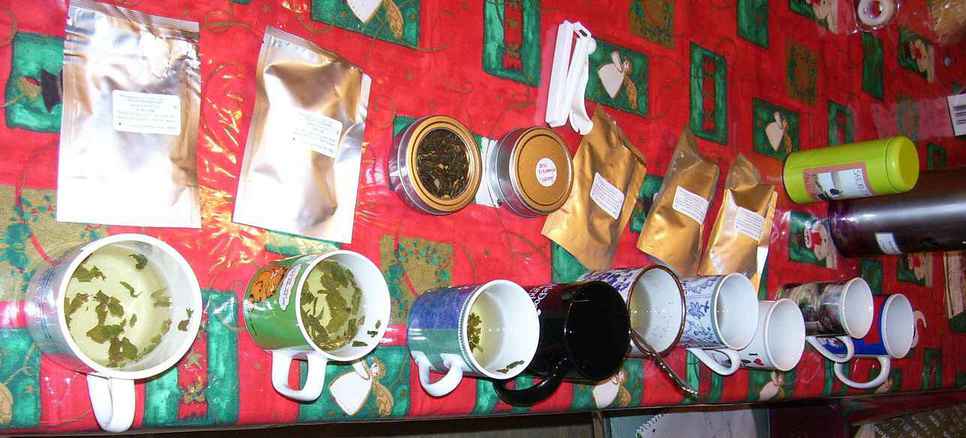
Taste-testing 9 teas side by side
Appendix
Tap Water Dilution of Boiling Water
If all you have to brew tea is boiling water, you can dilute it with cold tap water to the right temperature; ratios/percentages below for cold & warm.

The enemy.
Sometimes I am stuck using a boil-only kettle, like a stove kettle or simple electric kettle (or a fancy kettle pre-set to boiling, or a “water boiler” like a Zojirushi) or Keurig machine.10 I don’t settle for boiling my good loose tea and oversteeping it into bitterness, but I use a trick: dilute it with some tap water to the right temperature. (There’s nothing special about water temperature, so it’s simply a weighted average.)
I measured my kitchen tap water at ~43℉, and I observe that even a full boil on my kettle’s meat thermometer or all Zojirushis is still only ~205℉; so the necessary dilution ratios are, arithmetically (ignoring finer details like volume or temperature of the cup, which I assume to be at room temperature like most dishes):
Tea Type |
Target Temperature |
Boiling (205℉) : Tap (43℉) Ratio (by mass) |
Tap % |
|---|---|---|---|
White Tea |
150℉ |
1.9 : 1 |
34% |
Green Tea |
160℉ |
2.6 : 1 |
28% |
Oolong Tea |
170℉ |
3.6 : 1 |
22% |
My tap water is colder than usual, so most people will want to use more tap water (or less boiling water), and so having a lower dilution ratio.
Many places have roughly room temperature water, in which case:
Tea Type |
Target Temperature |
Boiling (205℉) : Tap (72℉) Ratio (by mass) |
Tap % |
|---|---|---|---|
White Tea |
150℉ |
1.4 : 1 |
42% |
Green Tea |
160℉ |
2.0 : 1 |
33% |
Oolong Tea |
170℉ |
2.8 : 1 |
26% |
Electric Vs Stove Kettle: Fight!
Water Experiment
And they seem to make me queasy & cause digestive problems if I drink more than 1–2 mugs.↩︎
The idea here is to highlight ones which are not necessarily popular or liked on average, but which one would not encounter by default or which are highly polarizing. (It would be nice if there was a large tea rating website where one could automatically extract ‘controversial’ teas & clusters to build sets of recommendations for exploration, but as far as I know, there isn’t one.) I’ve seen tea recommendation lists before, but usually they focus on popular teas or teas the author loved, while what I would have benefited from more was a list of high-information teas, where the author says, “you should try roasted oolongs, kukicha, hojicha & matcha green tea, and pu’erh because people tend to love or hate them, and you’ve probably never tried them before”.↩︎
Looking through my history 2006–6201214ya, I order tea on a roughly annual or semi-annual basis, after which I have increased my consumption & purchasing:
2006-10-16 ($31.14$192006)
2007-12-17 ($15.9$102007)
2008-08-01 ($68.43$442008)
2010-02-15 ($53.68$342010)
Thinking back, that 2 year gap between orders #3 and #4 was probably due to a Christmas where I received more than 2 pounds of tea, which took me a very long time to drink.
2010-07-05 ($50.53$322010)
2011-05-14 ($79.18$512011)
2011-04-12 ($60.55$392011)
2012-07-15 ($114.27$752012)
2013, overall ($132.1$882013)
2015-06-06 ($129.23$902015)
2015-07-10 ($107.69$752015)
2015-09-01 ($159.38$1112015)
2016-02-16 ($84.46$612016)
2016-05-09 ($119.08$862016)
2016-08-11 ($166.15$1202016)
2016-11-26 ($216$1562016)
2016-02-09 ($65.08$472016)
2016-04-08 ($87.23$632016)
2017-06-19 ($198.19$1472017)
2017-06-27 ($52.58$392017)
2017-07-18 ($132.12$982017)
2017-10-03 ($33.71$252017)
2017-10-04 ($99.77$742017)
2018-02-22 ($132.72$1012018)
2018-04-26 ($407.35$3102018)
2018-11-12 ($22.34$172018; $72.27$552018; $30.22$232018)
2019-05-06 ($135.23$1062019)
2019-07-27 ($82.92$652019)
2019-11-10 ($133.96$1052019)
2020-01-02 ($153.45$1222020)
2020-01-27 ($157.22$1252020)
2020-06-02 ($176.09$1402020)
2020-07-24 ($188.67$1502020)
2020-10-16 ($226.4$1802020)
2020-12-31 ($201.25$1602020)
2021-03-19 ($258.8$2082021)
2021-06-29 ($273.73$2202021)
2021-08-19 ($298.61$2402021)
2022-02-03 ($140)
2022-09-22 ($258)
2023-03-07 ($225)
2024-07-04 ($181)
2024-12-02 ($100)
Several purchases were triggered by travel, wanting to try out new tisanes like yaupon or yerba mate or a specific genre like CO2 decaffeination, or sales. I’ve tried broadening my horizons and ordered 9 teas from a number of retailers through Amazon.com (principally Tao of Tea, Pure Herbal, & Summit Tea), and while some of Tao of Tea was good, overall I was not impressed. Harney & Sons worked out much better for finding teas beyond Upton.↩︎
An analogue thermometer can be given a quick & dirty calibration by testing it against ice-water and boiling water. If it’s a few degrees off, no big deal—tea, unlike some things like eggs or chocolate, is not that sensitive to temperature. As long as it’s within ±5F or so, that’s good enough. (More precision is spurious because of all the other error: the water itself will be conducting & convecting & have temperature gradients, the tea kettle will continue to heat even after being turned off, you’ll steep for different amount of time anyway, and so on.)↩︎
Much of the research is of poor quality and from East Asia & China in particular, which is always a red flag for anything to do with traditional Asian treatments; reviews/meta-analyses, like the Cochrane reviews on “Shengmai (a traditional Chinese herbal medicine) for heart failure” & “Ginseng for cognition” typically find few high-quality studies & small inconsistent benefits.↩︎
Not always. The Venetian in Las Vegas omitted an electric kettle, despite it being a fairly expensive suite; when I called Housekeeping to point out the omission, they insisted on both charging me for it and needing to be there in person whenever someone bothered to come up with a kettle! As I was busy, I wound up never getting a kettle (and made do with my caffeine pills and tea at restaurants). I still resent their nickel-and-diming.↩︎
I don’t know why caterers have lots of weird herbal & decaf teas, but then sometimes not even a simple green tea. There must be some business reason: herbal teas are often much cheaper, so perhaps caterers are forced to take package deals?↩︎
As a brightly-green-colored fine powder, you do not want any matcha getting loose in your luggage or pocket, so any kind of resealable or large container is a bad idea. One wants foil packets which are so robust one might have to tear them open with one’s teeth. When it comes to travel, Murphy’s law is not mocked, and anyone traveling with jars of loose staining powder is courting disaster.↩︎
As usual, caveat emptor. The turmeric & curcumin research I’ve looked at has been no better than the usual run-of-the-mill (and usually wrong) alternative medicine/supplement research, and in the case of curcumin, there has been outright fraud in fabricating research.↩︎
Although this dilution problem is less relevant to Keurig machines—so common in hotel rooms—because the Keurig machines have such low capacity that by the time you get a decent amount of heated water, it has cooled down to green tea temperature. This is just one of the many ways that Keurig machines are frustrating to use for tea, from low capacity to loud noise. (Although they avoid the most important coffee machine failure modes: being unable to produce plain hot water, or producing only water which tastes foully of stale coffee.) Amusingly, the seemingly cheap & crummy “Mr. Coffee” coffee machines (one of the more common ones after Keurigs) are adequate.↩︎