Terrorism Is Not Effective
More effective ways to kill = terrorists are stupid, or killing not most important thing to them
Terrorism is not about causing terror or casualties, but about other things. Evidence of this is the fact that, despite often considerable resources spent, most terrorists are incompetent, impulsive, prepare poorly for attacks, are inconsistent in planning, tend towards exotic & difficult forms of attack such as bombings, and in practice ineffective: the modal number of casualties per terrorist attack is near-zero, and global terrorist annual casualty have been a rounding error for decades. This is despite the fact that there are many examples of extremely destructive easily-performed potential acts of terrorism, such as poisoning food supplies or renting large trucks & running crowds over or engaging in sporadic sniper attacks.
Efficacy sometimes reveals what people really want. One of the least commonly noted pieces of evidence for the theory that Terrorism is not about Terror (besides the other points like the complete failure to obtain their policy goals) is how unterrifying most terrorism is, and how attacks usually have such low death tolls.
No terrorist group has achieved a kill rate anywhere near a conventional military; and are vastly less than those death tolls for guerrilla organizations or dictators. Stalin or Mao could, in a bad day, exceed the deaths caused by all international terrorism over the last 2 centuries1. 9/11, the crowning incident of terrorism in those centuries, was equaled by just 29 days2 of car accidents in the USA345678—and 9/11 was only accidentally that successful9! 9/11 is also a sterling example of the availability bias: besides it, how many attacks could the best informed Western citizen name? Perhaps a score, on a good day, if they have a good memory; inasmuch as the MIPT database records >19,000 just 1968–36200422ya, it’s clear that terrifyingly exceptional terrorist attacks are just that. Remarkably, it seems that it is unusual for terrorist attacks to injure even a single person; the MIPT database puts the number of such attacks at 35% of all attacks.10 Certainly the post-9/11 record would seem to indicate it was a fluke11. And statistically, it seems that for established terrorist groups, assassinating their leader does them a favor—they survive longer, presumably because they had ossified.12 Many terrorist organizations keep very detailed financial records (consider the troves of data seized from Al-Qaeda-in-Iraq, from Bin Laden’s safehouse, or Al Qaeda’s insistence on receipts), with little trust of underlings, suggesting far less ideological devotion than commonly believed & serious principal-agent problems. Stories about terrorist incompetence are legion1314 and the topic is now played for laughs (eg. the 201016ya movie Four Lions15), prompting columnists to tell us to ignore all the incompetence and continue to be afraid.
The mystery is that this doesn’t have to be the case. Mass murder is quite feasible without the techniques terrorists resort to. We don’t even have to resort to speculation to improve on the contemporary terrorist state-of-the-art16; history teaches us quite enough.
The most famous terrorist attacks like the 2008 Mumbai attacks (10 attackers killed >173, wounded >308) may not suffice to prove the point that ‘grand spectacle’ terrorism is inefficient in killing, since the Pakistani support undermines the fact of their low-tech simple approach (extensive state sponsorship, arming, training, engaging in literally an amphibious assault, and realtime intelligence/advice from their Pakistani handlers), and nevertheless, the efficiency per-attacker was far below many other instances of terrorism (like Breivik or Nice). But we can point to others:
The 2018 Australian strawberry contamination incident, involving needles found in strawberries, cost relatively little (only a few grower bankruptcies & estimates of sales losses as low as $15.31$122019 million), but is striking because the original still-unknown culprit may have planted only a few needles, and the rest were done by copycats.
Further of interest is the Gruinard Island “Dark Harvest” bioterrrorism incident, which successfully coerced the British government into decontaminating the island at a cost somewhere >$2,232,107.18$688,0001986; a contemporary bioterrorism extortion in California, the 1989 California medfly attack (also successful in coercing the desired government response), appears to’ve cost ~$115.7$401989–$289.26$1001989m (subtracting the baseline cost from the range WP gives).
The 198244ya Chicago Tylenol murders (7 deaths, national panic, culprit remains unknown) seem to have involved nothing more complicated than some shoplifting, dumping in some cyanide, and putting the bottles back on the shelves; this forced the recall & destruction of $100m (2017: $254m) of Tylenol products, industry-wide upgrades of tamper-evident safety seals & package sealing & pills, and large losses in sales.
Some pesticide in the wrong place can cost:
And an anonymous phone call20 cost the Chilean economy $300 million.21
Competent Murders
The natural comparison, of course, is to private citizens without government or organizational backing who set out to kill a lot of people over a brief, no more than few days long, period. Or as we call them where I come from, ‘mass murderers’; but let’s narrow things down: how many people can you kill in a short period of time? Let us consult Wikipedia which – ever helpful – has even compiled a sorted list for us: “List of mass murderers and spree killers by number of victims”.
The 200125ya Shijiazhuang bombings killed 108 people and was officially blamed on an unemployed deaf man. As of 201016ya, the global record for undisputed attacks was held by one Woo Bum-kon, who killed 56-6222 people in 198244ya, with an honorable mention to William Unek (57 confirmed kills as of 195769ya). The US record goes to Seung-Hui Cho with 32 kills in 200719ya (the US record being broken by Omar Mateen in 2016 with 49 kills). Bum-kon lost the record in 201115ya to the Norwegian Anders Behring Breivik who killed 8 with a bomb and then killed 69 campers with firearms23, totaling 77 kills. This record was broken 5 years later in the 2016 Nice attack by Mohamed Lahouaiej Bouhlel, with 84+ deaths.
The most striking thing one notices in the entries is how these atrocities rarely involve extremely elaborate preparations, and how minimal the equipment was:
Bum-kon’s Uiryeong massacre was literally on the spur of the moment, when he got drunk after an argument with his girlfriend; somewhat unusually, he had access to grenades via the police, but the grenades arguably did not contribute to the death toll24.
William Unek killed his first 21 people with just an axe.
In the Japanese Akihabara massacre, Katō had nothing but a rented truck and a knife, nor any known martial arts training or especial fitness—and yet, in a large crowd with multiple police already at the scene, he still managed to kill 7 people and wound 10. In the 2016-07-26 Sagamihara stabbings, the attacker Satoshi Uematsu killed 19 people & injured 26. (Like Bum-kon’s massacre, Uematsu benefited from the late-night circumstances, as almost all of the mentally & physically handicapped people were stabbed in their sleep.) The 2014 Kunming attack witnessed 8 men & women with knives kill >33 people and injure >143, while an 2015-09-18 attack by 9 attackers killed 50 people (see also School attacks in China (2010-12)). The 2010 Hebei tractor rampage (exactly what it sounds like) killed 17.
Cho had two pistols, bought a few weeks before the Virginia Tech massacre. Seung-Hui made the most elaborate preparations (videos & letters, multiple gun store trips), but one still has the impression that he could’ve finished all his preparations in just a few hours.
The one that did, Anders Breivik, is almost the exception that proves the rule—he had bought fertilizer in May 201115ya, months before the attack, but that bomb was almost a non-event: he killed an order of magnitude more in the second attack with his firearms. (He apparently worked on his 1500-page manifesto for 2 years, though he didn’t kill anyone by dropping it on them.)
Omar Matene simply entered a nightclub with a handgun and semi-automatic rifle (having failed at buying body armor because he went to the wrong store first, then was turned away at the second) and started shooting; he bluffed about having bombs during the attack, but otherwise had made no further preparations
Bouhlel had acquired a small arsenal of weapons, most of which were fake or broken; his main weapon was simply a rented truck he ran people over with
The speed with which these mass murders were prepared and carried out are quite shocking when we compare them to the multiple years and intricate multinational terrorist network it took to bring 9/11 to fruition. I am not the only one to notice this, nor is Schneier25; the terrorists themselves know it, according to STRATFOR:
It must be remembered that simple terrorist attacks are relatively easy to conduct, especially if the assailant is not concerned about escaping after the attack. As jihadist groups such as AQAP have noted in their online propaganda, a determined person can conduct attacks using a variety of simple weapons, from a pickup truck to a knife, axe or gun. Jihadist ideologues have repeatedly praised Nidal Hassan and have pointed out that jihadists operating with modest expectations and acting within the scope of their training and capability can do far more damage than operatives who try to conduct big, ambitious attacks that they lack the basic skills to complete.
OK. So this alone suggests that perhaps terrorists are, to put it mildly, adopting suboptimal techniques for killing people. But wait! These are impressive body counts, but maybe terrorists are hoping to win the lottery and achieve a 9/11 attack (even though for every 9/11, there are dozens & hundreds of attacks which kill 10 or 20 people, or even only the terrorist). After all, the 19 terrorists averaged 157 kills just in that one attack. That’s nearly 3 times Bum-kon’s lifetime total.
Competent Soldiers
Now we should shift comparisons. Civilians—with minimal preparation, with no training, with nothing special whatsoever about them—can kill up to 60 people. What could someone with years of preparation and hundreds of thousands of dollars available26 do?
Well, I can’t answer that. But I can point to an interesting example.
Simo Häyhä was a Finnish sniper in the Winter War, when the Soviet Union invaded Finland. He ultimately killed over 54227 Russians – and survived the war.
Now, Simo was a rare marksman; this is true. But consider the handicaps he labored under:
he is fighting in Finland in the depths of an unusually harsh winter;
he is subject to military discipline/constraints;
he is in the middle of a full-scale conventional war, where life is cheap and death could come at any moment if he is on the wrong side of the shifting boundaries;
he is using a relatively old and ordinary bolt-action rifle with iron sights;
he is being specifically targeted by the Russians (who are not military incompetents, even after Stalin’s purges), who are dispatching their own snipers and artillery squadrons for the sole purpose of killing him; etc.
Simo was working in challenging conditions, let us say.
But a modern sniper can buy the finest rifles on the market, and can confine his activities to temperate areas where he does not need to freeze his tookis while waiting for a shot. He is opposed only by police and paramilitary organizations with little training or even familiarity with counter-sniper weapons and tactics. (It is not as if they have ever had to!) He can travel anywhere within the country and wait indefinitely for his next attack. The many historical examples of serial killers teach us this disturbing lesson: if he is controlled and patient, a man can kill indefinitely even while making close personal contact with the victim and killing in inefficient ways. (One running theme with serial killers is how effective simply picking random victims is at preventing capture or even identification of victims, eg. despite Israel Keyes providing a count & descriptions, 6+ murders remain unidentified and certainly would have never been solved). How much more so could a sniper picking random targets!
The Beltway snipers offer an (incompetent) example: the nation was transfixed and horrified, the DC area gridlocked for weeks, and extraordinary measures were taken like the Secretary of Defense authorizing the deployment of Army surveillance aircraft. Another dubious example comes courtesy of the Swedish shooter John Ausonius who eluded capture for 6 months despite crippling his guns with pseudo-silencers, walking up to several of his 11 victims, and robbing banks on a bicycle.
It is not unreasonable to think that a terrorist-sniper could kill indefinitely, at a high tempo. If he shot one person a month, he will exceed Bum-kon in just 5 years. If the 20 9/11 hijackers had instead become snipers, they would at that slow rate match Simo in 2 years or so, and 9/11 in ~12 years. And they could keep on killing. It’s not like they have to retire after a decade or two.
Why Not?
Propaganda, Not Deaths
So if all these other methods are easier, or more effective, then why do terrorists like hijackings and bombings? Stupidity or fanaticism might explain why one group would sabotage itself, but it can’t explain all groups for centuries.
One possible explanation is given by Philip Bobbitt’s Terror and Consent – the propaganda of the deed is more effective when the killings are spectacular (even if inefficient). The dead bodies aren’t really the goal.
But is this really plausible? Try to consider the terrorist-sniper plan I suggest above. Imagine that 20 unknown & anonymous people are, every month, killing one person in a tri-state area28. There’s no reason, there’s no rationale. The killings happen like clockwork once a month. The government is powerless to do anything about it, but their national & local responses are tremendously expensive (as they are hiring security forces and buying equipment like mad). The killings can happen anywhere at any time; last month’s was at a Wal-mart in the neighboring town. The month before that, a kid coming out of the library. You haven’t even worked up the courage to read about the other 19 slayings last month by this group, and you know that as the month is ending next week another 20 are due. And you also know that this will go on indefinitely, and may even get worse—who’s to say this group isn’t recruiting and sending more snipers into the country?
Consider the 2001 anthrax attacks after 9/11. In my memory, the sheer terror and reflexive jingoism that gripped the country after 9/11 was at least doubled during them.
The anthrax attacks killed very few people & a tiny percentage of 9/11 (0.17%: 5⁄2,974 × 100). But their randomness and duration through time made them deeply & irrationally frightening.
Just 5 people died of anthrax over the 3 weeks of the anthrax attacks; and people were panicked. How much more devastating would it have been if it had been 20 people who had died? Or if the mailings had continued month after month? I think that it would have been much more effective, and that this supports the value of my sniper plot29.
External Links
“The Political Effectiveness of Terrorism Revisited”, Abrahms 2012
“Secret without Reason and Costly without Accomplishment: Questioning the National Security Agency’s Metadata Program”, Mueller & Stewart 2014
Fry The Brain: The Art Of Urban Sniping and Its Role in Urban Warfare, John West 2008
Nine Lives: My time as the MI6’s top spy inside al-Qaeda, Dean et al 2018
Appendix
On the Absence of True Fanatics
A few honest men are better than numbers.
Oliver Cromwell, letter to Sir William Spring (September 1643383ya)
If we were bees, ants, or Lacedaemonian warriors, to whom personal fear does not exist and cowardice is the most shameful thing in the world, warring would go on forever. But luckily we are only men—and cowards.
The famous Tueller drill reports that a knife man can cover 21 feet & stab in just 1.5 seconds—faster than most trained people can draw and shoot a gun. While victims fight back, they are still dispatched in seconds31.
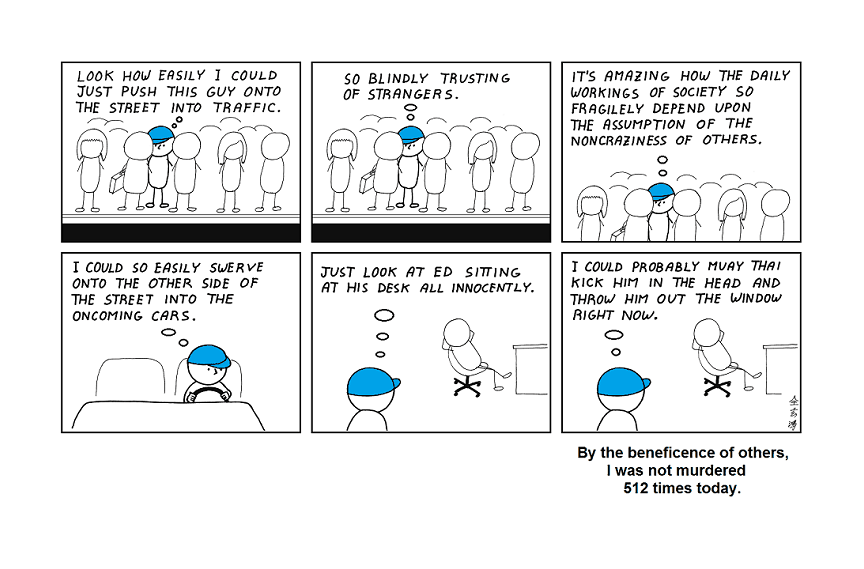
“The Beneficence of Others”, Abstruse Goose
There is a lesson here. I take away this message: most people don’t really care. Most organizations lack asabiyyah. The existentialists tell us we have tremendous power & freedom but we don’t use it and we forget it except on occasion when we read with awe of prodigious feats by religious figures like self-immolation or self-mummification or the Kaihogyo’s endless marathons, or enjoy fictional examples. I agree that we have tremendous destructive powers, but this also implies that we have limited constructive powers. (Destructive powers don’t interfere with each other, but they mean that it is far harder to create than to destroy. Anyone can destroy a DVD with ease, but to manufacture it, much less create whatever it stored, is much harder—a task fit for an entire country or civilization.)
Destruction can be useful though. Many people all over the political spectrum has expressed earnest desires in the last few years to destroy some group or institution. Terrorists come to mind.
But the odd thing is, very little destruction has happened. A nut with a gun has an average kill or destruction rate better than that of your average terrorist. A little effective planning, and a nut could do a lot. Marvin Heemeyer is a case in point. Despite unrelenting police opposition, he and his armored bulldozer destroyed 13 buildings worth $7 million. He was stopped by his own incompetence when he drove the bulldozer into a basement; he then committed suicide.
I also point out a far more effective terrorist strategy than existing ones in the preceding essay on terrorism.
A good answer for terrorists specifically is the social one; but what about everyone else? Why do they not pursue their targets with all the highly effective means possible?
The answer is motivation and values. We value ordinary comforts & life. The power is available to us only at the cost of everything else. Fruitful comparison might be made with idiot savants or autistics with obsessive interests, or less pathologically, subgroups like ‘otaku’ or ‘anoraks’.
Fictional examples are also of interest. Larry Niven offers us the Known Space’s Pak Protector—a genius variety of human who are obsessed with protecting their kindred. Though described as super-intelligences, Niven, being an ordinary human himself, depicts Pak feats within reach of a motivated human. Vernor Vinge postulates ‘Focus’ in his A Deepness In The Sky: a hyperfocus or permanent state of being ‘in the zone’—with the monomania that implies. (It is worth noting that studies of human genius frequently say that raw IQ and talent suffer diminishing returns past 130 IQ, such that while very high IQ individuals are still far more likely to make breakthroughs or reach the heights of professional accomplishment than any lower percentiles (see for example the SMPY lifetime achievement results), there’s still a good chance of being fairly ordinary and they don’t come off as an entirely different species—perhaps because they are held back by being less exceptional in other key ways like motivation, openmindedness, conscientiousness, extraversion, or monomania, traits which currently cannot be affected.)
Fanatics are frightening. Suicide tactics in even small quantities can be highly effective. The Jewish sicarii, or Japanese kamikaze are cases in point. Though small in number, they were more effective than conventional methods. (Kamikazes were neutralized by the end of WWII, but only by vast opposition—hundreds of defending planes, pickets stationed more than 50 miles away, improved artillery, etc.) That terrorists do so little enhances this point: one 9/11 was so effective that for a million dollars or two at most, it triggered the expenditure (and waste) of thousands of lives and literally trillions of dollars. 1 or 2 million dollars wouldn’t even buy a dictator a worthless tank which the USAF could bomb! Compare this to something like Occupy Wall Street, which has determinedly avoided violence, in a misguided attempt to shame the shameless and inspire action. (The shame seems important; Gandhi succeeded with minimal violence on his part because he waged in essence a propaganda campaign against the British elite, who never before had trouble holding India, while it is often forgotten that Nelson Mandela was a terrorist, perhaps because the South African elites were unified and could not be simply shamed—so the ANC switched to international propaganda combined with long-term threats.) Moral suasion is neither sufficient nor necessary, and I suspected OWS would run into a similar fate as the Bonus Army: burned out of their camps, dispersed, and ultimately as effective as the anarchists and socialists of yore who were giants compared to their pusillanimous contemporaries. As it turned out, OWS was easily dispersed by police when they tried, and at least of August 201313ya, the OWS programme has been a failure & they have disappeared from national consciousness.
The idea of elite cohesion (or asabiyyah) is an interesting one; what I wonder, as I watch modern politics, is “are the current Anglosphere elites more or less cohesive than past cohorts, and if they are, is this due to free market ideologies and mechanisms which serve to punish dissidents and elevate those who are capable [sociopathic and intelligent enough to ‘sparkle’?] and also who wish to defend and cleave to the status quo?” Some interesting quotes from “Insight: The Wall Street disconnect”:
Paulson responded by putting out a press release that described his $28 billion, 120-person fund as an exemplar of the American Dream: “Instead of vilifying our most successful businesses, we should be supporting them and encouraging them to remain in New York City.” Other captains of finance like to portray themselves as humble entrepreneurs. One owner of a multi-billion-dollar hedge fund grumbled in the midst of the financial crisis that he has to worry not only about making trading decisions but also about “all the hassles that come with running a small business.”…“I think everyone gets what the anger is about… But you just can’t say, ‘Well I want all debts forgiven.’ That is not happening,” says one West Coast trader, who like most still working in the financial services industry, declined to be identified by name in this article…“At first I had friends who were scratching their heads at the protests,” says Ader…Thomas Atteberry, a partner and portfolio manager with Los Angeles-based First Pacific Advisors, a $16 billion money management firm, says his success “wasn’t a gift” and he had to work hard to get where he is. Atteberry says he understands the frustration many feel about income inequality. But he said the problem isn’t with those who are successful, but rather our “tax codes and regulations.”…Many of America’s well-to-do, not just Wall Streeters, say they don’t feel particularly advantaged. A recent survey by marketing firm HNW Inc. found that half of the nation’s richest 1% “don’t see themselves as being part of that elite group.” Also, 44% of those surveyed told HNW’s pollsters they already pay too much in taxes….”I think Wall Street hasn’t taken in how much anger there is out there and they haven’t taken partial responsibility for the financial crisis,” says Brookings Institution fellow Douglas Elliott, who was an investment banker for two decades before joining the liberal-oriented public policy group. “I think both sides—Wall Street and Main Street—misunderstand each other.”
Suppose people angry at Goldman Sachs were truly angry: so angry that they went beyond posturing and beyond acting against Goldman Sachs only if action were guaranteed to cost them nothing (like writing a blog post). If they ceased to care about whether legal proceedings might be filed against them; if they become obsessed with destroying Goldman Sachs, if they devoted their lives to it and could ignore all bodily urges and creature comforts. If they could be, in a word, like Niven’s Protectors or Vinge’s Focused.
Could they do it? Could they destroy a 3 century old corporation with close to $1 trillion in assets, with sympathizers and former employees throughout the upper echelons of the United States Federal Government (itself the single most powerful entity in the world)?
Absolutely. It would be easy.
As I said, the destructive power of a human is great; let’s assume we have 100 fanatics—a vanishingly small fraction of those who have hated on GS over the years—willing to engage even in assassination, a historically effective tactic32 and perhaps the single most effective tactic available to an individual or small group.
Julian Assange explains the basic theory of Wikileaks in a 200620ya essay, “State and Terrorist Conspiracies” / “Conspiracy as Governance”: corporations and conspiracies form a graph network; the more efficiently communication flows, the more powerful a graph is; partition the graph, or impede communication (through leaks which cause self-inflicted wounds of secrecy & paranoia), and its power goes down. Carry this to its logical extreme…
If all links between conspirators are cut then there is no conspiracy. This is usually hard to do, so we ask our first question: What is the minimum number of links that must be cut to separate the conspiracy into two groups of equal number? (divide and conquer). The answer depends on the structure of the conspiracy. Sometimes there are no alternative paths for conspiratorial information to flow between conspirators, other times there are many. This is a useful and interesting characteristic of a conspiracy. For instance, by assassinating one ‘bridge’ conspirator, it may be possible to split the conspiracy. But we want to say something about all conspiracies.
We don’t. We’re interested in shattering a specific conspiracy by the name of Goldman Sachs. GS has ~30,000 employees. Not all graphs are trees, but all trees are graphs, and corporations are usually structured as trees. If GS’s hierarchy is similar to that of a binary tree, then to completely knock out the 8 top levels, one only needs to eliminate 256 nodes. The top 6 levels would require only 64 nodes.
If one knocked out the top 6 levels, then each of the remaining subtrees in level 7 has no priority over the rest. And there will be 27 − 26 or 64 such subtrees/nodes. It is safe to say that 64 sub-corporations, each potentially headed by someone who wants a battlefield promotion to heading the entire thing, would have trouble agreeing on how to reconstruct the hierarchy. The stockholders might be expected to step in at this point, but the Board of Directors would be included in the top of the hierarchy, and by definition, they represent the majority of stockholders.
We could in fact partition a binary tree in half just by assassinating the root node, the CEO, and this has become a revived strategy in this age of the corporation; John Robb, “Piercing the Corporate Veil”:
CEO kidnapping isn’t new. It is common practice in Brazil, Mexico, etc. The difference in Iraq is the motive. In Iraq, it isn’t purely financial gain. It is being used as a way to unravel the fledgling Iraqi government. Here’s why. America’s second largest ally in Iraq isn’t the UK. Not even close. Corporations like Halliburton provide almost as many trigger pullers and engineers as the US Army. They are the battalions of foot soldiers in Thomas Barnett’s sys-admin force—connecting Iraq to the US and the world. This role converts CEOs into generals/colonels in the US globalization machine (leaders of new entrants in the rapidly expanding long tail of warfare). They are now legitimate and highly prized targets.
…The corporation is a particularly bad organization for warfare. It is much too centralized. The institution of the CEO is a particular weakness (a systempunkt in global guerrilla lingo). The CEO’s network centrality makes him/her a single point of failure for the entire corporate organism….
Financial trauma. The departure of the CEO from a public company can create substantial market volatility in the company’s stock (see this Fed study for more) for up to two years after the event. Note: This volatility offers the incentive of rapid financial gains to guerrillas with the foreknowledge of attacks through leveraged investments in options and derivatives…
…a CEO is an excellent strategic target as well as a tactical target. As a rule of thumb, I would consider all CEOs that reside/work within a nation-state at war with non-state guerrillas at risk. Under almost all measures of this new method of warfare, CEOs are better targets than government or military officials. Remember, in this flat world, it is easy to pull up a CEO’s name, address, credit history, and even a satellite photo of his/her home from a Cyber Cafe in Peshawar.
A worrisome counter-example is Cantor Fitzgerald, which lost an entire office and 2⁄3 of its headcount on 9/11, but is still around. But this fits into the graph formalism well if we look at the details and notice that the damage was entirely confined to a single group in CF. An office is just a subgraph—losing an entire office meant that the hierarchy was preserved: one subtree was lopped off, and the main tree continued. Every survivor knew where they were in the hierarchy. “The Survivor Who Saw the Future for Cantor Fitzgerald”, reveals many interesting details from the ‘attack’ point of view relevant to the graph perspective:
Cantor was the linchpin of its business (“In 200125ya, more than 70% of all Treasuries were traded through Cantor.”), a business which, thanks almost directly to 9/11 and the subsequent invasions of Afghanistan & Iraq with the continued deficits & war-spending, was about to boom from $5.7 trillion to $16.1t 2000–2012:
…based on data released by the company and payouts to families, Cantor and eSpeed made about $150 million a year, on average, in the five years after the attacks. For all its losses and sorrows, Cantor actually had the wind at its back. eSpeed thrived in 2002 and 2003 thanks in part to the nation’s ballooning debt. As the government sold more bonds to finance its deficit, the bond market grew and Cantor had more Treasuries to trade.
the Cantor CEO and chairman, Howard W. Lutnick, worked in the NYC office yet by sheer luck happened to not be there
Cantor had a London office and which was able to handle Cantor’s main business:
Unable to reach Mr. Lutnick on Sept. 11, Lee Amaitis, the head of the London office and a close friend, began mapping out a plan. He helped reconfigure Cantor’s trading systems so that trades could be processed through London, rather than New York. Mr. Lutnick and his remaining employees in New York soon decamped to a windowless computer center in Rochelle Park, N.J. Thanks to eSpeed, Cantor could clear its trades electronically. Forty-seven hours after the planes hit, as the bond market nervously reopened for business, so did Cantor.
the aforementioned eSpeed was also crucial—the humans were not that necessary:
In 199927ya, he took public Cantor’s electronic trading subsidiary, eSpeed. Some of his brokers feared that such electronic trading systems would eventually put them out of work. In fact, Mr. Lutnick’s electronic push helped Cantor stay afloat after Sept. 11. Cantor lost almost all of its brokers—but eSpeed didn’t need brokers. Without the new trading technology, Cantor might have gone under. “In a way, eSpeed saved them,” says Richard Repetto, an analyst at Sandler O’Neill, which itself lost 66 employees at the World Trade Center.
One could launch the attack during a board meeting or similar gathering, and hope to have 1 fanatic take out 10 or 20 targets. But let’s be pessimistic and assume each fanatic can only account for 1 target—even if they spend months and years reconnoitering and preparing fanatically.
This leaves us 36 fanatics. GS will be at a minimum impaired during the attack; financial companies almost uniquely operate on such tight schedules that one day’s disruption can open the door to predation. We’ll assign 1 fanatic the task of researching emails and telephone numbers and addresses of GS rivals; after a few years of constant schmoozing and FOIA requests and dumpster-diving, he ought to be able to reach major traders at said rivals. (This can be done by hiring or becoming a hacker group—as has already penetrated Goldman Sachs—or possibly simply by open-source intelligence and sources like a Bloomberg Terminal.) When the hammer goes down, he’ll fire off notifications and suggestions to his contacts33. (For bonus points, he will then go off on an additional suicide mission.)
GS claims to have offices in all major financial hubs. Offhand, I would expect that to be no more than 10 or 20 offices worth attacking. We assign 20 of our remaining 35 fanatics the tasks of building Oklahoma City-sized truck bombs. (This will take a while because modern fertilizer is contaminated specifically to prevent this; our fanatics will have to research how to undo the contamination or acquire alternate explosives. The example of Anders Behring Breivikreminds us that simple guns may be better tools than bombs.) The 20 bombs may not eliminate the offices completely, but they should take care of demoralizing the 29,000 in the lower ranks and punch a number of holes in the surviving subtrees.
Let’s assume the 20 bomb-builders die during the bombing or remain to pick off survivors and obstruct rescue services as long as possible.
What shall we do with our remaining 15 agents? The offices lay in ruins. The corporate lords are dead. The lower ranks are running around in utter confusion, with long-oppressed subordinates waking to realize that becoming CEO is a live possibility. The rivals have been taking advantage of GS’s disarray as much as possible (although likely the markets would be in the process of shutting down).
15 is almost enough to assign one per office. What else could one do besides attack the office and its contents? Data centers are a good choice, but hardware is very replaceable and attacking them might impede the rivals’ efforts. One would want to destroy the software GS uses in trading, but to do that one would have to attack the source repositories; those are likely either in the offices already or difficult to trace. (You’ll notice that we haven’t assigned our fanatics anything particularly difficult or subtle so far. I do this to try to make it seem as feasible as possible; if I had fanatics becoming master hackers and infiltrating GS’s networks to make disastrous trades that bankrupt the company, people might say ‘aw, they may be fanatically motivated, but they couldn’t really do that’.)
It’s not enough to simply damage GS once. We must attack on the psychological plane: we must make it so that people fear to ever again work for anything related to GS.
Let us postulate one of our 15 agents was assigned a research task. He was to get the addresses of all GS employees. (We may have already needed this for our surgical strike.) He can do this by whatever mean: being hired by GS’s HR department, infiltrating electronically, breaking in and stealing random hard drives, open source intelligence—whatever. Where there’s a will, there’s a way.
Divvy the addresses up into 14 areas centered around offices, and assign the remaining 14 agents to travel to each address in their area and kill anyone there. A man may be willing to risk his own life for fabulous gains in GS—but will he risk his family? (And families are easy targets too. If the 14 agents begin before the main attacks, it will be a while before the Goldman Sachs link becomes apparent. Shooting someone is easy; getting away with it is the hard part.)
I would be shocked if Goldman Sachs could survive even half the agents.
The reader will object that this is an absurd mad intellectual game! Which it is. Where are 100 humans who would not flinch at such cold-blooded mass murder, who will devote unceasing years to the mission, who will live on $1 of bulgur pilaf a day to save money for bombs & bribes?
Coordination Problems
Why do large countries like France34 or China focus on hammering smooth all their ethnic and linguistic diversity and establishing “patriotism”? Why did Robert D. Putnam find that “diversity” in America correlated with low community trust, public goods, charity, friends, and quality of life? Why do our 100 fanatics seem the stuff of fiction? Reading in economics once, I hit the phrase “all economics is coordination problems”, and it seemed exactly true to me: why do businesses have all these managers and infrastructure and sheer apparent waste? Because of principal-agent problems and similar issues, all of which can be construed as coordination problems. Why do we need them? Because there are so many heterogeneous people involved, all differing in various ways with different interests, and they need to be hammered into a coherent force.
Why not just select similar people, eliminate this massive overhead of coordination, and just let them work on stuff? After all, this seems to be exactly what happens in places like the Apollo program or the spy satellite programs, startups like Github or Apple or Google or Microsoft; far from illustrating how “diversity is strength”, these programs seem to thrive on being a homogenous cluster of geeky young male White/Asian techs sharing the same cultural shibboleths like Star Wars or Monty Python, with a striking absence of women, blacks, Hispanics, or humanities types. If this blatant systematic discrimination was not useful, why do we see so few startups blasting apart established tech giants with their underpriced women? (Alan Greenspan, for example, ran a profitable economics firm using discriminated-against women.) The easy answer is simply that the discrimination works in getting the people they need with the Right Stuff. Well… it works for a while: there’s only so many energetic skilled young techies. But when you can cluster enough of them in one homogenous company, you may get something amazing.
Amazing until it keeps growing, heterogeneity builds up, and problems with coordination start happening…
Discussion
I have just laid out a scheme whereby agents extraordinary only in dedication have exerted world-shaking power. Similar scenarios are true of other sectors. (The Secret Service works hard, but can they protect the President against the 100 fanatics?) Destruction and offense is always easier than construction and defense, but it’s hard to see why the fanatic advantage would be completely negated in constructive enterprises. (Small groups of programmers and engineers routinely revolutionize sectors of technology, without being especially fanatical.) But of course, we see very few such schemes in either direction. That is the point. There is a very large gap between what we can do and what we will do. Coordination is extremely hard (see again the principal-agent problem).
But the scary thought is—will things remain that way? I have been at pains to keep the agents ordinary. Is there any way now or in the future to create such agents? My thoughts, anyway, immediately turn to the famed Assassins, whose name supposedly comes from their use of hashish to delude their agents into more than usual religious zealotry, and who were quite effective in bad circumstances until finally extirpated by the Mongols. Yes, drugs are a worrying precedent; the cravings of addiction can make someone do anything, no matter how depraved. And what are drugs but chemicals which affect small parts of the brain? And if a chemical will affect the brain in such a way, are there chemicals with enhanced effects? Or another way of accomplishing the same effect, perhaps with electricity?
In short, is there any reason to believe wireheading will not work in humans like it works in mice? Wireheading is generally dismissed35 as a problem that neatly solves itself: someone with an electrode in their pleasure center will be like a drug addict with an unlimited supply—they will bestir themselves only enough to stay alive to keep activating the electrode, if even that. Darwin takes care of the problem. But some see wireheading as potentially very useful, and it is not hard to think of safeguards. For example, what if the electrode is not under the control of the subject? Someone else controlling it could use it to get useful work out of the subject, although one could analogize a wirehead is an evil genie: they truly care only about the stimulation and getting control of it, and not genuinely serving the controller (eg. Ringworld) and like all evil genies, susceptible to backfiring spectacularly on anyone trying to use them. (“The only thing that really worried me was the ether. There is nothing in the world more helpless and irresponsible and depraved than a man in the depths of an ether binge, and I knew we’d get into that rotten stuff pretty soon.”) That is one scenario. Here is another: the electrode is under the control of a program connected to metrics chosen by the subject, like going to the gym. (Related topic: nicotine & habit-formation.) The incentives are much more closely aligned: the subject could gain control of the stimulation, but that would frustrate another goal of his (going to the gym). Imagine the program hooked up to a comprehensive plan for attacking Goldman Sachs; one rather doubts that an agent will break the plan and not eat bulgur pilaf if that means he is simultaneously sabotaging the plan and also depriving himself of pleasure.
Such a prospect is awesome, in both the negative and positive sense. A wirehead has such potential.
And the next logical step, an uploaded mind which has been patched and rewritten to not even need pleasure-center stimuli to carry out its chosen goals? That would be a Singularity in the Vingean sense that one truly cannot predict beyond—whether the world will end in fire or ice.
The Better Angels of Our Nature, Pinker
The Better Angels of Our Nature:
Where are they now? In most of the developed world, domestic terrorism has gone the way of the polyester disco suits. It’s a little-known fact that most terrorist groups fail, and that all of them die.194 Lest this seem hard to believe, just reflect on the world around you. Israel continues to exist, Northern Ireland is still a part of the United Kingdom, and Kashmir is a part of India. There are no sovereign states in Kurdistan, Palestine, Quebec, Puerto Rico, Chechnya, Corsica, Tamil Eelam, or Basque Country. The Philippines, Algeria, Egypt, and Uzbekistan are not Islamist theocracies; nor have Japan, the United States, Europe, and Latin America become religious, Marxist, anarchist, or new-age utopias.
The numbers confirm the impressions. In his 200620ya article “Why Terrorism Does Not Work”, the political scientist Max Abrahms examined the 28 groups designated by the U.S. State Department as foreign terrorist organizations in 200125ya, most of which had been active for several decades. Putting aside purely tactical victories (such as media attention, new supporters, freed prisoners, and ransom), he found that only 3 of them (7%) had attained their goals: Hezbollah expelled multinational peacekeepers and Israeli forces from southern Lebanon in 198442ya and 200026ya, and the Tamil Tigers won control over the northeastern coast of Sri Lanka in 199036ya. Even that victory was reversed by Sri Lanka’s rout of the Tigers in 200917ya, leaving the terrorist success rate at 2 for 42, less than 5%. The success rate is well below that of other forms of political pressure such as economic sanctions, which work about a third of the time. Reviewing its recent history, Abrahms noted that terrorism occasionally succeeds when it has limited territorial goals, like evicting a foreign power from land it had gotten tired of occupying, such as the European powers who in the 1950s and 1960s withdrew from their colonies en masse, terrorism or no terrorism.195 But it never attains maximalist goals such as imposing an ideology on a state or annihilating it outright. Abrahms also found that the few successes came from campaigns in which the groups targeted military forces rather than civilians and thus were closer to being guerrillas than pure terrorists. Campaigns that primarily targeted civilians always failed.
In her book How Terrorism Ends, the political scientist Audrey Cronin examined a larger dataset: 457 terrorist campaigns that had been active since 196858ya. Like Abrahms, she found that terrorism virtually never works. Terrorist groups die off exponentially over time, lasting, on average, between five and nine years. Cronin points out that “states have a degree of immortality in the international system; groups do not.”196
Nor do they get what they want. No small terrorist organization has ever taken over a state, and 94% fail to achieve any of their strategic aims.197 Terrorist campaigns meet their end when their leaders are killed or captured, when they are rooted out by states, and when they morph into guerrilla or political movements. Many burn out through internal squabbling, a failure of the founders to replace themselves, and the defection of young firebrands to the pleasures of civilian and family life.
…Only slightly less subtle are the methods of Hamas and other Palestinian terrorist groups, who hold out a carrot rather than a stick to the terrorist’s family in the form of generous monthly stipends, lump-sum payments, and massive prestige in the community.219 Though in general one should not expect extreme behavior to deliver a payoff in biological fitness, the anthropologists Aaron Blackwell and Lawrence Sugiyama have shown that it may do so in the case of Palestinian suicide terrorism. In the West Bank and Gaza many men have trouble finding wives because their families cannot afford a bride-price, they are restricted to marrying parallel cousins, and many women are taken out of the marriage pool by polygynous marriage or by marriage up to more prosperous Arabs in Israel. Blackwell and Sugiyama note that 99% of Palestinian suicide terrorists are male, that 86% are unmarried, and that 81% have at least six siblings, a larger family size than the Palestinian average. When they plugged these and other numbers into a simple demographic model, they found that when a terrorist blows himself up, the financial payoff can buy enough brides for his brothers to make his sacrifice reproductively worthwhile.
Atran has found that suicide terrorists can also be recruited without these direct incentives. Probably the most effective call to martyrdom is the opportunity to join a happy band of brothers. Terrorist cells often begin as gangs of underemployed single young men who come together in cafés, dorms, soccer clubs, barbershops, or Internet chat rooms and suddenly find meaning in their lives by a commitment to the new platoon. Young men in all societies do foolish things to prove their courage and commitment, especially in groups, where individuals may do something they know is foolish because they think that everyone else in the group thinks it is cool.220 (We will return to this phenomenon in chapter 8.) Commitment to the group is intensified by religion, not just the literal promise of paradise but the feeling of spiritual awe that comes from submerging oneself in a crusade, a calling, a vision quest, or a jihad. Religion may also turn a commitment to the cause into a sacred value-a good that may not be traded off against anything else, including life itself.221
The commitment can be stoked by the thirst for revenge, which in the case of militant Islamism takes the form of vengeance for the harm and humiliation suffered by any Muslim anywhere on the planet at any time in history, or for symbolic affronts such as the presence of infidel soldiers on sacred Muslim soil. Atran summed up his research in testimony to a U.S. Senate subcommittee:
When you look at young people like the ones who grew up to blow up trains in Madrid in 200422ya, carried out the slaughter on the London underground in 200521ya, hoped to blast airliners out of the sky en route to the United States in 200620ya and 200917ya, and journeyed far to die killing infidels in Iraq, Afghanistan, Pakistan, Yemen or Somalia; when you look at whom they idolize, how they organize, what bonds them and what drives them; then you see that what inspires the most lethal terrorists in the world today is not so much the Koran or religious teachings as a thrilling cause and call to action that promises glory and esteem in the eyes of friends, and through friends, eternal respect and remembrance in the wider world that they will never live to enjoy…. Jihad is an egalitarian, equal-opportunity employer: . . . fraternal, fast-breaking, thrilling, glorious, and cool. Anyone is welcome to try his hand at slicing off the head of Goliath with a paper cutter.222
…The prospect of an attack that would kill millions of people is not just theoretically possible but consistent with the statistics of terrorism. The computer scientists Aaron Clauset and Maxwell Young and the political scientist Kristian Gleditsch plotted the death tolls of eleven thousand terrorist attacks on log-log paper and saw them fall into a neat straight line.261 Terrorist attacks obey a power-law distribution, which means they are generated by mechanisms that make extreme events unlikely, but not astronomically unlikely.
The trio suggested a simple model that is a bit like the one that Jean-Baptiste Michel and I proposed for wars, invoking nothing fancier than a combination of exponentials. As terrorists invest more time into plotting their attack, the death toll can go up exponentially: a plot that takes twice as long to plan can kill, say, four times as many people. To be concrete, an attack by a single suicide bomber, which usually kills in the single digits, can be planned in a few days or weeks. The 200422ya Madrid train bombings, which killed around two hundred, took six months to plan, and 9/11, which killed three thousand, took two years.262 But terrorists live on borrowed time: every day that a plot drags on brings the possibility that it will be disrupted, aborted, or executed prematurely. If the probability is constant, the plot durations will be distributed exponentially. (Cronin, recall, showed that terrorist organizations drop like flies over time, falling into an exponential curve.) Combine exponentially growing damage with an exponentially shrinking chance of success, and you get a power law, with its disconcertingly thick tail. Given the presence of weapons of mass destruction in the real world, and religious fanatics willing to wreak untold damage for a higher cause, a lengthy conspiracy producing a horrendous death toll is within the realm of thinkable probabilities.
…A few brave analysts, such as Mueller, John Parachini, and Michael Levi, have taken the chance by examining the disaster scenarios component by component.271 For starters, of the four so-called weapons of mass destruction, three are far less massively destructive than good old-fashioned explosives.272 Radiological or “dirty” bombs, which are conventional explosives wrapped in radioactive material (obtained, for example, from medical waste), would yield only minor and short-lived elevations of radiation, comparable to moving to a city at a higher altitude. Chemical weapons, unless they are released in an enclosed space like a subway (where they would still not do as much damage as conventional explosives), dissipate quickly, drift in the wind, and are broken down by sunlight. (Recall that poison gas was responsible for a tiny fraction of the casualties in World War I.) Biological weapons capable of causing epidemics would be prohibitively expensive to develop and deploy, as well as dangerous to the typically bungling amateur labs that would develop them. It’s no wonder that biological and chemical weapons, though far more accessible than nuclear ones, have been used in only three terrorist attacks in thirty years.273 In 198442ya the Rajneeshee religious cult contaminated salad in the restaurants of an Oregon town with salmonella, sickening 751 people and killing none. In 199036ya the Tamil Tigers were running low on ammunition while attacking a fort and opened up some chlorine cylinders they found in a nearby paper mill, injuring 60 and killing none before the gas wafted back over them and convinced them never to try it again. The Japanese religious cult Aum Shinrikyo failed in ten attempts to use biological weapons before releasing sarin gas in the Tokyo subways, killing 12. A fourth attack, the 200125ya anthrax mailings that killed 5 Americans in media and government offices, turned out to be a spree killing rather than an act of terrorism.
Mao’s death toll has been estimated to be anywhere from 10 million to 80 million, or 120,000–960,000 deaths per year. If we use the per-year terrorism death rate from Alan Harris of 1000, and apply it to the 20th century (a generous application), then the last century’s terrorism death toll was still vastly smaller than a single year of Mao.
One review of US military psyops programs speaks for itself (“Military Social Influence in the Global Information Environment: A Civilian Primer”, King 201016ya):
↩︎Beyond this, U.S. military perception management specialists are convinced that modern enemy information campaigns have been so successful that they have tipped the balance in recent conflict, successfully frustrating U.S. and allied forces (Collings & Rohozinski, 200818ya; Murphy, 201016ya; Seib, 200818ya). For instance, it has been argued that optimal management of satellite television, Internet-based media, and journalist access to information thwarted Israeli Defense Force (IDF) activity in Lebanon in 200620ya (Caldwell et al 200917ya). And Al Qaeda, many believe, continues to be a formidable foe, not because of military resources, but as a result of their highly coordinated global media campaign (Kilcullen, in Packer, 200620ya; Seib, 200818ya).
“Deaths from international terrorism compared with road crash deaths in OECD countries”: “In the 29 OECD countries for which comparable data were available, the annual average death rate from road injury was approximately 390 times that from international terrorism. The ratio of annual road to international terrorism deaths (averaged over 10 years) was lowest for the United States at 142 times. In 200125ya, road crash deaths in the US were equal to those from a September 11 attack every 26 days.”↩︎
And let’s not even talk about the usual death toll; “The Most Dangerous Person in the World?”, CounterPunch:
↩︎Deaths of Americans due to terrorist activities, according to the US State Department, have averaged less than 15 per year since 200224ya. And all of those occurred abroad. The majority were in Saudi Arabia, Egypt and the Occupied Palestinian Territories. (Civilian deaths in Iraq and Afghanistan were not counted due to the fact those occurred in war zones.)
John Mueller, “Reacting to Terrorism: Probabilities, Consequences, and the Persistence of Fear”; Ohio State University, February 6, 200719ya:
↩︎However, as can be seen in the figure, the number of people worldwide who die as a result of international terrorism by this definition is generally a few hundred a year. In fact, until 200125ya far fewer Americans were killed in any grouping of years by all forms of international terrorism than were killed by lightning. Moreover, except for 200125ya, virtually none of these terrorist deaths occurred within the United States itself. Indeed, outside of 200125ya, fewer people have died in America from international terrorism than have drowned in toilets. Even with the September 11 attacks included in the count, however, the number of Americans killed by international terrorism over the period is not a great deal more than the number killed by lightning—or by accident-causing deer or by severe allergic reactions to peanuts over the same period. In almost all years the total number of people worldwide who die at the hands of international terrorists is not much more than the number who drown in bathtubs in the United States—some 300–400.
Another assessment comes from astronomer Alan Harris. Using State Department figures, he assumes a worldwide death rate from international terrorism of 1000 per year—that is, he assumes in his estimate that there would be another 9/11 somewhere in the world every several years. Over an 80 year period under those conditions some 80,000 deaths would occur which would mean that the lifetime probability that a resident of the globe will die at the hands of international terrorists is about one in 75,000 (6 billion divided by 80,000). This, he points out, is about the same likelihood that one would die over the same interval from the impact on the earth of an especially ill-directed asteroid or comet. If there are no repeats of 9/11, the lifetime probability of being killed by an international terrorist becomes about one in 120,000.
Never are opportunity costs more relevant than in security. From Mueller & Stewart 201115ya:
↩︎Although these tallies make for grim reading, the total number of people killed in the years after 9/11 by Muslim extremists outside of war zones comes to some 200 to 300 per year. That, of course, is 200 to 300 too many, but it hardly suggests that the destructive capacities of the terrorists are monumental. For comparison, during the same period more people—320 per year—drowned in bathtubs in the United States alone. Or there is another, rather unpleasant comparison. Increased delays and added costs at U.S. airports due to new security procedures provide incentive for many short-haul passengers to drive to their destination rather than flying, and, since driving is far riskier than air travel, the extra automobile traffic generated has been estimated to result in 500 or more extra road fatalities per year.
Given the rarity and low costs of attacks, it’s very hard to justify expensive security measures like full body scanners; a conservative analysis nevertheless writes in its abstract:
↩︎The cost of this technology will reach $1.2 billion per year by 2014. The paper develops a cost-benefit analysis of AITs for passenger screening at U.S. airports. The analysis considered threat probability, risk reduction, losses, and costs of security measures in the estimation of costs and benefits. Since there is uncertainty and variability of these parameters, three alternate probability (uncertainty) models were used to characterise risk reduction and losses. Economic losses were assumed to vary from $2-50 billion, and risk reduction from 5-10%. Monte-Carlo simulation methods were used to propagate these uncertainties in the calculation of benefits, and the minimum attack probability necessary for AITs to be cost-effective was calculated. It was found that, based on mean results, more than one attack every two years would need to originate from U.S. airports for AITs to pass a cost-benefit analysis. In other words, to be cost-effective, AITs every two years would have to disrupt more than one attack effort with body-borne explosives that otherwise would have been successful despite other security measures, terrorist incompetence and amateurishness, and the technical difficulties in setting off a bomb sufficiently destructive to down an airliner. The attack probability needs to exceed 160-330% per year to be 90% certain that AITs are cost-effective.
Or consider the broader picture; “Terror, Security, and Money: Balancing the Risks, Benefits, and Costs of Homeland Security” (201115ya), by John Mueller and Mark Stewart:
↩︎The cumulative increase in expenditures on US domestic homeland security over the decade since 9/11 exceeds one trillion dollars…Thus far, officials do not seem to have done so and have engaged in various forms of probability neglect by focusing on worst case scenarios; adding, rather than multiplying, the probabilities; assessing relative, rather than absolute, risk; and inflating terrorist capacities and the importance of potential terrorist targets. We find that enhanced expenditures have been excessive: to be deemed cost-effective in analyses that substantially bias the consideration toward the opposite conclusion, they would have to deter, prevent, foil, or protect against 1,667 otherwise successful Times-Square type attacks per year, or more than four per day.
…As we approach the tenth anniversary of 9/11, federal expenditures on domestic homeland security have increased by some $360 billion over those in place in 2001. Moreover, federal national intelligence expenditures aimed at defeating terrorists at home and abroad have gone up by $110 billion, while state, local, and private sector expenditures have increased by a hundred billion more. And the vast majority of this increase, of course, has been driven by much heightened fears of terrorism, not by growing concerns about other hazards-as Veronique de Rugy has noted, by 2008 federal spending on counterterrorism had increased enormously while protection for such comparable risks as fraud and violent crime had not, to the point where homeland security expenditures had outpaced spending on all crime by $15 billion.[3] Tallying all these expenditures and adding in opportunity costs-but leaving out the costs of the terrorism-related (or terrorism-determined) wars in Iraq and Afghanistan and quite a few other items that might be included-the increase in expenditures on domestic homeland security over the decade exceeds one trillion dollars.
There are a number of estimates of how much Iraq has cost:
The Bush administration estimated Iraq at $50-60 billion.
Joseph Stiglitz in 200521ya estimated a total cost of >$2 trillion.
In 2008 Stiglitz upped it to >$3 trillion (see The Three Trillion Dollar War: The True Cost of the Iraq Conflict).
In 2011, President Obama publicly estimated the cost of Afghanistan & Iraq at >$1 trillion.
Also in 201115ya, the CRS estimated Pentagon expenditures at >$1.3 trillion 2001–10201115ya.
The Watson Institute for International Studies’s 201115ya report “The Costs of War” puts it at >$3.2 trillion (omitting interest, non-federal medical & social service expenses, aid to Iraq or Afghanistan or Pakistan, or damage done to non-American interests).
From the translation of a 200125ya recording of Bin Laden released by the Pentagon:
…we calculated in advance the number of casualties from the enemy, who would be killed based on the position of the tower. We calculated that the floors that would be hit would be three or four floors. I was the most optimistic of them all…
Notice that Bin Laden clearly does not expect any towers to collapse, much less 2 or 3, and that only the people on a few floors would be killed; contrast this to the reliable & easily calculated figures of >4000 casualties if Al Qaeda had instead carried out the Bojinka plot (which successfully tested a bomb on board an international airliner). While the results of 9/11 were ultimately more impressive, this was unforeseeable by AQ; it was the wrong choice to make if they cared about results. (Playing the lottery is a bad decision, even if you happen to win one time.)
For more context, see a compilation of 1994–10200422ya statements by Bin Laden (which does not include the above).↩︎
“Global terrorism follows a power law”, Physics World, discussing the ArXiv paper “Title: Scale Invariance in Global Terrorism”:
↩︎Clauset and Young analysed a database that contains details of more than 19,900 terrorist events that occurred in 187 countries between 196858ya and 200422ya. According to the database, which is maintained by the National Memorial Institute for the Prevention of Terrorism (MIPT), at least one person was killed or injured in some 7,088 of these events.
“Al Qaeda in Its Third Decade: Irreversible Decline or Imminent Victory?”, Brian Michael Jenkins, RAND 201214ya:
Arrests of homegrown terrorists show an uptick in 200917ya and 201016ya, but this is primarily the result of increased recruiting in the Somali diaspora and the FBI’s increased use of sting operations. Ethiopia’s invasion of Somalia provoked strong sentiments among America’s Somalis, who regard Ethiopians as their historical enemies. Fund-raising and recruiting began soon after, which U.S. authorities became aware of when American Somalis turned up in Somalia. This discovery led to a nationwide effort involving federal agents and local police working with cooperative Somali communities to prevent further recruiting.
Fortunately, few of America’s jihadists have proved to be very dedicated or competent. They are not determined, cunning “lone wolves”; they are skittish stray dogs. Most of the 32 jihadist terrorist plots uncovered since 9/11 were immature expressions of intentions. Only ten had what could be described as an operational plan, and of these, six were FBI stings. Perhaps the most serious interrupted plot was Najibullah Zazi’s plan to carry out suicide bombings in New York’s subways. Outside of the stings, only three plots led to attempted attacks. One was Faisal Shazad’s failed bombing in Times Square. Only two resulted in fatalities: Carlos Bledsoe’s shooting at an Army Recruiting Center in Arkansas and Nidal Hasan’s attack at Fort Hood. “Active shooters” like Hasan are currently considered the most worrisome threat.
By comparison, the United States saw an average of 50 to 60 terrorist bombings per year in the 1970s and a greater number of fatalities. The passage of ten years since 9/11 without a major terrorist attack on an American target abroad or at home is unprecedented since the 1960s.
And think, these numbers are all true despite how much the FBI stings smell like entrapment and trumped-up malcontents; AQ indeed has little operational capability under any serious pressure—unless one wishes to argue that the US government is actually competent when it comes to fighting terrorism, though nowhere else?↩︎
Of course, terrorism is not about terror, so it’s not a surprise that actually accomplishing terrorist groups could experience ‘mission drift’ or ‘lost purposes’ where members prefer the status quo and inactivity and pursuing more congenial goals that used to be correlated with the organization accomplishing its goal (much like Max Planck’s quote that science advances death by death).
“Academics Debate Whether Osama bin Laden’s Death Will Have Imapct on al-Qaeda Leaders”:
↩︎…53% of the terrorist organizations that suffered such a violent leadership loss fell apart—which sounds impressive until you discover that 70% of groups who did not deal with an assassination no longer exist. Further crunching of the numbers revealed that leadership decapitation becomes more counterproductive the older the group is. The difference in collapse rates (between groups that did and did not have a leader assassinated) is fairly small among organizations less than 20 years old but quite large for those more than 20 years in age, and even larger for those that have been around more than 30 years.
Assassination of a leader does seem to negatively impact smaller terrorist groups: The data shows organizations with fewer than 500 members are more likely to collapse if they suffer such a leadership loss. But organizations with more than 500 members are actually more likely to survive after an assassination, making this strategy “highly counterproductive for larger groups,” Jordan writes.
Consider how Squeaky Fromm’s failure to understand her assassination of President Gerald Ford would fail because she hadn’t loaded her gun: “It wouldn’t go off!…It didn’t go off. Can you believe it? It didn’t go off.” Oklahoma City bomber Timothy McVeigh was arrested immediately afterwards for driving without license plates. Why did Mohammed A. Salameh get arrested after the 1993 World Trade Center bombing trying to get his deposit back for the truck used in the bombing? Or the DC snipers for sleeping in their car, or John Ausonius robbing banks on a bicycle, or a Muslim Russian who blew herself up when an unexpected text message was sent by her cellphone carrier (or Somalis just blowing themselves up, not that they beat the Iraqi instructor who killed himself & 21 recruits), or the British Muslim who eschewed AES in favor of a Caesar cipher “because ‘kaffirs’, or non-believers, know about it so it must be less secure”!
Abdullah al-Asiri, after cleverly arranging contact with his assassination target (a Saudi deputy Minister), decided to execute him with a bomb hidden up his anus; the bomb was not big enough to do more than slightly injure the minister (but did kill him). Ibrahim Abdeslam did likewise, perhaps because he smoked too much weed to bother with planning.
The Boston bombers Dzhokhar and Tamerlan Tsarnaev were undone when they decided it would be a great idea to kill a police officer, then do some carjacking and robbery.
The 2010 Times Square car bombing attempt bomber failed to do his homework and believed he had created a fertilizer bomb, but he hadn’t, and in any case, his wiring meant that all he accomplished was setting his car on fire. Still, that was better than the 2007 Glasgow International Airport attack, where they tried to use a car bomb made out of propane, but drove the car into a bollard rather than anywhere important, set it on fire, and one of the terrorists himself caught on fire and was the only fatality. (Propane is a recurring theme and does not seem to work very well, eg. another French attack similarly failed: “Inès Madani, 19, and her three friends were alleged to have followed to the letter his instructions to ‘fill a car with gas cylinders, sprinkle petrol in it and park in a busy street … BOOM.’ The women ran off leaving the warning lights flashing after failing to detonate the gas by setting fire to a rag.”)
Mohammed Taheri-Azar ran over 9 people—killing none—and turned himself in peaceably; reportedly, he managed to choose a narrow area where he couldn’t accelerate, was too lazy to get a gun permit so he could buy a gun, decided not to enlist in the US military because he had bad eyesight, and in general was feckless, prompting the reporter to write:
Taheri-Azar’s incompetence as a terrorist is bewildering. Surely someone who was willing to kill and die for his cause, spending months contemplating an attack, could have found a more effective way to kill people. Why wasn’t he able to obtain a firearm or improvise an explosive device or try any of the hundreds of murderous schemes that we all know from movies, television shows, and the Internet, not to mention the news? And once Taheri-Azar decided to run people over with a car, why did he pick a site with so little room to accelerate?
A would-be jihadist tried to shoot up a train in France in August 2015 but had to beg for his handgun back after two American soldiers wrestled it away and in any event, all his guns had jammed and he knew neither how to unjam a gun nor how to load a magazine into his handgun.
In the 2016 Nice attack, Mohamed Lahouaiej Bouhlel tried the Taheri-Azar strategy but this time chose an open street filled with crowds and used a truck (as previously recommended by Al-Qaeda & later by ISIS, and also employed in the 2016 Berlin attack with >11 fatalities); this simple strategy resulted in an astonishing 84+ deaths, comparable to the 1955 Le Mans disaster. (A 2024 China lone-wolf attack was reportedly up to ≥35 fatalities, before CCP censorship clamped down.) Still, there were some peculiar aspects: police “found a fake automatic pistol; two fake assault rifles, a Kalashnikov and an M-16; a nonfunctioning grenade; and a mobile phone and documents.”, leaving one to wonder why a terrorist would bring along a broken grenade and 3 useless guns—the grenade understandably couldn’t be tested in advance, but surely he at least test-fired the assault rifles? Which makes the laziness of Riaz Khan (0 fatalities) all the more remarkable in telling his ISIS recruiter (whose frustration can only be imagined) that he wasn’t going to bother to learn how to drive a car:
The transcript of the conversation begins with the terror chief asking: “What weapons do you intend to kill with?” Riaz replied: “Knife and axe are at the ready.” It goes on: “Brother, would it not be better to do it with a car?” He responds: “I can not drive.” The terror chief instructs: “You should learn.” Khan answers: “Learning takes time.” The ISIS commander then responded: “The damage would be much greater.” Khan says: “I want to go to paradise tonight.”
Ahmad Khan Rahami conducted >3 bombings in NY/NJ in 2016, killing no one, and was quickly identified because of fingerprints & the cellphones he used as detonators were registered in his name; despite his head start, he only made it a few miles into NJ where he was found sleeping, homeless-style, in front of a bar.
And in 2024, Thomas Matthew Crooks had a semi-automatic AR-15 rifle which he used in a prone position on a rooftop a few hundred feet away from Donald Trump, in an ideal sniping situation (thus possibly the largest Secret Service failure in history), where an ordinary shooter would have accuracy of a few centimeters—and missed so badly he killed someone else.↩︎
From “The Terrorism Delusion: America’s Overwrought Response to September 11”:
↩︎In sharp contrast, the authors of the [50] case studies, with remarkably few exceptions, describe their subjects with such words as incompetent, ineffective, unintelligent, idiotic, ignorant, inadequate, unorganized, misguided, muddled, amateurish, dopey, unrealistic, moronic, irrational, and foolish.9 And in nearly all of the cases where an operative from the police or from the Federal Bureau of Investigation was at work (almost half of the total), the most appropriate descriptor would be “gullible”. In all, as Shikha Dalmia has put it, would-be terrorists need to be “radicalized enough to die for their cause; Westernized enough to move around without raising red flags; ingenious enough to exploit loopholes in the security apparatus; meticulous enough to attend to the myriad logistical details that could torpedo the operation; self-sufficient enough to make all the preparations without enlisting outsiders who might give them away; disciplined enough to maintain complete secrecy; and-above all-psychologically tough enough to keep functioning at a high level without cracking in the face of their own impending death.”10 The case studies examined in this article certainly do not abound with people with such characteristics. In the eleven years since the September 11 attacks, no terrorist has been able to detonate even a primitive bomb in the United States, and except for the four explosions in the London transportation system in 200521ya, neither has any in the United Kingdom. Indeed, the only method by which Islamist terrorists have managed to kill anyone in the United States since September 11 has been with gunfire—inflicting a total of perhaps sixteen deaths over the period (cases 4, 26, 32).11
Director Chris Morris on the real-life inspirations:
↩︎I was, out of curiosity, just reading about the subject. I was reading a book by Jason Burke on Al-Qaeda, and I came across an example of a bunch of people from Yemen who wanted to blow up a U.S. warship on Millennium Eve. They went down in the middle of the night, 3 a.m., they filled up a boat with explosives, and it sank. I thought, “Ah.” I laughed out loud when I read that. I wasn’t expecting to laugh when I was reading that book. Then I came across a couple more examples—a guy who set out to blow up an officer at a compound, I think it was a Kurdish compound. He went off on a job, he was called back, so he built up over another week and a half, basically got himself psyched up to do it, went up to the compound. As he was going through the gate the guard said, “Who are you here to see?” He said, “I’m here to see the chief officer.” He said, “All right. By the way, what’s under your shirt?” The guy said, “Oh, yeah, it’s a bomb.” And again I thought, this is just ridiculous. How he got to that point. And then I started pursuing that line. I read a few other books, and similar little silly things happened, things that were sort of stupid-level, ordinary human behavior funny. Then I went to a high court case. There were a bunch of guys in the docks for buying fertilizer making very loose plans what to do with it, and there was about three months of surveillance from MI-5. Page after page of absolutely ludicrous, pretty much stoner drivel. Drug-free, but it was hard to believe when you read it. I thought, wait, we’re on to something here. The ideology is terrifying, but it’s somewhat modified when it’s juxtaposed with conversations about what a great actor Johnny Depp is, how cool he’d look with a big beard. Just silly things, which seem surprising, until you think, “Why would these guys be any different to any other bunch of guys?”… I was struck that Khalid Sheikh Mohammed took an hour to get himself ready for the camera, because he kept wanting to choose a costume that didn’t make him look fat. You have this, I think, right the way through the top.
Although such speculation can be very fun and quite educational. I refer the interested reader to the thousands of plots suggested in Bruce Schneier’s first, second, third, and fourth “Movie-Plot Threat Contests”↩︎
Ireland’s estimated loss in dollars from the Irish pork crisis of 2008.↩︎
“An unaddressed issue of agricultural terrorism: A case study on feed security”, Kosal & Anderson 200422ya:
↩︎Fifteen years later, also in rural Wisconsin, chlordane, an organochlorine pesticide, was intentionally added to rendering plant material that was then distributed to major animal feed producers (Neher, 1999; Schuldt, 1999). Tainted feed was identified as having been distributed to over 4,000 farms, principally dairies, and led to recalls in four Midwestern states of products including cheese, butter, and ice cream that were suspected of contamination. The action level for chlordane is parts per billion. The charged suspect [caught through letters] was a competitor of the targeted facility. The cost to the feed producer alone was estimated at over $250 million.
Kosal & Anderson 200422ya, describing the Dioxin Affair:
↩︎In late winter 199927ya, poultry farmers in Belgium began reporting sharp decreases in egg production, chicks exhibiting abnormal developmental behavior, and instances of unexpected death, predominantly due to eggs failing to hatch (Bernard et al 199927ya; Crawford, 199927ya; Lok and Powell, 200026ya). Dioxin-contaminated feed originating from a single producer of fat for animal feed was found to be the cause. Apparently, one single storage tank had been contaminated. The incident prompted a U.S. ban on all chicken and pork from the European Union; trade suspensions and warnings with respect to other European foodstuffs were issued by over 30 governments around the world. The estimated financial impact exceeded $1.5 billion (Reuters, 1999; Lok and Powell, 2000). Three cabinet-level ministers from Holland and Belgium resigned, and the Belgium Premier lost his June 1999 reelection bid. The official source of the dioxin has not been conclusively determined.
Wikipedia fails to mention that the 2 infamous grapes were probably not even poisoned.↩︎
“Poisoned Grapes, Mad Cow, and Protectionism”, Engel 199927ya.↩︎
You would think that by this point we would know exactly how many!↩︎
Bruce Schneier remarks in 2011, of a survey/book of known American terrorist incidents which found that most involved law enforcement and its informers, that none successfully employed a bomb:
↩︎Note that everyone who died was shot with a gun. No Islamic extremist has been able to successfully detonate a bomb in the U.S. in the past ten years, not even a Molotov cocktail. (In the U.K. there has only been one successful terrorist bombing in the last ten years; the 200521ya London Underground attacks.) And almost all of the 33 incidents (34 if you add LAX) have been lone actors, with no ties to al Qaeda.
Inasmuch as Bum-kon could’ve killed his victims as effectively with his firearms. His attacks were unopposed by the police and were stopped by his suicide, so Bum-kon could have just shot the <10 people killed by grenades; Wikipedia describes his leisurely massacre:
↩︎Initially, he killed three operators at the local telephone exchange to prevent others calling from emergency services. He then walked from house to house and used his position as a police officer to make people feel safe and gain entry into their homes. He shot most of his victims, but in one case he killed an entire family with a grenade. He continued this pattern for a full eight hours. After Woo had shot a number of people in one village, he would resume the spree killing in a nearby village. In the early hours of April 27, after rampaging through five villages in Uiryeong county, Woo took his final two grenades and strapped them to his body. He then held three people captive and then set the grenades’ fuses, killing both himself and his final victims.
“Where Are All The Terrorist Attacks?”, 2010-05-04:
↩︎As the details of the Times Square car bomb attempt emerge in the wake of Faisal Shahzad’s arrest Monday night, one thing has already been made clear: Terrorism is fairly easy. All you need is a gun or a bomb, and a crowded target. Guns are easy to buy. Bombs are easy to make. Crowded targets – not only in New York, but all over the country – are easy to come by. If you’re willing to die in the aftermath of your attack, you could launch a pretty effective terrorist attack with a few days of planning, maybe less.
According to the 9/11 Commission Report, the resources actually expended by al-Qaeda on 9/11 were roughly >$500,000 and 5 years.↩︎
This is just his confirmed kill count.↩︎
Impossible, you say, that they could remain at liberty for so long? Then consider the example of George Metesky the “Mad Bomber”, who placed 47 bombs in New York City over 20 years, injuring 15 people. He was only apprehended when his letters to the newspapers began including such highly specific details as working for Con Edison & then developing pneumonia & tuberculosis.↩︎
One possible objection to my sniper plot is that by selecting Simo Häyhä as my exemplar, and suggesting that an indefinite kill-rate of 1 person per month, I am cherry-picking my data; most terrorist-snipers, the suggestion goes, would be more akin to the Beltway sniper attacks by John Allen Muhammad and Lee Boyd Malvo: resulting in few deaths (11) and relatively quick apprehension (3 weeks).
The DC sniper attacks, however, were not conducted at sniper ranges, were multiple killings by the same person in the same time and location, and were conducted poorly—the two were arrested and discovered because they were sleeping in their car.↩︎
Mueller & Stewart 201115ya:
↩︎Beyond the tiny band that constitutes al-Qaeda central, there are, continues Sageman, thousands of sympathizers and would-be jihadists spread around the globe who mainly connect in Internet chat rooms, engage in radicalizing conversations, and variously dare each other to actually do something. [Hoffman 200620ya. Inside Terrorism. Revised and expanded. New York: Columbia University Press.] All of these rather hapless-perhaps even pathetic-people should of course be considered to be potentially dangerous. From time to time they may be able to coalesce enough to carry out acts of terrorist violence, and policing efforts to stop them before they can do so are certainly justified. But the notion that they present an existential threat to just about anybody seems at least as fanciful as some of their schemes.
By 200521ya, after years of well-funded sleuthing, the FBI and other investigative agencies noted in a report that they had been unable to uncover a single true al-Qaeda sleeper cell…It follows that any terrorism problem in the United States and the West principally derives from rather small numbers of homegrown people, often isolated from each other, who fantasize about performing dire deeds and sometimes receive a bit of training and inspiration overseas.
Steve Moore, “The Mountain of Missing Evidence” while writing on the Amanda Knox case:
↩︎When I was on an FBI SWAT Team, we had an exercise designed to teach us the dangers of trying to fight off a knife attack. A red magic-marker played the part of a knife, and an “assailant” would attempt to attack another member of the SWAT Team with it. We did this in white t-shirts and open sleeves so we could see the wounds. Within seconds, the assailant had usually dispatched the victim with stabs and slashing attacks to the neck and torso, as the victim fought back desperately. Without exception though, the attacker was “cut”. Always. And almost every time on the hands or fingers. This is because the victim, in attempting to fight off a knife, reaches for the hands, which deflects the knife into fingers or other parts of the hands. In addition to the “cuts”, there were bruises and lacerations simply from elbows and arms flying. Also, folding knives have no ‘hilt’, a perpendicular piece between the knife handle and blade to keep your hand from sliding forward when using the knife for stabbing. When this happens, the attacker usually receives slash injuries to his finger just below (or in the vicinity of) the second knuckle. Amanda could not have known that. She had no such cuts. Rudy Guede, when arrested had such cuts across three of his fingers. One piece of evidence used against O.J. Simpson in his stabbing/slashing murder trial was that he had a severe cut on his finger, likely inflicted during a stabbing motion when his hand slid over the blade. In the FBI, I have been involved in several physical altercations, including a couple of attempts to take a knife away from a person. Each of those events ended in all parties having bruises and/or cuts. And these people weren’t fighting for their life; they were just fighting to keep from being arrested. Meredith had 46 wounds consistent with a fight for her life. Rudy had just such cuts on his hand. If Meredith had been attacked by three people, is it plausible that in all of Meredith’s fighting that she was unable to inflict a single scratch or a bruise on either of her other two attackers? Not really.
All anecdotes like Lincoln or Kennedy or Archduke Ferdinand aside, statistical analysis seems to bear out that, as one might expect, assassinations do change things. See “Hit or Miss? The Effect of Assassinations on Institutions and War”, Jones & Olken 200917ya.↩︎
This may or may not be a useful strategy. Lehman Brothers was reportedly savaged by its fellows, who smelled its financial weaknesses; but Cantor Fitzgerald was reportedly attacked after 9/11, yet has survived:
↩︎Such was Mr. Lutnick’s reputation that in the days and weeks after Sept. 11, some of his rivals actually gloated over Cantor’s devastation. They jumped at the opportunity to put an end to his firm, which pocketed many millions in commissions while enabling the great investment houses to trade bonds in relative anonymity.
See for example Robb’s 200719ya The Discovery of France, and more generally James C. Scott’s fascinating Seeing Like A State.↩︎
eg. in Dan Simmons’s Hyperion Cantos or Larry Niven’s Known Space↩︎
Social Factors
If I may, the social explanation (see my “Terrorism is not about Terror”) explains much about terrorism, and in particular it explains this oddity. Have you never discussed flipping out or going postal or carrying out a terrorist attack with your friends? Have you noticed that always it is the elaborate and fun-to-discuss attacks you discuss?30 (Have you noticed how interesting a topic the question “how many people could someone easily kill?” is, and how many subject areas it draws upon?)
No terrorist says to himself, “I’m going to follow a boring but effective strategy: I’ll enlist, get sniper training, and kill a couple hundred civilians”—even though it worked so well for Simo against much more challenging targets.
This kind of strategy would accomplish much more than a regular suicide bombing, but they never do it or any halfway effective strategy. (I refer again to “Why Terrorism doesn’t work”; if many terrorists failed to adopt effective strategies, that’d be one thing—but just about all of them? That’s a systemic failure which requires a systemic explanation.)
They don’t want to adopt military discipline, train in sniper tactics and marksmanship for years, and separate permanently.
It’d spoil the fun.